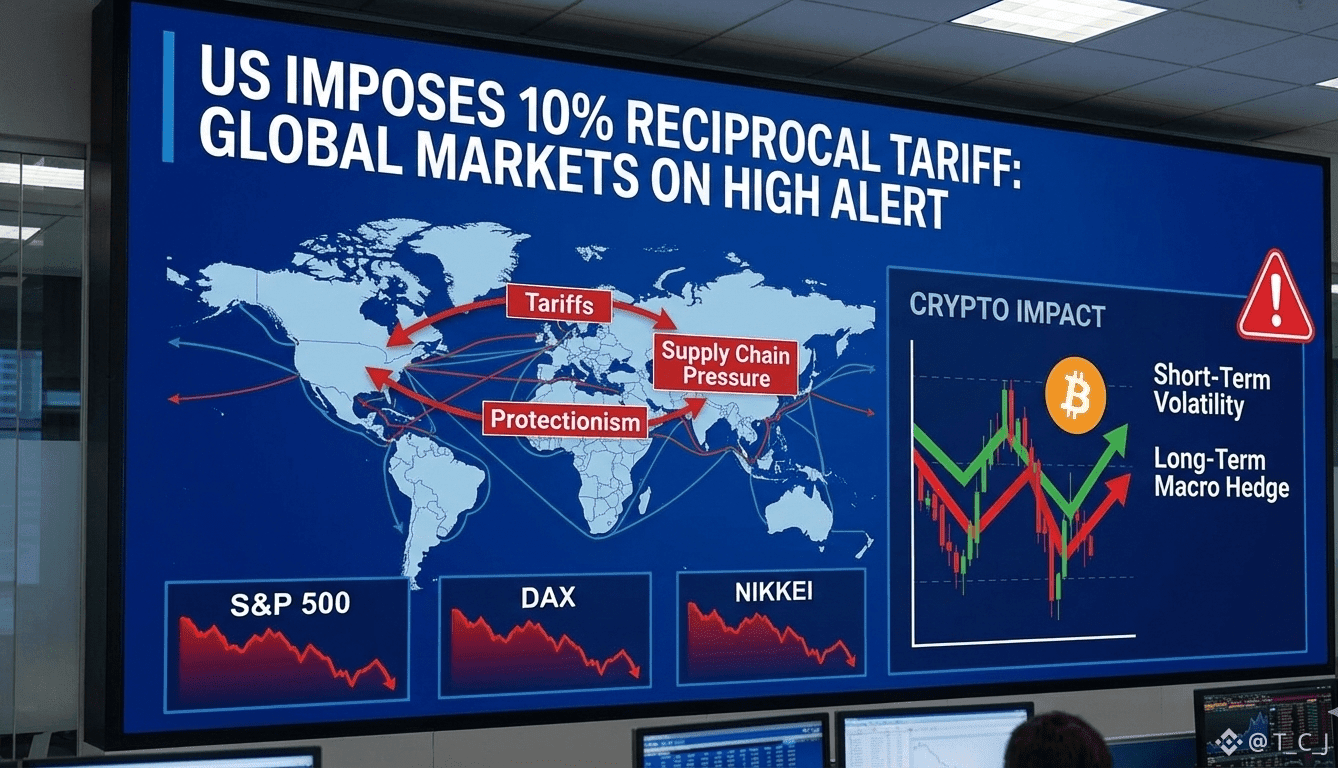
The recent decision by the United States to impose a 10% reciprocal tariff is not just a trade policy update, but a broader macro signal, with repercussions that can be felt across global markets, the inflation outlook, supply chains, and risk assets. In this article, we will explore the meaning of this decision, its broader implications, and its potential impact on crypto markets in particular.
What does a 10% Reciprocal Tariff mean?
A reciprocal tariff simply means that if a country imposes an import duty on US goods, the US will impose a similar tariff on that country's exports. This 10% rate can serve as a baseline, applicable to different trade partners.
This move points to protectionism, where the focus is more on protecting domestic industries than on free trade. The US argues that this policy will promote "fair trade," but from a global perspective, it could increase trade friction.
Why is this decision significant for global markets?
The global economy is already experiencing several pressures—
Sticky inflation
Slowing growth
Geopolitical uncertainty
In such an environment, increased tariffs could make supply chains more expensive and complex.
Key macro implications:
Pressure on trade volumes: Higher tariffs could slow cross-border trade.
Cost-push inflation: As imported goods become more expensive, companies face higher input costs.
Policy uncertainty: Businesses may postpone long-term investment decisions.
Markets generally dislike policy uncertainty, and this is why global risk sentiment appears fragile following this decision.
Potential Impact on Equity Markets
The immediate reaction in equity markets could be sector-specific:
Export-heavy companies: May come under pressure
Domestic-focused industries: May show relative outperformance
Global supply chain-linked stocks: Higher volatility may be observed
Short-term volatility is possible in US equities, especially regarding the earnings outlook of multinational companies. Equities in emerging markets may be more vulnerable, as they rely more heavily on exports and foreign capital flows.
Commodities, USD, and Emerging Markets
Commodities:
Industrial metals such as copper and aluminum may come under pressure as trade slowdowns impact demand expectations.
Safe-haven assets such as gold may find support, especially if uncertainty increases.
US Dollar (USD):
The USD may remain strong in the short term, as the dollar is considered a safe asset during global risk-off phases.
In the long term, if trade tensions hurt US growth, USD strength may be questioned.
Emerging Markets (EMs):
Pressure on EM currencies and bonds
Risk of capital outflows
Higher borrowing costs
Tariffs have historically been negative for EM assets, especially when global liquidity is tight.
The Role of Crypto Markets and Bitcoin
The reaction of crypto markets is not always linear. Bitcoin and the broader crypto ecosystem have exhibited mixed behavior during trade tensions.
Short-term perspective:
Risk-off sentiment may see crypto assets initially sell-off.
High-beta altcoins remain more volatile.
Medium to long-term perspective:
Many investors view Bitcoin as a "non-sovereign asset" and a "macro hedge."
If tariffs increase inflationary pressures and monetary policy flexibility decreases, Bitcoin's narrative could strengthen.
Bitcoin historically attracts attention during geopolitical and macro uncertainty, even if short-term price action remains volatile.
Short-Term Volatility vs. Long-Term Macro Implications
Short-term:
Headlines-driven volatility
Sharp moves in both equities and crypto
Sentiment indicators fragile
Long-term:
Risk of global trade fragmentation
Higher structural inflation
Constraints on monetary policy
If trade tensions persist, global markets will have to adjust to a low-growth, high-uncertainty environment. In such scenarios, alternative assets, including crypto, are gradually becoming part of portfolio discussions.
Final Market Insight
The 10% reciprocal tariff imposed by the US is more than a tactical policy move. It signals a shift in global trade dynamics and rising protectionism. Equity markets, commodities, currencies, and crypto—all could feel the ripple effects of this policy shift.
This phase may bring short-term volatility to crypto markets, but Bitcoin's relevance to the long-term macro narrative cannot be ignored. As pressure on traditional systems increases, investor perspectives also evolve.
In the coming months, markets will closely price in not just economic data, but also policy signals and geopolitical decisions. In such an environment, low clarity and high volatility may become the new normal.
#TradeWar #MarketVolatility #InflationOutlook
#Bitcoin #CryptoMarkets #CryptoMacro #MarketInsight #DigitalAssets