Analysis of their recent performance, market correlation, and how investors are positioning them in their portfolios.
### Performance and Market Correlation: A Clear Divergence
The most direct comparison from the provided data reveals that Bitcoin and gold have recently behaved very differently, challenging the simple "digital gold" narrative.
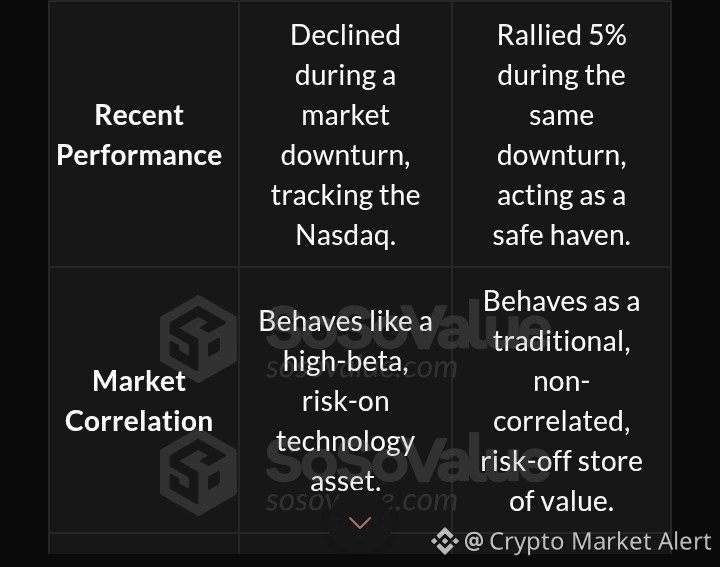
*HashKey_Capital** highlights this divergence during crypto's "brutal November." It states: **"While gold rallied 5%, BTC tracked Nasdaq's decline, proving its risk-asset correlation."** This is a critical observation. During a period of market fear and a significant crypto sell-off, gold performed its traditional role as a safe-haven asset, increasing in value. In contrast, Bitcoin's price movement was tightly linked to technology stocks, marking it as a risk-on asset.
This suggests that in the current macroeconomic environment, investors are treating Bitcoin more like a high-growth tech stock than a stable store of value like gold.
### Investor Perspective and Portfolio Allocation
The distinction in their market roles is also reflected in how investors are allocating capital.
**Tactical vs. Core Holding:** According to a tweet from an investor (`DEG_2020`) included in the data, their portfolio consists of "Gold, Silver, BTC (planned to switch to short)." This implies a strategy where gold is a stable, core holding, while Bitcoin is viewed as a more volatile, tactical asset that can be traded both long and short based on market conditions.
***The Scarcity Argument Persists:** Despite its risk-on behavior, the fundamental comparison to gold based on scarcity remains a key part of the Bitcoin narrative. According to the detailed cryptocurrency review,Eric Trump commented that Bitcoin is "easier to transfer globally compared to gold" and that its fixed supply of 21 million coins creates "genuine scarcity."
### The "Tokenized" Aspect: Bridging Traditional and Digita
While the provided data doesn't detail specific tokenized gold products, it does highlight the broader trend of asset tokenization. an in-depth article from TechFlow Selected discusses Pakistan's plan for a **$2 billion economic experiment in asset tokenization**, aiming to transform national assets like sovereign bonds and commodities into digital assets on a blockchain.
This trend is the very foundation of tokenized gold. It seeks to combine the established stability and historical value of physical gold with the benefits of blockchain technology: improved liquidity, fractional ownership, and ease of transfer—precisely the advantages Bitcoin boasts over physical gold.
### Summary: Bitcoin vs. Tokenized Gold
Here is a summary of the comparison based on the available data:
**Recent Performance** | Declined during a market downturn, tracking the Nasdaq. | Rallied 5% during the same downturn, acting as a safe haven. |
**Market Correlation** | Behaves like a high-beta, risk-on technology asset. | Behaves as a traditional, non-correlated, risk-off store of value. |
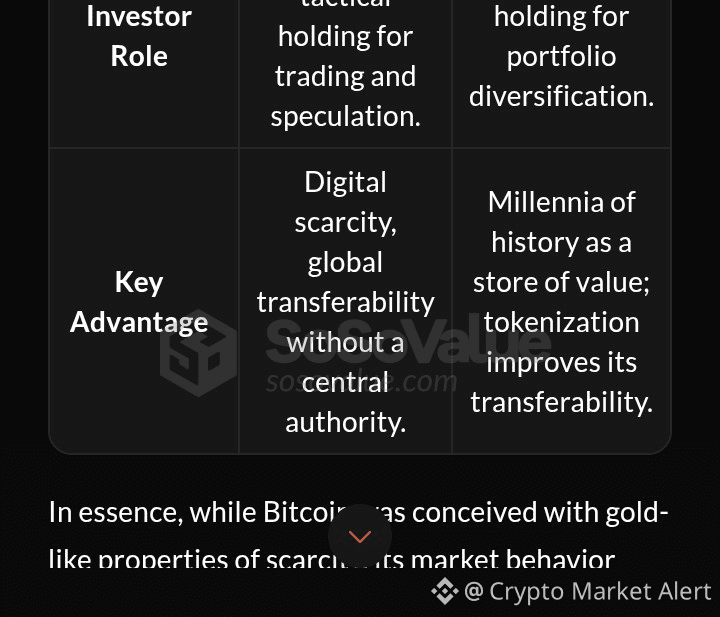
**Investor Role** | A volatile, tactical holding for trading and speculation. | A stable, core holding for portfolio diversification. |
**Key Advantage** | Digital scarcity, global transferability without a central authority. | Millennia of history as a store of value; tokenization improves its transferability. |
In essence, while Bitcoin was conceived with gold-like properties of scarcity, its market behavior currently aligns more with a high-risk, high-reward technology asset. Tokenized gold represents an effort to give the traditional safe-haven asset the technological advantages of a digital currency, creating a direct competitor to Bitcoin's "store of value" use case by bringing the old world onto new rails.
#BTC #Gold #tokenisedgold #binance