
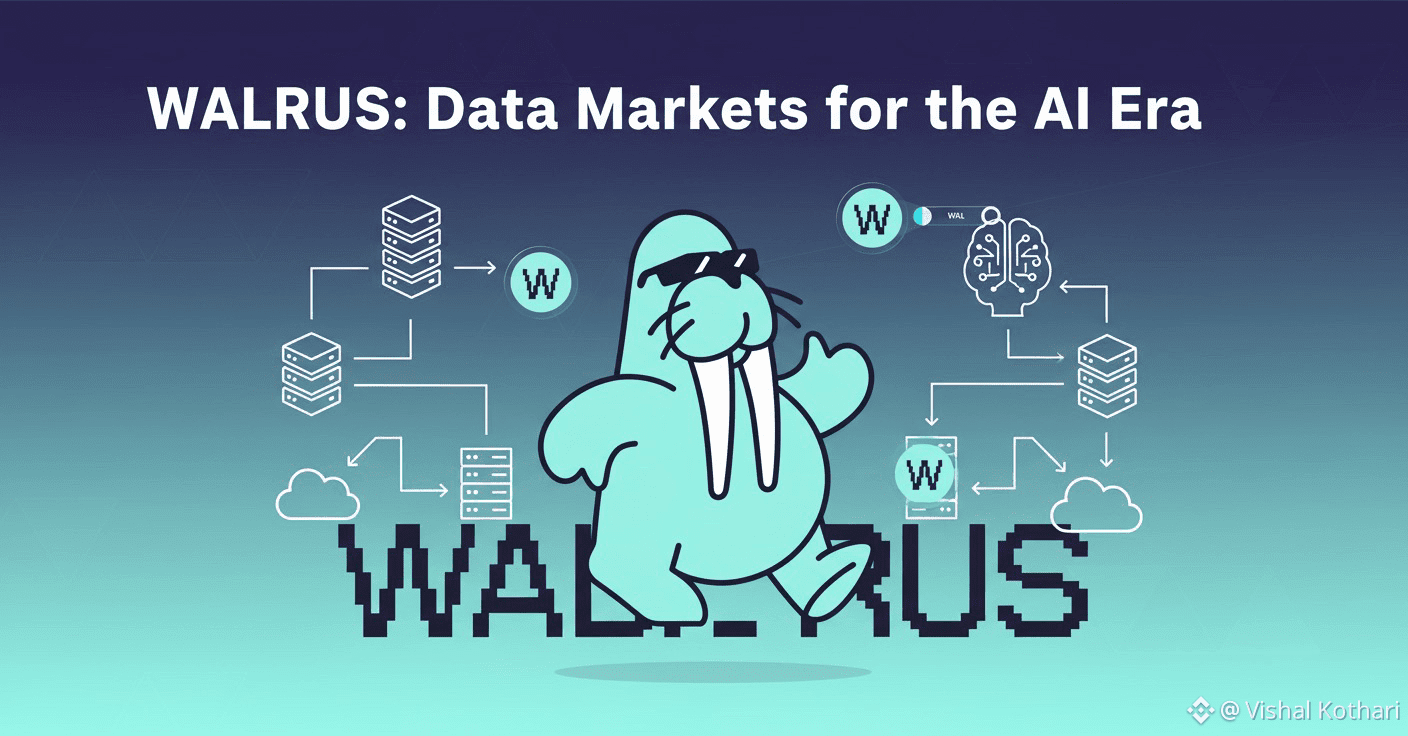
@Walrus 🦭/acc stands at the forefront of decentralized storage innovation, transforming how large files are managed on blockchain networks. Built on the high-performance Sui blockchain, this protocol addresses critical pain points in data storage for Web3 applications, offering scalability, affordability, and programmability like never before. With its native WAL token driving the ecosystem, Walrus is poised to become the go-to solution for dApps handling massive blobs of data, from AI datasets to multimedia content.
Core Technology Behind Walrus
Walrus leverages advanced erasure coding techniques, specifically a proprietary method inspired by fountain codes, to shatter large binary files into smaller fragments. These shards are then distributed across a network of storage nodes, ensuring redundancy and availability without the exorbitant costs of traditional replication. Unlike older systems that replicate data multiple times, Walrus achieves high durability—up to 99.9999%—while slashing storage expenses by orders of magnitude, making it viable for exabyte-scale operations.
This efficiency stems from its integration with Sui's object-centric model, where data blobs become verifiable on-chain objects. Developers can reference these blobs directly in smart contracts, enabling dynamic interactions that were previously impossible in passive storage layers. For instance, a dApp could automatically retrieve and process video files based on user triggers, all while maintaining censorship resistance and fault tolerance across thousands of independent nodes.
The protocol's architecture also incorporates delegated staking, where WAL holders delegate tokens to performant nodes, securing the network through economic incentives. Nodes must prove data availability via cryptographic commitments, preventing lazy behavior or data loss. This blend of erasure coding, Sui's parallel execution, and proof mechanisms positions Walrus as a next-generation storage layer, far surpassing predecessors in speed and cost-effectiveness.
The WAL Token: Fueling the Ecosystem
At the heart of Walrus lies WAL, the native utility token that powers every aspect of the protocol. Users pay for storage in WAL, with payments structured upfront for fixed durations to ensure predictable fiat-denominated costs despite crypto volatility. These funds trickle out over time to nodes and stakers, fostering long-term commitment and financial sustainability.
WAL's deflationary mechanics add another layer of appeal. Short-term stake shifts incur penalty fees, partially burned to discourage disruptive behavior that triggers costly data migrations. Similarly, staking with underperforming nodes leads to slashing, with burned portions reducing circulating supply. These mechanisms not only enhance network stability but also create upward pressure on WAL's value, rewarding patient participants.
Beyond payments and staking, WAL enables governance, allowing holders to vote on upgrades, fee structures, and expansion plans. Its role extends to cross-chain bridges, facilitating interoperability with other ecosystems. As Walrus grows, WAL's multifaceted utility—storage fees, staking rewards, governance power, and burning—makes it a cornerstone asset for investors and builders alike.
Use Cases Powering Web3 Innovation
Walrus shines in high-data-demand scenarios where centralized clouds fall short. AI developers can store vast training datasets on-chain, enabling agents to access and process them seamlessly via Sui smart contracts. This programmability unlocks AI-driven dApps that evolve in real-time, such as autonomous trading bots analyzing petabytes of market data without off-chain dependencies.
NFT platforms benefit immensely, hosting high-res media like videos and 3D models directly on Walrus. Creators mint NFTs with embedded blob references, ensuring immutable, decentralized delivery that resists takedowns. SocialFi apps leverage it for user-generated content, storing profiles, posts, and feeds scalably, while maintaining user sovereignty over data.
Enterprises enter the fray with backup solutions and RWA tokenization, offloading sensitive files to a censorship-resistant network. DeFi protocols use Walrus for oracle data feeds and historical transaction logs, enhancing transparency. Even gaming dApps store assets like textures and levels, supporting massive multiplayer worlds without centralized servers. These applications highlight Walrus's versatility, bridging consumer and institutional needs.
Walrus vs. Traditional Storage Solutions
Decentralized storage has evolved, but Walrus marks a paradigm shift. IPFS excels at content-addressed pinning but struggles with large-scale coordination and retrieval guarantees. Arweave offers permanent storage via blockweave, yet at premiums unsuitable for mutable data. Filecoin introduces market dynamics for deals, but high retrieval fees and complexity deter casual users.
Walrus differentiates through Sui-native efficiency, delivering sub-second retrievals and costs rivaling AWS S3 fractions. Its programmable blobs integrate natively with Move-language contracts, unlike retrofitted solutions elsewhere. Fountain-code erasure provides better space efficiency than Reed-Solomon in competitors, handling node failures gracefully even at scale.
Centralized giants like Google Cloud dominate with reliability but sacrifice decentralization, exposing users to censorship and outages. Walrus counters with horizontal scaling, where adding nodes boosts capacity infinitely, all verified on-chain. This positions it as the decentralized alternative ready for prime time.
Roadmap and Mainnet Momentum
Launched in March 2025 after rigorous testnets, Walrus hit mainnet with immediate traction. Early phases focused on core storage primitives, followed by staking dashboards and developer SDKs. Upcoming milestones include AI-specific tooling, cross-chain expansions to Solana and Ethereum, and enterprise-grade APIs for hybrid cloud setups.
Community initiatives amplify growth, with airdrops rewarding early Sui users and node operators. Leaderboard campaigns on platforms like Binance Square track top stakers and dApp builders, distributing WAL bonuses to spur adoption. Partnerships with Mysten Labs ensure deep Sui synergy, while integrations with WalletConnect streamline user onboarding.
Future visions eye "data markets for the AI era," where tokenized datasets trade frictionlessly. Enhanced burning schedules and yield optimizers will attract DeFi liquidity, potentially mirroring successes like Celestia. With exabyte ambitions, Walrus's trajectory promises exponential utility.
Staking Strategies for WAL Holders
Engaging with Walrus staking unlocks passive income while securing the network. Delegate WAL to vetted nodes via intuitive dashboards, earning yields from storage fees and inflation rewards. Long-term locks amplify APYs, as penalties deter churn, creating stable pools.
Risk management is key: monitor node performance metrics like uptime and bandwidth to avoid slashing. Liquid staking derivatives, emerging soon, allow trading staked positions without unbonding delays. Diversify across node clusters for optimal security.
For power users, run your own node with modest hardware—Sui's efficiency keeps barriers low. Proficient operators capture higher shares, blending hardware yields with token appreciation. As adoption surges, staking becomes a gateway to governance influence.
Building on #Walrus - Developer Guide
Developers dive in via Walrus SDKs, supporting JavaScript, Rust, and Move. Upload blobs with simple API calls: fragment, encode, and register on-chain. Retrieval proofs verify integrity before download, ideal for latency-sensitive apps.
Smart contract integration shines—embed blob IDs in NFTs or DeFi vaults for automated data ops. Sample code snippets accelerate prototyping, from media galleries to dataset marketplaces. Grants fund innovative dApps, fostering a vibrant builder economy.
Tools like CLI uploaders and explorer dashboards aid debugging. Community Discord channels offer real-time support, accelerating from idea to deployment.
Market Dynamics and Investment Thesis
WAL trades dynamically, reflecting storage demand and Sui's momentum. As dApps proliferate, fee velocity drives burns and scarcity. Bullish catalysts include AI hype, where data-hungry models flock to cheap, programmable storage.
Risks like oracle dependencies and competition persist, but Sui's TVL growth and Mysten backing mitigate them. Position sizing favors long-term horizons, pairing staking with spot holdings. Walrus embodies Web3's data layer evolution.
Community and Ecosystem Growth
Walrus thrives on grassroots energy, with 10,000+ Discord members and active X threads. Ambassador programs reward content creators, mirroring Binance Square dynamics. Hackathons yield gems like decentralized video platforms.
Influencers dissect tokenomics, while educators craft guides for newcomers. This flywheel—users to stakers to builders—propels virality, cementing Walrus as a Sui staple.
In summary, #WalrusProtocol redefines decentralized storage, blending cutting-edge tech with economic ingenuity. WAL holders stand to gain from a network scaling to meet Web3's data explosion. Dive in, stake up, and build the future.

