
The Issue: Economically Fragile, Highly Engaged DeFi Systems
Decentralized finance systems have been able to attract unprecedented engagement of all sorts. Users spend considerable time and energy in the various Web3 gaming and social systems, crypto marketplaces, and decentralized governance exchanges. Yet, large volumes of economic value are typically absent. Money flows in, then out of the economy with ease. Users are highly engaged with the systems, but the economy flows of value are largely insubstantial.
This situation results from the underlying design of DeFi systems, which reward volume, surface-level engagement, and short-term interaction over meaningful, constructive participation.
Engagement Without Purpose
Engagement as metric devoid of meaningful economic value, systems simply record daily transactions, time spent per interaction, and approximate level of on-chain activity. They have achieved system-wide participation, but largely to no productive end.
Some organizations engage their audiences without creating value, as these organizations may encourage their users to perform activities that do not result in value creation, gaining and losing activity streams, and showing impressive results without true growth.
Current financial technology based on decentralized economy (DeFi) lacks the inefficiencies of traditional advertising during the Web2 era because all incentives are directly linked to the balance sheet.
The emissions trap, based on the distribution of tokens to users in a system, is the root cause of the activity rich, value poor engagement.
The design of these emissions creates the system’s initial growth as users engage with their rewards. Structures gradually decay as users optimize activities not for the system, but for their own personal gain, and the mercenary behavior of the capital then creates extractive activities of the smaller value economy. Ultimately creating a loss of trust, as the disclosure of activity, distributes over engaged users and then contracts without a change in activity or participation. The system that once appeared active, collapses.
Other Sources of Inefficiency: Fragmentation of Efforts
In other systems, fragmentation brings inefficiencies. User effort is spread thinly across protocols, chains, applications, and systems of rewards. There is a lack of interoperability of engagement signals and no shared mechanism to value them.
This lack of compounding effect leaves a user with disconnected contributions across ecosystems. Every protocol weighs those contributions individually, but capital decisions are shallow and disconnected, making them unable to recognize patterns of contribution from a user that may be of high value and aligned with the ecosystem over the long term.
This fragmentation prevents the systems from building capital intelligence. Without feedback aggregation and normalization, the systems are left with noise. Capital flows are a function of short-term decisions, rather than long-term signals.
Behavioral Volatility as a Design Outcome
Increased user engagement destabilizes the systems further by amplifying behavioral volatility. The systems train users to act quickly, as when users are rewarded for their engagement, incentivized protocols create a context in which rewards are quickly given, then withdrawn.
When engagement is rewarded by the protocol, the result is poor market outcomes. As protocols incentivize rapid market actions, the systems create a context that destabilizes the market.
In this landscape, capital does not settle down. It moves, but remains unanchored, which blocks the build-up of structured financial layers.
No Translation of Engagement into Capital
One of the biggest challenges is the absence of a translation layer of engagement into capital. Most systems simply skip the economic relevance gauging step from activity to reward.
In classic finance, participation does not always grant immediate rewards. Work is assessed, filtered, and contextualized before the funding responds. Credit, history, and strategy alignment all play into the equation. With Web3, however, this is often collapsed down to a single step.
In the absence of translation, engagement is shallow. It activates systems, but does not elevate them.
The Cost of Stagnation
The systemic stagnation of the design, which is rich in engagement and poor in capital, is the long-term result. Protocols fail to outgrow their dependency on incentives. Users lose faith. The capital becomes ephemeral, and innovation stagnates. Resources are spent on maintaining participation, rather than on increasing efficiency.
This stagnation undermines the promise of decentralized finance–to open, build, and strengthen systems of capital. Without the ability to convert activity into discipline capital allocation, decentralization is reduced to just a buzzword.
Why This Issue Matters
As Web3 grows, so do the costs due to inefficiency. Larger investments need predictable returns, with discipline, while users need to find systems where their efforts are valued rather than exploited.
APRO addresses the problem. There's a lot of attention to the problem in the marketplace, so the problem isn't generating more. The problem is to redefine how it is valued, processed, and engaged with tactically and strategically. Until there is a solution for this translation problem, Web3 will seem financially fragile, despite appearing vibrant in the marketplace.
In addressing the engagement-rich, capital-poor paradox, APRO has provided a new layer of financial intelligence. Rather than introduce new incentives, it focuses on engagement as a signal to be valued meaningfully, rather than as noise to be rewarded.
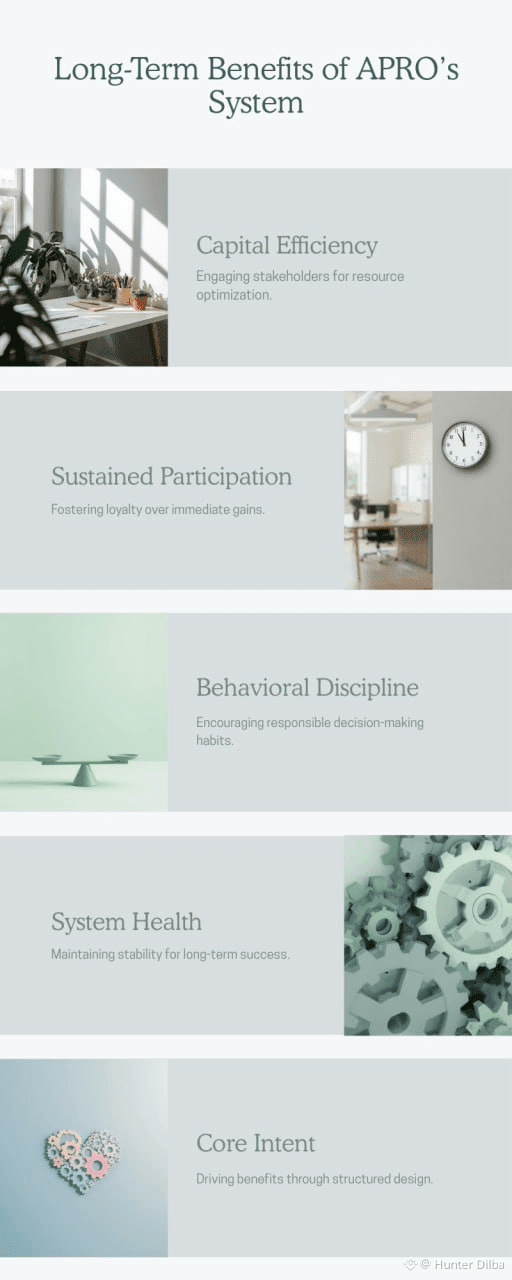
APRO’s Core Thesis: Engagement as Structured Input
APRO starts with an observation: engagement is not valuable on its own but is valuable when systematic engagement is analyzed and utilized purposefully. Most decentralized systems view user interactivity as an activity. APRO evaluates user interactivity as a data stream, one that could facilitate informed decisions regarding the association of that data with available resources. This differentiation exemplifies APRO’s core thesis and differentiates it from incentive-driven Web3 ecosystems.
APRO does not ask how we can improve the participation in its systems. It instead asks a more foundational question: which active participation should receive the allocation of resources and under what circumstances?
From Raw Activity to Economic Signal
In traditional DeFi and Web3 systems, user engagement is measured in a primitive way: counting how many clicks, actions, transactions, or tokens staked. These metrics are very easy to get but are economically unhelpful. These metrics do not consider the difference between a persistent user and a user opportunistically engaging with the system.
APRO frames user engagement as structured input, a pre-requisite signal which must undergo classification, prioritization, and contextualization before it can shape the distribution of resources. Not all actions are the same, and not all users have the same level of contribution. This is the premise on which APRO’s system is built to account for.
This shift mirrors how other developed systems handle information. Markets do not react to noise; they react to filtered information. APRO uses the same logic to metabolize decentralized participation to behavioral data forms that capital systems can use responsibly.
Engagement Is Not Yield. It Is Instruction
A core concept of APRO is that the principle of direct engagement-to-yield is rejected. There is no automatic cause and effect system when it comes to activity and reward generation. There is a system instructs where the capital should be directed, at what level, and at what risk.
This separation has two consequences. First, it removes the reflexive loop that encourages users to maximize activity to the detriment of quality. Second, it lets capital be selective. It is the engagement that drives the decision to deploy capital without the extraction guarantee.
In effect, APRO is turning participation into governance input for capital rather than a claim on emissions.
Standardization Without Homogenization
In order to serve as organized input, engagement needs to be standardized in terms of it being comparable and flexibility to not lose detail. APRO solves this with modular engagement frameworks that classify activities into type, duration, consistency and impact.
For example, someone who has contributed for a long time is scored differently from a frequent contributor. A user positively contributing to the stability of a system has a different signal weight from one who is optimizing for a profit in the short run. APRO’s design intentionally avoids flattening such distinctions, enabling capital allocation to reflect behavioral quality, rather than volume alone.
This aids in the preservation of the nuances of aggregation. Participatory engagement data retains its contextual value while being interoperable across systems.
Pairing User Activity With Capital Efficiency
Participation engagement systems asymmetrically ignore the abundance of user effort and the scarcity of capital. Having both systems out of equilibrium causes destabilization. APRO achieves equilibrium by not allowing user actions to completely determine capital allocation while allowing user actions to shape capital’s response.
Capital allocation through APRO is pattern driven, not spike driven. It is designed to celebrate consistent engagement rather than a short-term focus. Over time, engagement is directed toward more constructive behaviors than merely profit driven.
This is not coercive behavioral design, but rather through consequences. Users are not given prescriptive actions; rather, they are shown which actions are supported through considerable and sustained capital.
Engagement as a Composable Financial Primitive
By regarding engagement as a structured input, APRO elevates it to a primitive of finance. Just as price feed, liquidity curve, and risk models inform DeFi systems, engagement data becomes an input layer that can be financially architect ed.
Protocols incorporating APRO do not outsource incentives; they outsource judgement. APRO interprets human activity at scale for systems to deploy capital more efficiently and effectively.
Compos-ability permits engagement driven intelligence to diffuse in and across ecosystems. Participative capital allocation is driven more by grouped activity than by transactional silo-ed interactivity.
A Shift in Responsibility
APRO’s core thesis also implies a redistribution of responsibility. Engagement is, on its own, not an automatic means to rewards. It also entails a responsibility to actually engage in a constructive manner. At the same time, capital systems bear the responsibility of adjudicating participation in an equitable and transparent manner.
This is a particular of APRO, when compared to the Web3 designs, where the systems of responsibility and meritocracy are hidden by incentives. APRO clarifies that engagement is input and capital is output. The layer of translation is where trust is built.
Why This Matters
The larger a decentralized system gets, the more costly poorly directed capital becomes due to misinformation. APRO’s thesis addresses this risk. APRO adds to the structure and order of capital in the system by processing collateral and capital engagement.
In doing so, APRO does not diminish participation. It gives it meaning. Engagement ceases to be a disregard able metric and becomes a palpable signal that can mold the effective and efficient deployment of a system’s capital.
This principle is APRO’s first operational prerequisite to avoid trapping a user’s activity in a closed loop of incentives and rather to produce a global flow of value.
From Activity to Allocation
Most decentralized systems start with an incorrect assumption. They see activity as a measure of engagement, and thus a measure of success. At some point profit became tightly aligned with engagement, and systems catered to driving high activity, regardless of whether it added profit to the ecosystem or not.
APRO is a counter to this logic - it is built with an assumption that activity is not just an outcome; it is an input. What matters is not that users take some action, but how those actions shape the base of governing and influencing capital. This shift from activity as an end goal to activity as a source of data is at the core of APRO.
In traditional finance, capital allocation does not happen on the basis of activity. There is a series of layered activities - analysts interpret the information, scenario weighing is done by risk models, and governance models set the boundaries for deployment. APRO applies this logic to decentralized systems to convert activity and engagement into structured signals that dictate allocation instead of destination liquidity.
Decoupling action from entitlement is the driving force behind this shift. In numerous Web3 models, an action will result in a claim, such as on emissions, rewards, or governance power. APRO eliminates this linkage. Engagement will not assume yield, but rather yield will be informed by where capital may be deployed in a responsible manner. This distinction prevents short-term positive feedback loops from damaging the system’s health.
APRO’s allocation framework considers engagement in multidimensional ways: consistency in time, contribution towards system’s stability, alignment with protocol’s objectives, and resultant downstream effects. Someone who repeatedly supports positive tier flows sends a distinct signal than a user who spikes in activity and flows during incentive events. These two users are active, but only one could be considered a positive allocation candidate.
Without prescribing it, this method changes the behavior of the participants. Organic incentive shifts result from the participants understanding that their engagement, and therefore the system’s activity, positive feedback’s to scale to a high value on a stable tier. The system no longer attracts users looking to simply extract value, but rather participants who are willing to interact with the system and generate value. As a result, allocation becomes an active decision rather than a default to the participants.
This architecture also brings in discipline from a capital perspective. Capital deployed is APRO is not chasing activity; it is responding to data interpretation. Detromining how resources are assigned is a step-by-step process, reversible, and context sensitive. This lowers the chance to being overexposed to passing fads and also shields the system from volatile pattern shifts; which is a consistent flow in incentive-heavy DeFi protocols.
Most importantly, APRO’s model is compos-able. Engagement signals can be synthesized across applications, settings, or user groups, letting capital allocation to data system wide behavior rather than from siloed events. This builds a feedback loop that is informational not extractive. Engagement informs allocation; allocation reinforces positive participation.
In this light, APRO regards feedback as information sophisticated markets would. activity is legible. allocation is collateral. The system is one where human activity brings participation to economic order rather than disorder.
Efficiency Over Emissions
The second pillar of APRO’s philosophy is a clear rejection of emissions led growth as the economies primary driver.
Efforts have embraced emissions in the past as a strategy to stabilize a decentralized system. They are a blunt instrument. When unemployed, they replace genuine effortless system shifts with momentum cycles disguised behind poor tokenomics.
APRO is driven by the idea that the only sustainable value is efficiency rather than emissions.
APRO believes the way emissions systems are designed assume you can solve the problem of capital inefficiency by increasing the cost to the system. Losing liquidity, retaining no participants, and demand weakens the system and ends up being rewarded with increased payment. This approach leads to the creation of short lived systems that degrade rapidly with capital. Participation steadily declines alongside the emissions.
APRO directly flips this logic. Rather than pulling systems designed to emit capital. systems are designed to emit no capital close to zero and deploy it efficiently. When emissions are present, efficiency is always the driving metric. The emissions are temporary, not the fundamental structure of the system.
APRO’s definition of efficiency is multifaceted. There is capital efficiency which looks at how much productive output is generated per unit of deployed capital. Then you have behavioral efficiency which looks at whether that engagement actually improved the system. Then you have operational efficiency which looks at how much coordination it took to produce that outcome. The system architecture of APRO is designed to optimize all three at the same time.
This emphasis changes how growth is evaluated. Instead of asking how many users engaged with the product, APRO asks how efficiently capital was utilized. Instead of celebrating volume of distribution, it tracks outcomes of allocation. Growth is a result of improved quality of the signal and waste reduction, not of increased issuance.
By deprioritizing emissions, APRO also reduces systemic fragility. Ecosystems that are built around emissions are highly sensitive to token price, market sentiment, and speculation cycles. In a downturn, incentives dry up and participation disappears. Systems built around efficiency are far more resilient, as their value proposition is operational rather than speculative.
From a governance perspective, this approach aligns incentives more cleanly. Participants are not fighting for emissions; they are contributing to a system with effective capital allocation. Governance decisions are made around closing allocation logic, not around adjusting reward mechanisms to keep attention.
Most importantly, prioritizing efficiency over emissions does not entail the absence of incentives, which means that participation in the system does not guarantee a reward. Productive engagement patterns dictate the allocation of capital, restoring its scarcity and the credibility of its allocation.The older this design gets, the more balanced it gets. Absorption gets autonomously selected. Patience is not important. The system does not grow because it retains customers, it grows because it puts its resources into the right automation.
While working inside an ecosystem sculpted with emissions-first philosophy for years, APRO’s position is deliberately conservative. They value going slow as it creates more of a system that has the ability to last a longer time. This self restoration is not an anaemic response to the ecosystem. It is the reason why they're going to last longer.
"From Activity to Allocation" and "Efficiency Over Emissions" working together define APRO’s philosophy the best. They describe a system where absorption determines how much working value is created for the system and value efficiency takes the lead on growing the system in balance to how much polar emissions are created. This is how APRO turns absorption on its head to create a stable and economic system that relies on ancient emissions as a crutch.
Behavioral Design: Incentivizing Responsibility, Not Reflex
In large volumes, decentralization systems do not simply malfunction due to bad actors; they also malfunction due to behavioral reflexes. When players act in response to simple stimuli, they optimize for extraction and ignore contributions. There are no ethical concerns; problems of systems design are far more impactful. Systems that incentivize contributions in the form of speed, volume, or frequency cross the threshold of abusive engagement, and do so in a self reinforcing feedback loop that harms the system itself.
Building out APRO's behavioral design begins from acceptance of a simple principle: negation of the system's design due to behavioral reflexes will not work; it will need to be incorporated. APRO does not incentivize participants with education into self-regulation. Instead, APRO uses self-regulation within the design itself.
APRO also does not incentivize participants with punishment.
The first of these design principles is the concept of delayed gratification. The reflex systems design reward systems such that there is a direct correlation of reward to level of engagement. The APRO system introduces temporal smoothing and actively disincentivizes the accumulation of points for simple engagement. Signals of participation are awarded for weighted point systems that accrue over time in order to reward sustained participation.The principle of non-linear reward attribution simply means that more activity does not result in more benefits forever. After a while, more activity will not make a difference. Which means that spam engagement won't work, and there is less incentive to manipulate surface-level metrics. Participants will have to act with more intention rather than with more volume.
Thirdly, assigning impact without attributing visibility. Many systems make the mistake of equating visibility, which includes things like activity on-chain, metrics on a dashboard, and public engagement, with impact. Unlike those systems, APRO has a behavior layer that followers behaviors that are economically meaningful APRO only considers behaviors that are correlated with output from the system when determining how to allocate tokens. this ensures that the outcomes are determined by responsibility rather than performative engagement.
The APRO system is not designed with punitive controls to enforce compliance. This means that there are no severe punishments for skirting the rules. The system is designed by ASGG to have amplification in a non punitive way. Responsible behavior will result in more weighted voting whereas reflexive behavior will result in less. Over time, participants get used to these dynamics and adapt on their own.
The result of this is lower ecosystem volatility. More predictable engagement along with more meaningful (and less performative) governance results in less volatility and decreases unpredictable governance. This is a result of behavioral design becoming subtle risk management.
In this regard, APRO considers behavior as a parameter which can be controlled, not an externality. It is not responsibility which is demanded, rather it is made economically rational.
APRO as Financial Middleware
To appreciate APRO's structural position, it can be helpful to think beyond application-layer metaphors. APRO is not a product, platform, or marketplace in the usual sense. It is financial middleware, an intermediate layer that converts human engagement to capital-relevant signals without holding either side outright.In conventional financial systems, middleware is ubiquitous. Clearinghouses, rating agencies, custodians, and risk engines sit between participants and capital, managing flows and enforcing discipline. In a web three environment, many of those functions are either collapsed into a single protocol or omitted entirely, resulting in a direct and fragile coupling between users and capital flows. APRO brings back that intermediate layer, and in a decentralized and programmable manner. One side of APRO is engagement-rich environments, communities, applications, ecosystems where users interact, contribute, and coordinate. On the other side is capital, liquidity providers, treasuries, strategy allocators, and yield instruments that are looking to be deployed in a productive manner. APRO does not replace either side. It intermediates between them. Three core functions flow from this mediation.
First is normalization. Engagement data is, by nature, heterogeneous. Different actions are worth different things; different platforms evaluate participation differently. APRO, without contextual loss, transforms engagement into comparable signal formats. This enables capital systems to make sense of human activity at scale without custom integration's for every application.
Second is filtration. Not all engagement must affect capital. APRO filters out noise, things like ephemeral spikes, opportunistic bursts, Sybil-like patterns, before signals get to allocation logic. This shields capital out of volatile behavioral exposure and minimizes the incentive attack surface.
Third is translation. Engagement signals are not, by default, capital commands. APRO, without engagement, converts structured signals into probabilistic guidance, where capital could be effective, what limits should be placed, and what certainty there is. Engines of allocation have the final say; APRO offers guidance, not orders.
APRO operates as middleware, meaning it scales horizontally instead of vertically. This is crucial setup; it’s able to interconnect with many applications, capital tactics, and governance systems all at once. Overall capital efficiency gets better not because APRO centralizes decision-making, but because it enhances the inputs to those systems.To some degree, the most the most important distinctions of APRO is that it does not suggest outcomes, lend or invest capital, or promise a yield. This disentanglement enables systemic risk to be contained. If a downstream strategy under performs or an upstream application fails, tier will not be impacted. Its value lies not in control of the assets, but signal quality.
By making this role explicit, APRO adds some degree of order to capital coordination tech without adding centralized intermediaries. reporting the value of proximate capital, abstraction operation of protocol intensifies capital responsiveness.
Going Forward Until the End of Time: Compounding Participation
The most significant effect of the design of APRO is in the long run. Decentralized networks unevenly optimize for short timeframes like narrative cycles, incentive epochs or even launches. This will be a spinning cycle of capital inflow, attention, and engagement. APRO will be designed to compound over time.
Engagement in a protocol or even around a value proposition, compounds memory. Collateral provided or capital stashed does not reset the timer around engagement from memory. This creates a durable effect on the protocol over time to result in long term effect on engagement. This is what will be remembered.System protocol is designed to compound engagement and that is what will be remembered.
This has negative long term outcomes.
First, it creates reputational gravity. Participants who consistently contribute in economically meaningful ways developments signal weight that cannot be reproduced overnight. New entrants cannot be excluded, but are unable to instantly dominate allocation outcomes. This stabilizes governance and diminishes the power of short term actors.
Second, it shifts growth dynamics from expansion to refinement. Rather than maximizing user count or transaction volume, ecosystems that integrate APRO are incentivized to improve signal quality. Improved interpreted engagement leads to better allocation and the attraction of more patient capital. Growth becomes endogenous.
Third, it changes the risk profile of capital deployment. When allocation conclusions are made based on long-horizon behavioral data, draw-downs become more manageable. Capital exits more slowly, reallocates more deliberately, and reacts to transient shocks with less violence. This is especially pertinent to treasury-managed ecosystems and their institutional participants.
Over extended time-frames, APRO leads to something rare in decentralized systems: path dependence with accountability. Decisions matter, and their effects persist. Engagement is no longer ephemeral; it leaves a trace that shapes the contours of future opportunity. This encourages foresight and discourages exploitation.
Relational engagement creates alignment between system longevity and individual interests. When users do system-preserving actions and the system remembers and acts accordingly, users benefit. This alignment occurs seamlessly due to the system's architecture without the need for recalibrating rewards.
On the macro scale, APRO signifies the maturing of Web 3. The value of misreading and misguiding human behavior rises as decentralized networks become more complex and sophisticated. APRO tackles this issue by embedding behavior interpretation into the infrastructure.
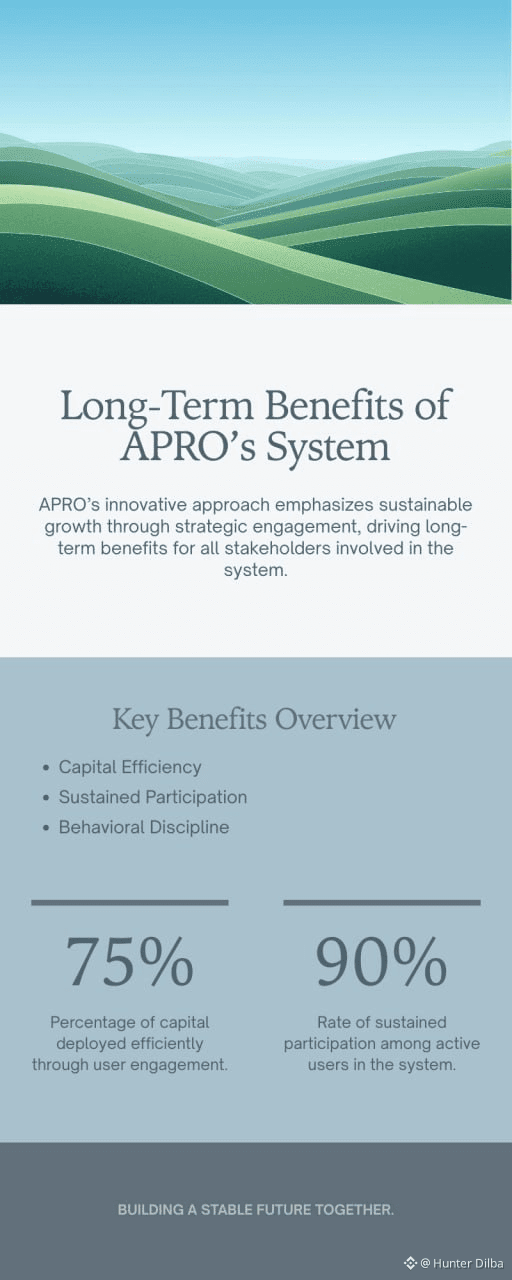
Rather than fostering faster growth, the key long-term effect is more survivable growth. Assets engagement is considered cost and liability. Capital is able to become more patient. Decentralized systems can self-sustain beyond the cycles of incentives.
Conclusion: When Effort Finds Its Financial Shape
APRO has a soft but impactfull evolutionary history in decentralized system design. Defining the domain considered "most web3 neophytes" offerings lacks value. Participation alone does not create value. There is no progress from motion without structure. There is no signal from activity without a pattern. APRO is built to correct this oversight.
APRO changes the framing around user engagement from the unquantifiable to the measurable. Rather than pseudo participatory erosion through emissions or a governance participation trick, APRO offers a translation layer that applies discipline to the evaluation of behavior relative to a moving target over time. Effort is captured, processed, and ultimately remembered.
This has a lot of important consequences when it comes to capital. Most decentralized systems have capital that shifts and changes because there is not enough confidence in the environments it is entering. There are short-term incentives available that pull liquidity in, and a lack of behavioral memory keeps it in. At the first sign of stress, liquidity moves back out again. APRO solves this. By matching the signals to where engagement is captured, with capital deployment, this gives a rational basis to keep capital persistent. Capital is no longer reacting to superficial metrics. It is responding to the underlying structure of responsibility.
Lengthening the focus further, it is equally a part of this to outline what APRO does not try to do. There is no yield to promise, no strategy to dictate, and no centralization of decision-making. No prescriptive attempt is made. It is not prescriptive. It is a contribution of infrastructure, not selection. APRO sets the conditions in which better decisions can be made, and it unassumingly gives up authority to keep the decisions made by protocols, by treasuries, and by allocators. This self-restraint is certainly a feature, and not a limitation.
In an environment that has often valued velocity instead of coherence, APRO brings in an ecosystem that has direction. It gives engagement a focus that has value instead of allowing it to be seen as a disposable input that can be used and thrown away. It lets capital have a value instead of being a speculative visitor, it allows the value of capital to be seen as a long-term participant. It allows decentralized coordination to move from a series of reactive loops. This moves it to a level of self-education, and self-education allows it to use the history it has built to learn.
Most importantly, APRO does not equate activity with value. APRO puts effort into building a financial model for a Web 3.0 discipline. Therefore, APRO is establishing a model for decentralized systems that want to do more than grow, but also want to last.

