
Imagine it’s 2010. You own a bar of gold. To make it "useful," you’d have to shave off a piece to buy groceries or lock it in a vault and hope its value goes up. For over a decade, Bitcoin was that gold bar—powerful, but static.
The "Bitcoin Liquidity Paradox" has always been the industry's biggest hurdle: How do you keep the world’s most secure asset (BTC) productive without losing its security?
Lorenzo Protocol has quietly answered this by building what I call the "Financial Abstraction Layer"—a sophisticated bridge that turns idle Bitcoin into a high-performance engine for institutional and retail wealth.
The Architecture of Credibility: Beyond the Hype
Most DeFi projects grow through "hype cycles" and temporary yield farming. Lorenzo is doing the opposite. It’s building infrastructure.
The protocol’s credibility isn't just a marketing claim; it’s baked into its institutional-grade partnerships. By collaborating with Ceffu (Binance’s institutional custody partner) and Cobo, Lorenzo ensures that the underlying Bitcoin is secured by the same multi-party computation (MPC) and cold storage tech used by global hedge funds.
How the Flow Works (The Visual Path)
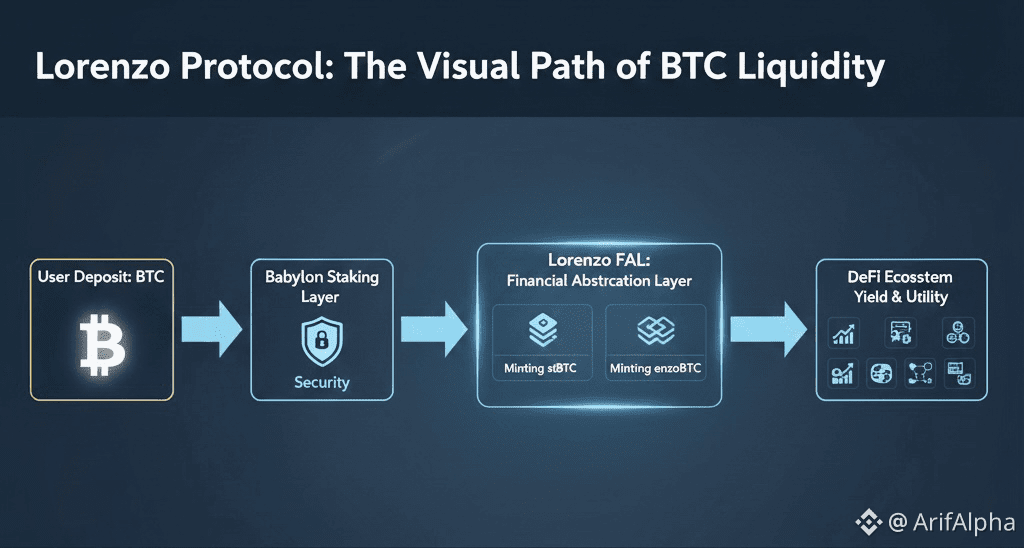
This "Liquid Restaking" flow means you don't just "lock" your BTC; you transform it. You receive stBTC (a liquid receipt), allowing you to earn staking rewards while simultaneously using that same value to provide liquidity or collateral across the BNB Chain and beyond.
Real-World Scenario: The "Corporate Treasury" Shift
Let’s look at a real scenario. Imagine a mid-sized tech company holding $5M in BTC as a treasury reserve.
• The Old Way: The BTC sits in a wallet. It’s "safe," but it's a "dead" asset. It does nothing for the company's monthly cash flow.
• The Lorenzo Way: The company stakes its BTC through Lorenzo. They earn a baseline yield for securing the network (via Babylon). Meanwhile, they receive stBTC, which they can deploy into USD1+ On-Chain Traded Funds (OTFs).
Now, that same $5M is securing a network, earning staking rewards, and generating stablecoin-denominated yield from real-world assets (RWAs) and quantitative strategies—all without the company ever "selling" their Bitcoin.
Why "Mindshare" Matters: The Professional Edge
In the Binance ecosystem, the most valuable currency isn't just the token—it's trust. Lorenzo captures this through three unique pillars:
1. OTFs (On-Chain Traded Funds): Lorenzo has pioneered the concept of tokenizing entire fund strategies. Instead of you chasing 10 different DeFi protocols, an OTF manages the complexity for you. It’s like an ETF, but transparent, 24/7, and settled on-chain.
2. Machine-Ready Yield: This is a "hidden" gem. Lorenzo is preparing for the AI economy. Their integration with Tagger AI means that as AI agents begin to handle payments, they will use Lorenzo’s stablecoins (USD1) and yield engines to manage "idle" machine capital.
3. Deterministic Execution: For institutions, "maybe" isn't good enough. Lorenzo focuses on predictable costs and finality, moving away from the "wild west" feel of early DeFi toward a "Banking On-Chain" reality.
The Future: From "Store of Value" to "Standard of Value"
The market is shifting. We are moving from a phase of speculative trading to institutional-grade asset management. Lorenzo Protocol isn't just another L2 or a simple bridge; it is the "operating system" for Bitcoin liquidity.
By applying professional risk management models (mathematical controls instead of manual oversight), Lorenzo is turning the "Not your keys, not your coins" mantra into a more productive reality: "Your keys, your yield, your control."
What do you think is the biggest barrier for traditional institutions entering the Bitcoin space: is it the lack of yield, or the complexity of self-custody? Let’s discuss in the comments—I’m curious if you think Lorenzo’s OTF model is the "missing link" for the next wave of Bitcoin adoption.
@Lorenzo Protocol #LorenzoProtocol $BANK

