
一天只有10美元的交易手续费?!Filecoin当前网络经济活动几乎停滞,生态活跃度处于垫底位置,“无人使用”“惨淡”的状态!
Only $10 in transaction fees per day?! Filecoin's current network economic activity is almost stagnant, with ecosystem activity at rock-bottom levels—a state of "no one using it" and "utterly dismal."

如图:
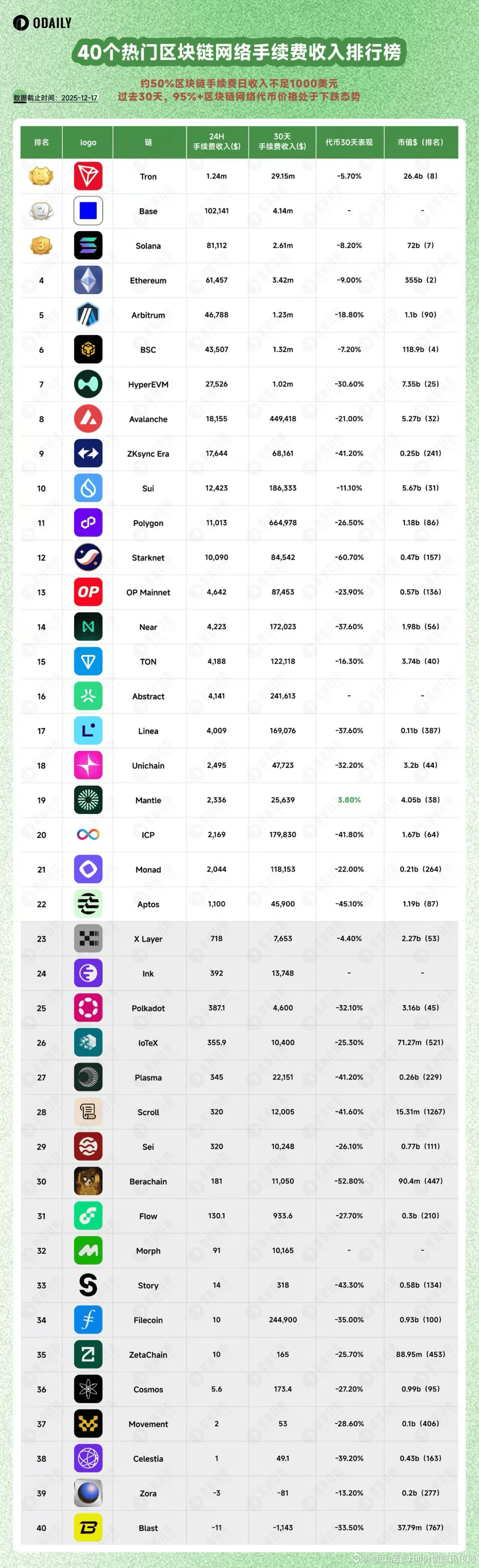
根据这张2025年12月17日的排行榜图片,Filecoin 在40个热门区块链网络的手续费收入排名中位列第34位,24小时手续费收入仅为10美元,30天累计也只有24,490美元。这确实是极其低的水平,几乎可以忽略不计。
与其他链的对比
榜单前几名(如Tron 124万美元、Base 10.1万美元、Solana 8.1万美元、Ethereum 6.1万美元)24小时手续费都达到数万到上百万美元,说明这些网络每天都有大量交易、转账、DeFi、NFT、游戏等高频活动在产生费用。
即使是排名中后段的链(如Polkadot 387美元、IoTeX 355美元),日手续费也在数百美元以上。
Filecoin 的10美元日收入,在整个榜单中属于倒数水平,只比少数几个更低的项目(如Celestia 1美元、Zora -3美元、Blast -11美元)略高。
这种极端低的网络手续费收入,直接反映了Filecoin网络上的链上活动极度稀少,几乎没有产生值得计费的交易或操作。
对Filecoin生态的含义
Filecoin作为去中心化存储网络,其手续费主要来源包括:
存储交易(用户支付FIL给存储提供者存放数据)
数据检索费用
少量的消息Gas费
日手续费只有10美元,意味着:
几乎没有新的存储需求——很少有用户在付费上传或续存大规模数据。
数据检索活动极低——即使有存储的数据,也很少被实际读取或使用。
整体网络利用率极低——大量存储提供者在线,但实际有偿订单寥寥无几。
结合榜单其他数据:
代币30天表现-35.00%(跌幅较大)
市值仅0.93亿美元,排名第100位
这些指标共同指向当前Filecoin生态活跃度非常低,用户和实际应用场景增长缓慢,市场关注度与资金流入都处于弱势状态。可以说,从网络经济活动(手续费收入)这个最直接的指标来看,Filecoin生态确实相当惨淡,远不如Solana、Base、Tron等主流公链活跃。
可能的深层原因
去中心化存储的实际需求尚未大规模爆发,用户更倾向于使用中心化云存储(更便宜、简单)。
竞争加剧(Arweave、Sia、Storj等替代方案,以及AWS、Google Cloud的低价策略)。
Filecoin网络设计复杂,存储交易门槛较高,普通用户和开发者参与成本大。
整体加密市场周期影响,2025年仍可能处于相对低迷阶段,存储类应用未起量。
一点平衡视角
Filecoin网络本身仍有数PB级的有效存储容量,技术上具备提供永久存储的能力,但这些容量大多是提供者自抵押或低价填充,真正来自外部付费需求的比例很低。低手续费并不完全等于“技术失败”,而更多反映了商业化和采用层面的瓶颈。
总之,从这张榜单的数据看,Filecoin当前网络经济活动几乎停滞,生态活跃度在主流L1/L2中处于垫底位置,确实可以用“惨淡”来形容。如果未来没有重大应用突破(如AI数据存储、大规模Web3内容分发等落地),这种低手续费状态可能还会持续。
提示:以上内容由AI生成,仅供参考!
——————————————————
Here is the English translation of your previous message and my response:
Only $10 in transaction fees per day?! Filecoin's current network economic activity is almost stagnant, with ecosystem activity at rock-bottom levels—a state of "no one using it" and "utterly dismal."
According to this ranking chart dated December 17, 2025, Filecoin ranks 34th out of 40 popular blockchain networks in fee revenue, with only $10 in 24-hour fees and a 30-day total of just $24,490. This is an extremely low level, almost negligible.
Comparison with other chains
The top networks (e.g., Tron at $1.24M, Base at $101K, Solana at $81K, Ethereum at $61K) generate tens of thousands to millions of dollars in daily fees, reflecting high-frequency activities like transactions, transfers, DeFi, NFTs, and gaming.
Even mid-to-lower ranked chains (e.g., Polkadot at $387, IoTeX at $355) have daily fees in the hundreds of dollars.
Filecoin’s $10 daily revenue places it near the bottom of the list, only slightly above a few even lower projects (e.g., Celestia at $1, Zora at -$3, Blast at -$11).
Such extremely low network fee revenue directly indicates very sparse on-chain activity on Filecoin, with almost no transactions or operations generating meaningful fees.
Implications for the Filecoin ecosystem
Filecoin, as a decentralized storage network, primarily generates fees from:
Storage deals (users paying FIL to storage providers for data storage)
Data retrieval fees
Minor message/gas fees
A daily fee of just $10 means:
Almost no new storage demand — very few users are paying to upload or renew large-scale data storage.
Extremely low data retrieval activity — even existing stored data is rarely accessed or used.
Very low overall network utilization — many storage providers are online, but paid orders are scarce.
Combined with other data from the chart:
Token 30-day performance: -35.00% (significant decline)
Market cap: only $93 million, ranked 100th
These metrics collectively point to very low activity in the Filecoin ecosystem, with slow growth in users and real-world applications, and weak market attention and capital inflow. From the most direct indicator of network economic activity (fee revenue), the Filecoin ecosystem is indeed quite bleak, far less active than mainstream public chains like Solana, Base, or Tron.
Possible underlying reasons
Real-world demand for decentralized storage has not yet exploded at scale; users still prefer centralized cloud storage (cheaper and simpler).
Intensified competition (alternatives like Arweave, Sia, Storj, plus low-price strategies from AWS and Google Cloud).
Filecoin’s network design is complex, with high barriers to entry for storage deals, making participation costly for ordinary users and developers.
Broader crypto market cycle effects — 2025 may still be in a relatively bearish phase, with storage-related applications not yet gaining traction.
A balanced perspective
Filecoin still has several PB of effective storage capacity and is technically capable of providing permanent storage. However, much of this capacity comes from providers’ self-pledging or low-cost filling, with very little from external paid demand. Low fees do not entirely mean “technical failure,” but rather highlight bottlenecks in commercialization and adoption.
In summary, based on this chart’s data, Filecoin’s current network economic activity is nearly stagnant, with ecosystem activity at the bottom among mainstream L1/L2 chains — it can indeed be described as “bleak.” Without major application breakthroughs in the future (e.g., AI data storage or large-scale Web3 content distribution taking off), this low-fee state may persist.
Note: The above content is AI-generated, for reference only!
