
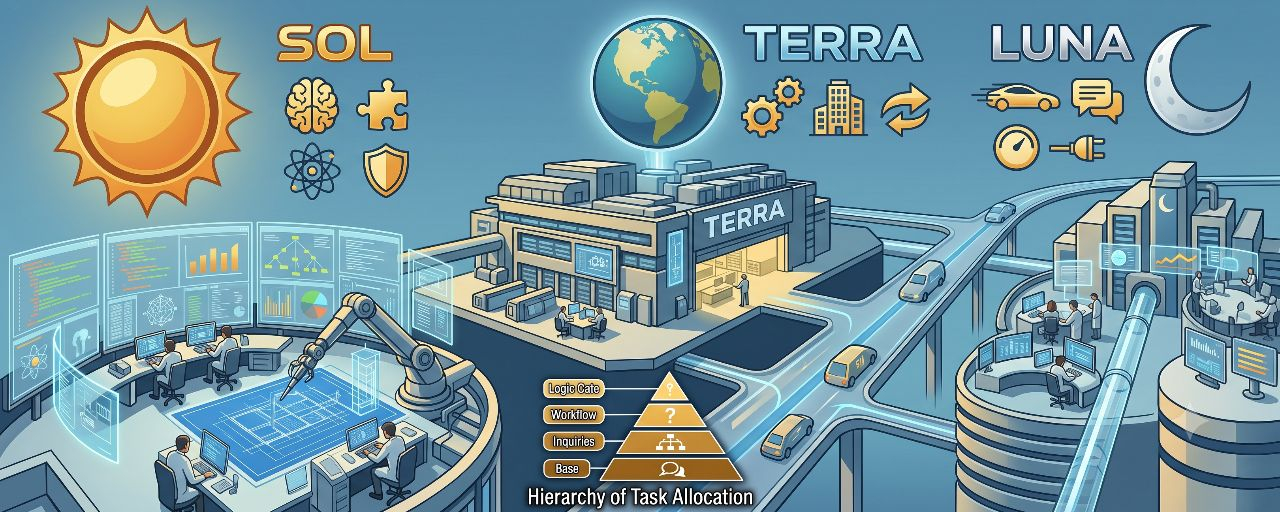
On June 26, 2026, OpenAI officially introduced the GPT-5.6 family, unveiling three distinct models: Sol, Terra, and Luna. Unlike previous releases centered around a single flagship model, GPT-5.6 represents a significant shift in OpenAI's product strategy. Instead of delivering one "best" model, the company now offers a complete model portfolio designed to address three different priorities: maximum intelligence, balanced performance, and high-throughput cost efficiency.
According to OpenAI, the GPT-5.6 series significantly improves capabilities in software engineering, computer operation, professional knowledge work, scientific research, and cybersecurity. At launch, the models are available only through a limited preview via the API and Codex to a small group of trusted partners, with broader ChatGPT availability expected at a later stage.
From a Single Model to an Entire Family
Over the past several years, OpenAI's model evolution has largely revolved around a single flagship architecture. Even when lightweight or turbo variants were introduced, they remained extensions of one central model.
GPT-5.6 changes that philosophy completely.
Instead of optimizing a single model for every scenario, OpenAI designed three specialized models from the ground up.
Sol serves as the flagship model, targeting complex reasoning, advanced programming, scientific research, cybersecurity, and long-horizon AI agents. It represents the highest level of reasoning capability and is intended for situations where accuracy is critical and mistakes carry significant costs.
Terra occupies the middle tier, balancing intelligence, stability, and operating costs. It is positioned as the ideal enterprise workhorse, handling knowledge management, document processing, coding assistance, office productivity, and internal AI assistants.
Luna, on the other hand, prioritizes speed and affordability. It is optimized for high-concurrency applications such as customer service, large-scale summarization, real-time conversations, content moderation, and lightweight automation.
This architecture suggests that OpenAI is evolving from a model developer into an AI infrastructure provider. Rather than simply claiming to have the most powerful model, the company is beginning to answer the questions enterprises actually care about: Which model should be used for which workload? How can performance and cost be optimized simultaneously?
Why Sol, Terra, and Luna?
The naming strategy itself deserves attention.
Unlike technical labels such as GPT-4o or o4-mini, Sol, Terra, and Luna are immediately recognizable and intuitive.
· Sol (the Sun) symbolizes peak intelligence and computational power.
· Terra (the Earth) represents stability, reliability, and broad applicability.
· Luna (the Moon) reflects agility, efficiency, and low-cost deployment.
The shift in naming reflects a broader transformation in AI itself.
Large language models are no longer products designed exclusively for AI researchers and engineers. They have become commercial products purchased by enterprises, deployed by developers, and increasingly understood by mainstream users.
Previously, the question was:
"Which model is the smartest?"
Going forward, the more practical question becomes:
"Which model is the right one for this specific task?"
This resembles the evolution of cloud computing. Organizations no longer purchase the most powerful server for every workload; instead, they choose GPU instances, CPU instances, memory-optimized machines, or edge nodes depending on the application's needs.
AI models are entering a similar era of intelligent workload allocation.
AI Products Are Entering the Era of Model Segmentation
OpenAI's three-model strategy is not an isolated move. It reflects a broader industry trend.
Anthropic now offers Claude Opus, Sonnet, and Haiku.
Google has Gemini Ultra, Pro, and Flash.
With Sol, Terra, and Luna, OpenAI has completed its own layered product lineup.
This signals that the AI industry has moved beyond competing solely on benchmark scores and raw model capabilities. Instead, competition is increasingly centered on engineering maturity and real-world deployment.
Early model comparisons focused on context length, reasoning ability, coding benchmarks, and multimodal performance.
Today, enterprise customers evaluate entirely different criteria:
· Inference cost
· Latency
· Reliability
· Throughput
· Security controls
· Compliance
· Tool integration
· Caching mechanisms
· Operational scalability
The strongest AI company of the next generation may not simply be the one with the highest benchmark score, but the one capable of delivering a comprehensive platform that combines flagship intelligence with cost efficiency and production-grade reliability.
GPT-5.6 embodies precisely this transition.
AI Agents Become the Centerpiece
Perhaps the most important aspect of GPT-5.6 is its continued investment in AI agents.
Traditional language models function primarily as conversational systems: users ask questions, and the model produces answers.
AI agents fundamentally change that relationship.
Instead of merely responding, agents can plan tasks, invoke external tools, operate software, verify results, recover from failures, and execute multi-step workflows autonomously.
According to OpenAI, GPT-5.6 introduces significant improvements in software engineering, computer operation, and professional knowledge work—all foundational capabilities for practical AI agents.
This changes the role of AI entirely.
Instead of asking AI to write an email, users may ask it to gather context, analyze documents, draft responses, verify tone, and send the message after approval.
Developers may ask AI to inspect an entire repository, identify bugs, implement fixes, execute tests, explain modifications, and submit pull requests.
Security analysts may rely on AI to review vulnerabilities, propose mitigations, validate patches, and generate detailed security reports.
These workflows require substantially stronger planning abilities, better long-context understanding, more reliable tool usage, and significantly lower cumulative error rates than traditional chatbot interactions.
GPT-5.6 therefore represents a transition from models that simply answer questions toward systems capable of sustained autonomous work.
Reasoning Continues to Advance
Over the past several years, progress in AI has shifted from fluent text generation toward increasingly sophisticated reasoning.
GPT-5.6 is explicitly positioned for software engineering, scientific research, professional knowledge work, and cybersecurity—all domains characterized by multi-step reasoning rather than simple question answering.
For software development, this means understanding large codebases, identifying dependencies, locating bugs, proposing modifications, and minimizing unintended side effects.
Scientific research requires reading technical literature, comparing evidence, evaluating competing hypotheses, designing experiments, and assisting with data analysis.
Cybersecurity presents an even greater challenge. Models must become increasingly capable of assisting defenders without enabling offensive misuse.
According to OpenAI's safety evaluations, GPT-5.6 demonstrates strong cybersecurity performance, making safety controls and deployment restrictions a central part of its release strategy.
This illustrates a broader reality:
As frontier models become more capable, their deployment inevitably becomes more complex.
Earlier generations primarily raised concerns around hallucinations, misinformation, and content moderation.
Future generations increasingly interact with real-world software systems, infrastructure, and automated workflows, transforming AI deployment into a matter of security governance rather than product engineering alone.
Cost Becomes a Strategic Competitive Advantage
Another defining feature of GPT-5.6 is its pricing strategy.
OpenAI now offers three pricing tiers, allowing organizations to match model capability with business requirements instead of defaulting to the most powerful—and most expensive—option.
For large-scale enterprise deployments, inference costs rapidly become one of the largest operational expenses.
An AI application that performs well during a prototype stage may generate millions of API calls per day after deployment.
Running every request through the flagship model is simply not economically sustainable.
The three-model architecture enables intelligent workload distribution.
Mission-critical reasoning tasks can be routed to Sol.
General enterprise productivity can rely on Terra.
High-frequency, latency-sensitive workloads can leverage Luna.
Combined with OpenAI's improved prompt caching mechanism, organizations can further reduce repeated inference costs by caching system prompts, knowledge bases, and long contextual inputs.
This represents a significant step toward making enterprise AI economically scalable.
Why Isn't GPT-5.6 Available to Everyone Yet?
Unlike previous releases, GPT-5.6 launched as a limited preview rather than a general public rollout.
According to OpenAI, access is currently restricted to selected API and Codex partners, with broader availability expected after additional evaluation.
Multiple media reports indicate that the restricted release is closely related to increasing government oversight of frontier AI systems, particularly concerning cybersecurity capabilities and potential misuse.
This reflects an important shift within the AI industry.
The release of frontier models is no longer purely a product decision.
It increasingly intersects with national security, public policy, and AI governance.
OpenAI itself appears to acknowledge this tension.
While the company recognizes the need for careful deployment of highly capable models, it has also expressed concern that extensive governmental approval processes should not become the long-term norm, as excessive restrictions could slow innovation and limit access for developers and defensive security researchers.
The industry now faces a fundamental dilemma:
Move too quickly, and advanced capabilities may introduce new risks.
Move too cautiously, and innovation may suffer.
GPT-5.6 may become an important case study for how future frontier AI systems are introduced to the public.
From Model Competition to Platform Competition
Ultimately, GPT-5.6 is about much more than stronger intelligence.
It signals a broader transformation in OpenAI's long-term strategy.
The next stage of AI competition will not be determined solely by benchmark performance or parameter counts.
Instead, success will increasingly depend on:
· Building comprehensive model portfolios
· Delivering production-ready AI agents
· Offering secure and cost-effective enterprise solutions
· Supporting vibrant developer ecosystems
· Providing reliable infrastructure at global scale
With Sol, Terra, and Luna, OpenAI is no longer simply launching another frontier model.
It is building a layered AI platform capable of serving researchers, developers, enterprises, and consumers simultaneously.
If GPT-4 represented the era of emergent intelligence, and GPT-4o brought multimodal interaction into the mainstream, GPT-5.6 may ultimately be remembered as the beginning of platform-oriented AI infrastructure.
In the years ahead, users may no longer interact with a single AI model. Instead, they will engage with an intelligent orchestration layer capable of dynamically selecting the optimal model, allocating computing resources, managing long-term memory, invoking external tools, and coordinating autonomous agents behind the scenes.
That is the true significance of GPT-5.6.
It is not merely another model upgrade—it is a decisive step toward AI becoming the foundational infrastructure of the digital economy.