
You’re walking through a supermarket, right? You grab a banana. You know it costs maybe fifty cents. But imagine if someone snuck in with a label maker, slapped a sticker on that banana that said “$1,000,” and the cashier just..believed it. No questions asked. The cashier hands over a thousand dollars from the register for your fruit. That sounds insane in the real world, but in crypto, this happens all the time. It’s the invisible nightmare that keeps analysts like me awake at night.
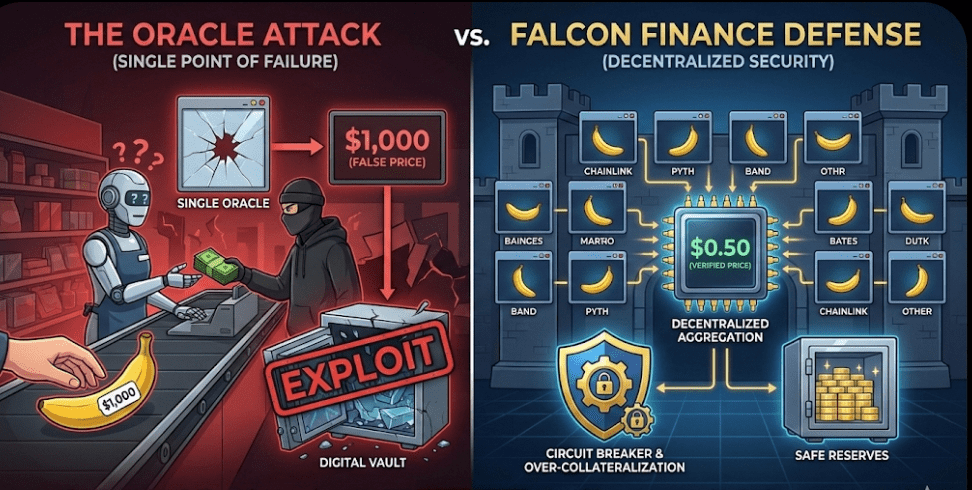 We call it an Oracle Attack. And if you are looking at newer, complex protocols like @Falcon Finance (FF), understanding this concept isn't just "nerd stuff." It represents the difference between keeping your assets safe or losing them to an exploit. See, a blockchain is actually kind of stupid. It doesn't know the price of Bitcoin. It doesn't know the price of Gold. It doesn't even know who won the Super Bowl.
It is a closed box. To get information from the outside world like the price of the assets you are trading it needs a messenger. That messenger is called an Oracle. Think of the Oracle as the only window in a windowless room. If the Oracle tells the smart contract that “the sky is green,” the smart contract has to believe the sky is green.
This is where things get messy, and this is exactly where a protocol like Falcon Finance has to build a fortress, not just a house. So, let's talk about the scare. How does the robbery actually happen? It usually starts with something called a flash loan. This is where a trader borrows millions of dollars for just a few seconds literally one single block on the blockchain and uses that massive pile of cash to manipulate the market.
They take that borrowed money and buy up a ton of a specific token on a small exchange. This buying pressure shoots the price up artificially. For a few seconds, that token looks incredibly valuable. The Oracle, if it’s lazy or cheap, looks at that one exchange, sees the high price, and reports back to the protocol: “Hey! This token is worth a fortune now!” The protocol’s doors swing open. It sees your collateral is suddenly "worth" millions, so it lets you borrow all the real money in the vault.
Then, you pay back the flash loan, keep the profit, and the protocol is left holding a bag of worthless tokens. It is a smash-and-grab job, but without breaking a single window. This is the history of DeFi failures. We have seen it with Mango Markets, we have seen it with Venus. The defenses failed because the Oracle was looking at the wrong reflection in the mirror. This brings us to Falcon Finance. You see, Falcon isn’t just doing the simple stuff. They are building what they call "universal collateralization."
They are taking stablecoins, sure, but they are also dealing with tokenized real-world assets, Bitcoin, and other complex value stores to mint their USDf. When you accept weird, diverse collateral, your Oracles need to be bulletproof. If Falcon Finance used a single source for its price feeds, it would be dead in a week. The defense strategy here has to be different. It’s not just about having a window; it’s about having ten windows looking at the same landscape from different angles.
Falcon Finance relies on what we call "decentralized aggregation." Instead of asking one guy what the price of Bitcoin is, the system asks twenty guys. If nineteen of them say “$95,000” and one guy screams “$1,000,000,” the system is smart enough to ignore the crazy guy. This is the first line of defense. They integrate with industry standards like Chainlink, which essentially does this homework for them. But it goes deeper.
You need internal circuit breakers. Imagine that cashier again. Even if the sticker says “$1,000,” a smart cashier would stop and say, “Wait, this is a banana. I’m not buying this.” That is the "sanity check." A protocol like Falcon sets limits. If a price moves 50% in one second, the system pauses. It freezes. It says, "This isn't natural." Defenses like this are crucial when you are dealing with the amount of liquidity Falcon is aiming for.
They also use over-collateralization keeping more money in the reserves than they actually lend out. It’s a buffer. If the Oracle gets tricked by 5%, the protocol can eat the loss without collapsing. So, where does this leave you? Well, when you look at a project like $FF , don't just look at the yield. Everyone loves a high APY. It triggers that dopamine hit. But the yield is meaningless if the vault is empty. You need to ask the boring questions. Where does the price data come from? Is there a delay on the price feed? Is there a circuit breaker?
Falcon Finance is interesting because they are trying to bridge the gap between "degen crypto" and "institutional finance." Institutions don't like label-maker attacks. They want steel vaults.In the end, security is a cat-and-mouse game. The attackers are getting smarter, using complex math to trick the feeds. But the defenses are evolving too.
Falcon Finance represents that next generation of armor. They aren't just trusting the price tag; they are verifying the fruit. As a user, your job isn't to audit the code line by line that's impossible for most of us. Your job is to understand that the "Oracle" is the heart of the system. If the heart stops beating, or beats too fast, the body dies. So, stick with the protocols that treat their Oracles like the crown jewels, not just a utility bill. Because in this market, the truth is the most expensive asset of all..

