What is happening around APRO right now is not just another rebranding exercise or a vague “AI narrative” that half the market is throwing around. The recent developments, when you strip away the noise, point to a project that is actively trying to reposition itself from a commodity oracle into infrastructure that targets harder, more defensible data problems. That distinction matters, because price feeds alone are already a solved problem with brutal competition and thin differentiation.
The strategic funding round led by YZi Labs, alongside Gate Labs and other Web3 funds, is not meaningful because of the headline itself, but because of what those investors typically fund. They are not known for passive bets on narrative tokens. Their capital usually comes with pressure for concrete delivery, especially in areas like prediction markets, real world data ingestion, and system-level reliability. This suggests APRO is being pushed toward higher accountability use cases where bad data has real financial consequences, not just cosmetic ones. If APRO fails to execute here, the market will not forgive it quietly.
The expansion from a Bitcoin-centric oracle into BNB Chain, Ethereum, Solana, and additional ecosystems also needs to be interpreted correctly. Multi-chain support by itself is not impressive anymore. Every serious oracle claims it. What matters is whether the same data quality, latency guarantees, and verification standards survive across chains. APRO’s messaging around AI-assisted verification and anomaly detection implies an attempt to automate trust minimization rather than relying purely on economic incentives or manual validation. That is a harder engineering problem, but it is also where the real moat could exist if implemented properly.
The “Oracle 3.0” framing that external analysts are attaching to APRO is not just marketing fluff if you read between the lines. First-generation oracles focused on simply getting data on-chain. Second-generation oracles optimized decentralization and token incentives. The third generation, if it is real, must address fidelity under adversarial conditions, cost efficiency at scale, and responsiveness in complex environments like RWAs and prediction markets. APRO’s emphasis on high-fidelity feeds and manipulation resistance directly targets the oracle trilemma that still quietly breaks many DeFi protocols during stress events.
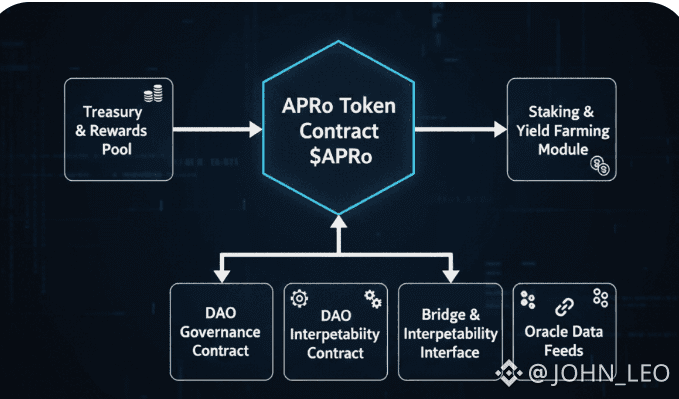
The recent Binance Square communication about APRO’s smart contract architecture is subtle but important. Binance does not routinely surface projects unless they fit a broader ecosystem narrative. Public discussion of architecture reliability, even without deep technical disclosure, usually signals that a protocol wants to be perceived as infrastructure rather than speculation. That aligns with the broader shift in how APRO is being talked about, not as “another oracle token,” but as a data backbone for applications that cannot tolerate bad inputs.
From a market perspective, AT being actively traded and promoted is a double-edged sword. Liquidity and visibility help adoption, but they also expose the protocol to harsher scrutiny. If APRO positions itself as an Oracle 3.0 system and then fails during volatile market conditions or complex data events, credibility damage will be immediate. The upside is that if it performs as claimed, it moves into a category where switching costs are high and integrations tend to be sticky.
In practical terms, APRO appears to be betting on complexity over convenience. That is a risky choice, but it is the correct one if the goal is long-term relevance. Simple price feeds are already commoditized. High-integrity data for prediction markets, RWAs, and AI-driven on-chain logic is not. The next year will expose whether APRO’s AI-enhanced verification and architectural claims translate into measurable reliability or remain well-written positioning. There is no middle ground here. Either it becomes part of the invisible plumbing of serious on-chain systems, or it gets absorbed into the background noise of “almost good enough” oracles.