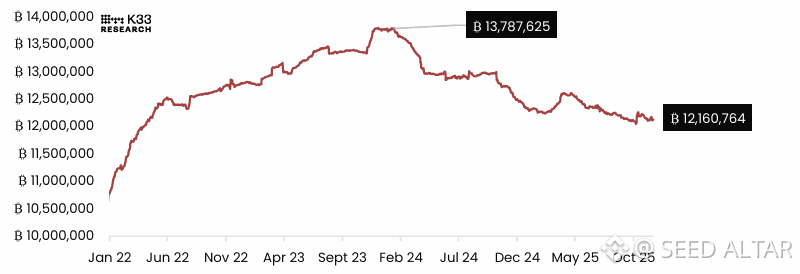
Supply aged 2 years or more. Source: K33 Research
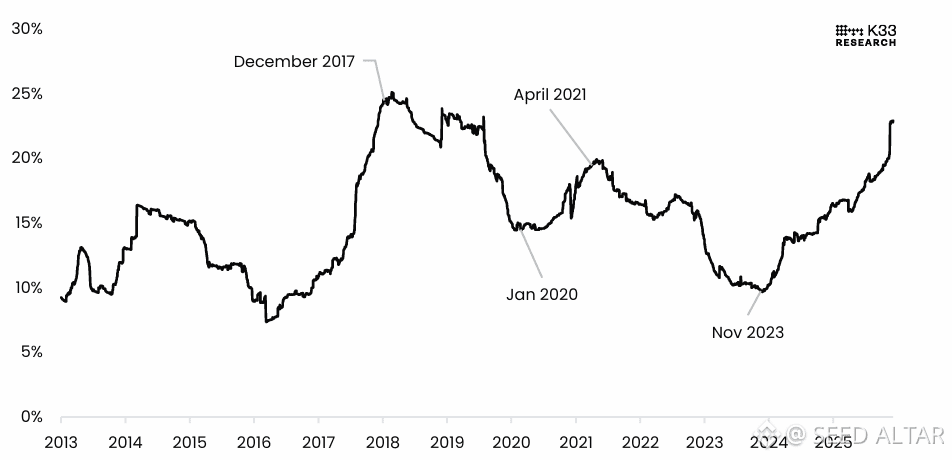
With nearly 20% of the total supply already reactivated over the past two years, as shown below, on-chain sell-side pressure is approaching saturation, setting the stage for a return of net buy-side demand.
2 year supply, or older, being reactivated over the past 2 years as a % of total supply. Source: K33 Research
Supported by deeper market liquidity, expanded institutional access, and clearer regulatory frameworks, 2026 is expected to be a post-distribution year, characterized by improved supply stability and a more constructive, demand-driven market structure.
Global crypto ETPs to surpass $400 billion
The 21Shares’ ‘State of Crypto’ report highlights how crypto ETPs are transitioning from niche access vehicles to a dominant distribution channel.
In 2025, Bitcoin ETPs alone hold over $140 billion in AUM – approximately 7% of the total BTC supply – , and it could potentially surpass $400 billion, rivaling the Nasdaq-100 (QQQ) by the end of 2026. Due to expanding retail access, falling regulatory barriers, and growing institutional and sovereign participation, a powerful, liquidity-driven adoption flywheel is emerging.$BTC

Crypto ETPs’ assets under management. Source: 21Shares
Bitcoin’s fading four-year cycle
Bitcoin’s traditional four-year halving-driven cycle is increasingly losing its dominance as the BTC matures into a global macro hedge. While the halving cycle still anchors Bitcoin’s transparent monetary policy, with issuance now below 1% annually, its marginal impact on price has diminished.
“Structural inflows, macro realignment, and regulatory clarity now anchor the market,” reports a 21Shares analyst.
The analyst continued, “Even though market outcomes can differ materially from expectations, we believe Bitcoin could be positioned to reach new all-time highs in 2026, with broader markets potentially benefiting from improving liquidity and rising institutional participation. Each cycle now delivers less exponential returns, but also far milder corrections