
As AI agents move from passive tools to active participants in financial systems, fintech faces a fundamental challenge: how do we allow machines to act independently without losing traceability, accountability, and control? In finance, trust is not optional. Every action must be explainable, auditable, and tied to responsibility. This is where Kite AI positions itself—not as a layer of hype, but as core infrastructure for safe AI autonomy.
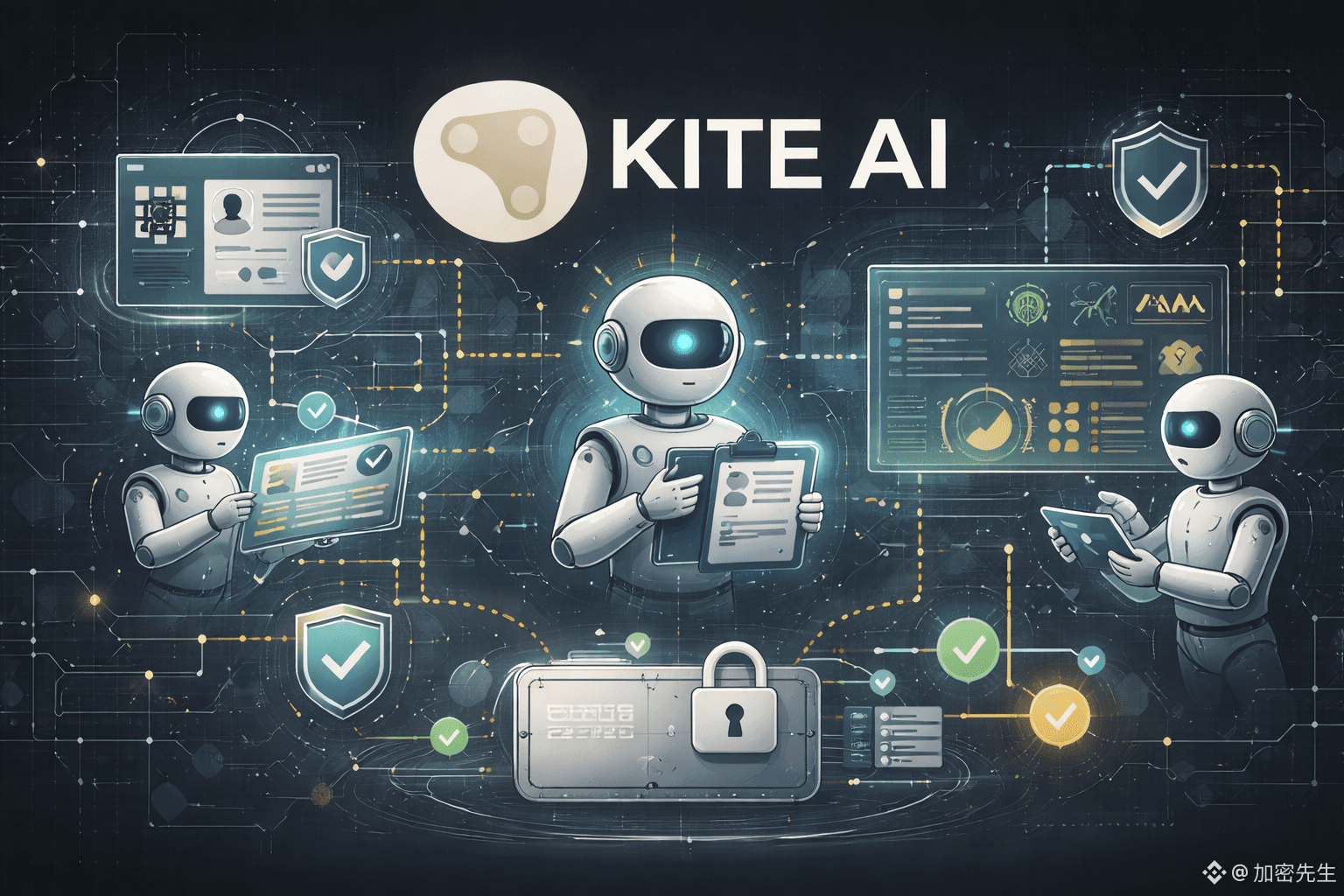
The first pillar is identity and verification. In traditional fintech, every transaction links back to a verified individual or institution. AI agents break this assumption because they are non-human actors. Kite AI solves this by giving each AI agent a verifiable on-chain identity. This identity is cryptographic, persistent, and permissioned. It clearly defines who created the agent, who controls it, and what it is allowed to do. Every transaction an AI agent executes is signed by this identity and recorded on-chain, creating a permanent and transparent audit trail.
This approach transforms AI agents from anonymous bots into accountable financial actors. If an AI agent pays for data, executes a trade, or interacts with a protocol, that action is always traceable. There is no ambiguity about “who did what.” In a fintech context, this matters deeply for compliance, dispute resolution, and regulatory oversight. Trust is no longer based on promises or assumptions—it is enforced by cryptography and public records.
The second pillar is governance and risk control. Autonomy without limits is dangerous, especially in financial systems where errors scale quickly. Kite AI embeds governance directly into smart contracts, allowing humans to define rules before autonomy begins. These rules act as guardrails. They can include spending caps, transaction frequency limits, approved counterparties, or strict conditions under which actions are allowed.
Once deployed, these guardrails are enforced automatically. An AI agent can make decisions and act in real time, but only within the boundaries set by its smart contracts. If an action exceeds those limits, the transaction simply fails. There is no need for manual intervention, and no room for emotional or impulsive behavior. Control is mathematical, continuous, and predictable.
Importantly, Kite AI separates intelligence from authority. AI agents may decide what to do, but they are never given unlimited power to do it. Authority always lives inside the contract logic. Emergency controls, permission revocation, and automated shutdown mechanisms can be triggered if abnormal behavior appears. This ensures that autonomy does not turn into systemic risk.
Together, identity and governance create a balanced model of AI participation in finance. AI agents can operate faster than humans, manage complex workflows, and interact across global systems—but they remain visible, accountable, and constrained. This balance is critical as fintech enters an era where machines are not just assisting finance, but actively running parts of it.
Kite AI’s design shows that the future of AI in finance does not require blind trust. It requires structure. With verifiable identity and smart contract guardrails, autonomous AI can be powerful without being dangerous—and innovative without being uncontrollable.

