I've come across countless projects claiming to combine AI and crypto, and many of them follow a familiar pattern: an AI agent, a long list of promised features, and a token at the center of the ecosystem. It's easy to become skeptical after seeing similar narratives repeated so often.
Newton Protocol caught my attention for a different reason. Instead of asking whether an AI agent can perform financial tasks, it focuses on a more practical question: how can users verify that an AI agent acted exactly as intended?
That question alone made me want to learn more.
What Newton Protocol Is
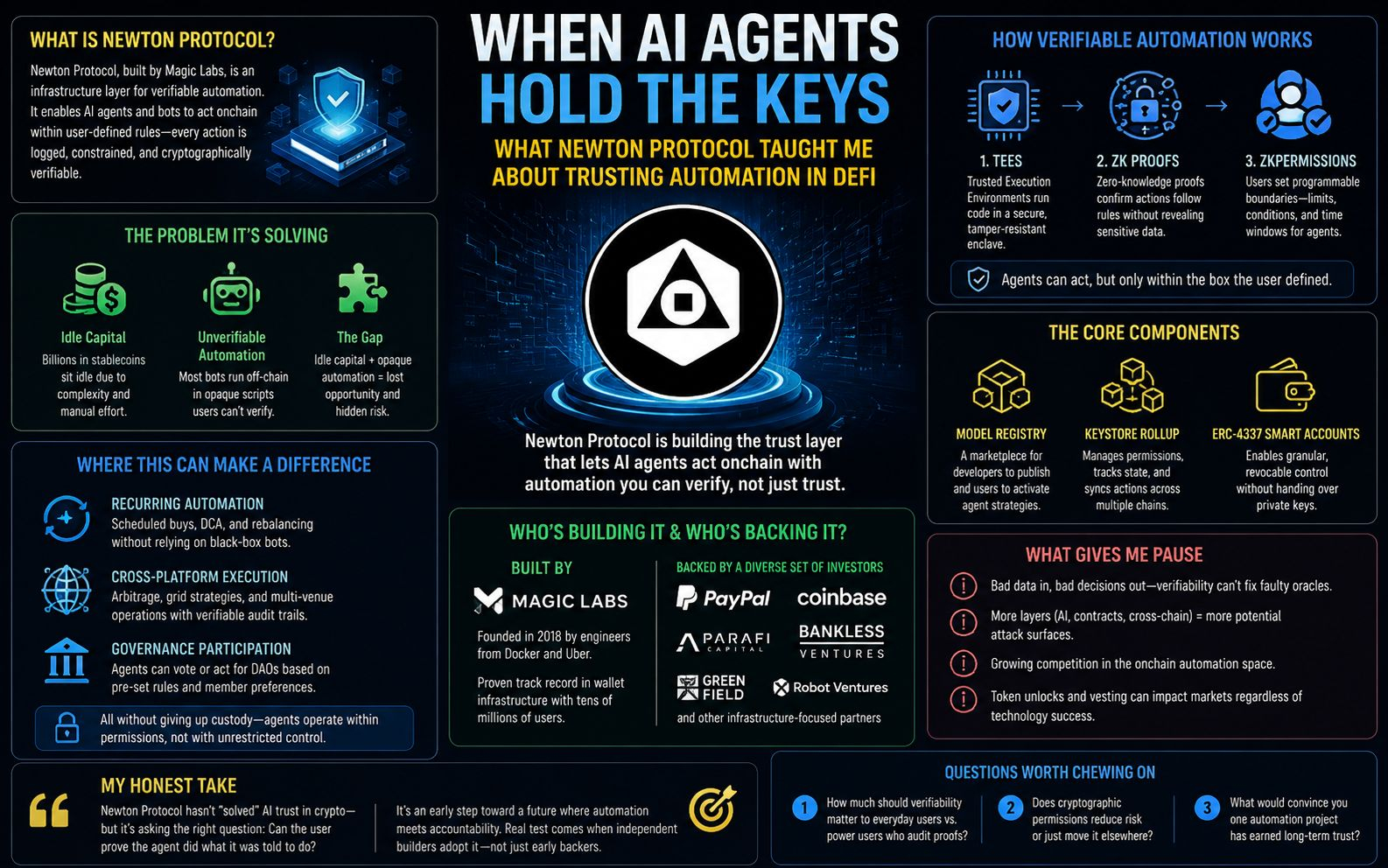
Based on Newton Protocol's official documentation, the project is being developed by Magic Labs with the goal of enabling verifiable onchain AI automation. Rather than positioning itself as another trading bot or DeFi application, the protocol aims to provide infrastructure that allows AI agents to operate within clearly defined user permissions while making their actions easier to verify.
According to the project, this approach combines trusted execution environments (TEEs) with zero-knowledge proofs (ZKPs). Together, these technologies are intended to help users confirm that an AI agent followed predefined rules without unnecessarily exposing sensitive information.
While these technologies are already established within the broader blockchain ecosystem, Newton Protocol's focus is on integrating them into a single framework designed specifically for AI-powered automation.
The Problem It Tries to Address
As I continued researching, the motivation behind the project became clearer.
Managing assets across multiple blockchains and DeFi protocols can require significant manual effort. Many users rely on automation tools or bots to simplify repetitive tasks, but these systems often operate with limited transparency regarding how decisions are made or whether predefined rules were consistently followed.
Newton Protocol attempts to address this challenge by emphasizing verifiable automation rather than automation alone. The idea is that users should not only delegate certain tasks to AI agents but also have a way to verify that those agents operated within the permissions they originally approved.
Whether this approach achieves broad adoption remains an open question, but I think it highlights an important discussion around accountability as AI becomes more involved in financial applications.
Understanding the "Verifiable" Approach
One of the more technical aspects of Newton Protocol is how it combines different security technologies.
According to the project's documentation:
Trusted Execution Environments (TEEs) are intended to provide a protected environment where approved code can execute while reducing the risk of unauthorized interference.
Zero-knowledge proofs (ZKPs) are designed to allow certain actions or computations to be verified without revealing all of the underlying private data.
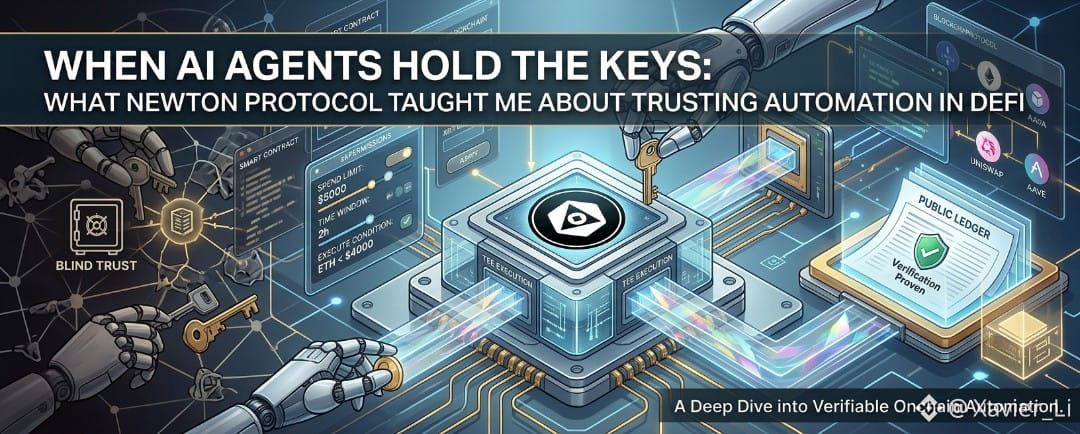
The documentation also describes a permission system that enables users to define limits before an AI agent performs actions. These permissions may include spending limits, approved assets, timing restrictions, or other predefined conditions.
If implemented as intended, this model could allow AI agents to operate within clearly defined boundaries instead of having unrestricted authority over a user's assets.
The Technology Behind the Protocol
Based on my understanding of Newton Protocol's documentation, the ecosystem consists of several components that work together to support AI-powered automation.
The project describes a Model Registry, where developers can publish AI agent strategies that users may choose to adopt. It also outlines a Keystore Rollup, which is intended to manage permissions and coordinate activity across supported blockchain networks.
Newton Protocol also references support for ERC-4337 smart accounts, a standard designed to offer more flexible account management. According to the project, this allows users to grant limited, revocable permissions to AI agents instead of giving them unrestricted control over a wallet.
None of these technologies are entirely new on their own. What I find interesting is the attempt to combine them into a single framework focused on verifiable AI automation.
The Team Behind the Project
Newton Protocol is being developed by Magic Labs, a company that has spent several years building wallet infrastructure for the Web3 ecosystem.
Based on publicly available information from the project, Magic Labs is applying its experience in wallet technology to a broader vision of AI-powered onchain automation. While the long-term success of this direction remains to be seen, it suggests that the project is building on existing technical experience rather than starting entirely from scratch.
As with any emerging infrastructure project, long-term adoption and continued development will ultimately matter more than early announcements or funding.
Where This Could Be Useful
While researching Newton Protocol, a few practical applications stood out to me.
One possibility is recurring portfolio management, where AI agents could automate routine actions within user-defined limits instead of requiring constant manual interaction.
Another potential use case is cross-chain execution, where predefined strategies could operate across multiple blockchain ecosystems while maintaining a verifiable record of their actions.
The protocol could also have applications in onchain governance, allowing AI agents to carry out voting or governance-related tasks according to rules established by the user.
What I find most encouraging is the emphasis on permission-based automation. If implemented as described, users remain in control of what an AI agent is allowed to do rather than handing over unrestricted authority.
Challenges Worth Considering
Despite the interesting approach, I don't think it's useful to ignore the challenges.
Even if an AI agent's actions are cryptographically verifiable, the overall outcome still depends on the quality of external data such as oracle feeds or market information. Verification cannot automatically correct inaccurate inputs.
The architecture is also technically complex. Combining AI systems, smart contracts, cryptographic proofs, and cross-chain infrastructure introduces additional components that must all function reliably and securely.
Competition is another factor. Interest in AI-powered blockchain infrastructure continues to grow, and it's likely that multiple projects will pursue similar goals over the coming years.
These challenges don't invalidate the idea behind Newton Protocol, but they are worth keeping in mind when evaluating any emerging infrastructure project.
Final Thoughts
After spending time reading Newton Protocol's documentation, I don't think the project has completely solved the challenge of trustworthy AI automation. That's probably too ambitious for any single protocol at this stage.
What impressed me most was the way it frames the problem. Instead of asking only whether an AI agent can perform a task, it asks whether users can independently verify that the task was completed according to predefined rules.
Whether this approach becomes an industry standard will depend on real-world adoption, developer participation, and how well the technology performs outside controlled environments.
For anyone interested in this area, I'd recommend reading Newton Protocol's official documentation and Litepaper alongside other independent resources before forming a conclusion. As always, this article reflects my personal research and should not be considered financial or investment advice.
Questions I'd Love to Hear Your Thoughts On
How important is verifiable automation compared with convenience when using AI agents in DeFi?
Do permission-based AI systems meaningfully reduce risk, or do they simply shift trust to different parts of the technology stack?
As more AI automation protocols emerge, what would convince you that one deserves long-term trust over the others?