
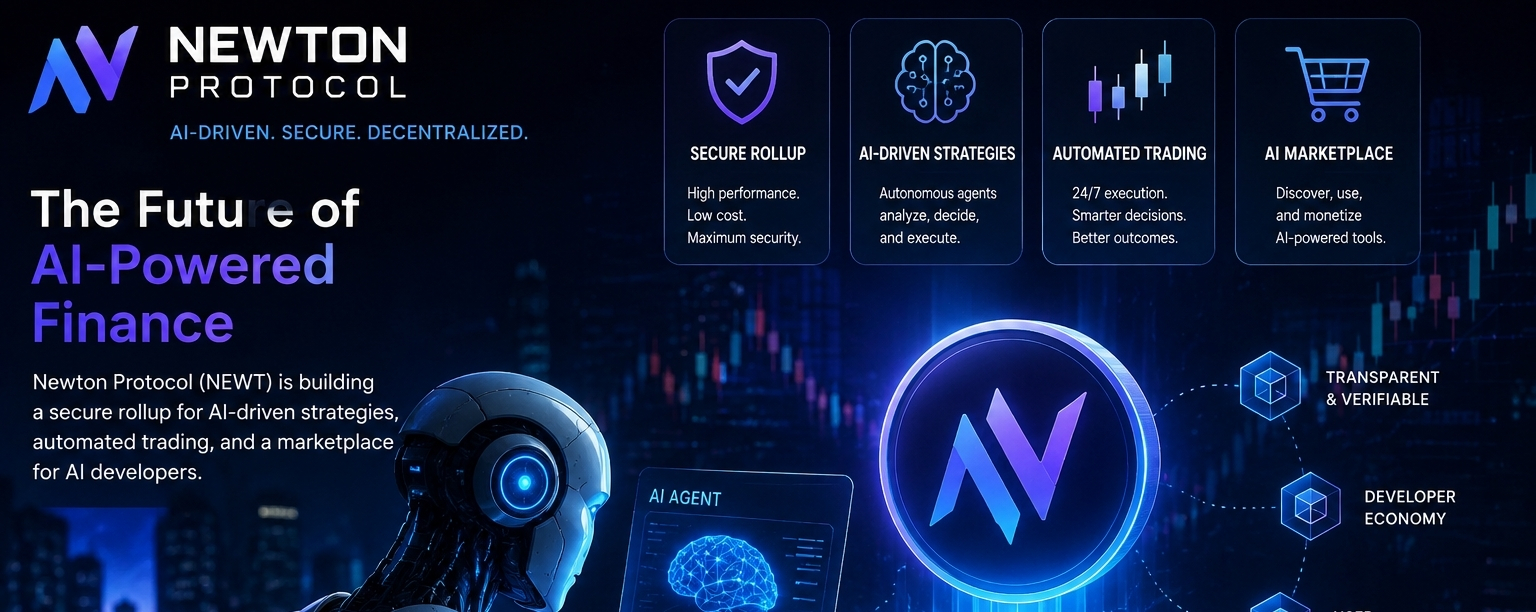
For years, artificial intelligence has mostly played the role of an assistant. It helps us search for information, write emails, summarize documents, and answer questions. But AI is slowly moving beyond that role. Instead of simply helping people make decisions, it is beginning to make certain decisions on its own.
Finance is one area where this shift could become especially significant.
Think about how much information financial markets generate every day. Prices move every second. News breaks around the clock. Economic reports, social media discussions, and global events constantly influence investor behavior. No individual can keep up with all of it. AI, on the other hand, can process enormous amounts of information almost instantly.
That naturally leads to a simple question: if AI can analyze markets faster than humans, should it also be allowed to act on that information?
The idea sounds promising. An AI system could monitor markets 24 hours a day, identify opportunities, manage risk, and execute trades without getting tired or distracted. But the moment we allow AI to move from analysis to action, a much bigger question appears.
Can we trust it?
This challenge sits at the center of what Newton Protocol (NEWT) is trying to solve. The project is not only concerned with making AI more capable. Instead, it focuses on creating an environment where AI can operate safely, transparently, and within clearly defined boundaries.
In many ways, Newton Protocol is less about artificial intelligence itself and more about building the trust layer that AI-driven finance may eventually require.
Why Smarter AI Isn't Enough
When people talk about AI, the conversation usually revolves around capability. How intelligent is the model? How accurate are its predictions? How quickly can it process information?
Those questions matter, but they are only part of the story.
Imagine giving an AI system access to your financial assets. Suddenly, intelligence is no longer the only thing that matters. You also want security. You want transparency. You want to understand what the system is doing and why it is doing it.
Even a highly sophisticated AI can make mistakes. Markets are unpredictable. Unexpected events happen. Models can misinterpret information or behave in ways their creators never anticipated.
That is why infrastructure becomes just as important as intelligence.
Newton Protocol approaches this challenge from a different angle. Rather than asking how powerful AI can become, it asks what kind of foundation needs to exist underneath AI before people are comfortable trusting it with meaningful financial decisions.
Creating a Place for AI to Operate Safely
One way to think about Newton Protocol is as an attempt to build a secure environment specifically designed for AI-driven financial activity.
The project is built around a secure rollup architecture, but the bigger idea is actually quite straightforward. If AI agents are going to execute strategies, manage assets, or interact with decentralized financial systems, they should do so within a framework that emphasizes accountability and transparency.
Too often, automated systems operate like black boxes. People see the results but have little understanding of how those results were produced.
That lack of visibility creates uncertainty.
Newton Protocol aims to reduce that uncertainty by creating a system where actions can be verified and rules are clearly defined. The goal is not simply to automate financial decisions. The goal is to make automation easier to trust.
This is where blockchain technology becomes relevant. Blockchain systems are built around transparency and verifiability, while AI brings speed, analysis, and adaptability. Newton Protocol is attempting to bring those strengths together.
The Rise of AI Agents
A major part of this vision revolves around AI agents.
Unlike traditional software, which waits for commands, AI agents can pursue objectives with a degree of independence. They can monitor changing conditions, evaluate options, and take actions based on predefined goals.
Imagine telling an AI agent that your objective is to maintain a balanced investment portfolio while limiting risk. Instead of manually checking markets every day, the agent continuously monitors conditions and adjusts its behavior according to the rules you have established.
For many people, that sounds incredibly useful.
After all, financial markets never take a break. Opportunities can appear at any hour, and important developments often happen when investors are asleep, busy working, or simply focused on other parts of life.
An AI system that remains active around the clock could potentially handle many of these tasks more efficiently than a human ever could.
But there is also an obvious concern. The more freedom an AI system receives, the more important it becomes to ensure that freedom is properly managed.
Automation without safeguards can quickly become a source of risk rather than a source of convenience.
A Marketplace for Innovation
Another interesting aspect of Newton Protocol is its vision for AI developers.
The future of AI will likely be shaped by countless individuals building specialized tools and strategies. Some developers may create systems focused on portfolio management. Others may specialize in market analysis, risk assessment, or automated trading.
Newton Protocol envisions a marketplace where these tools can be shared and discovered.
The idea is relatively simple. Instead of every user needing to build sophisticated AI systems from scratch, they could access solutions created by experienced developers. Developers, in turn, would have an opportunity to reach users and potentially earn rewards for their work.
If this model succeeds, it could create a healthy cycle of innovation. Better tools attract more users. More users create stronger incentives for developers. More developers lead to new ideas and improved solutions.
Over time, the ecosystem becomes stronger because participants benefit from each other's contributions.
Trust May Be the Real Product
When discussing AI-powered finance, it is easy to focus on algorithms, automation, and technical architecture.
Yet trust may ultimately be the most valuable thing any platform can offer.
People are generally willing to embrace new technologies when they feel confident those technologies are operating within clear and understandable rules. Transparency creates confidence. Accountability creates confidence. Security creates confidence.
Without those qualities, even the most advanced AI system may struggle to gain widespread acceptance.
Newton Protocol appears to recognize this reality. Its broader vision is not simply to create smarter automation but to create conditions where automation can be trusted.
That distinction may prove increasingly important as AI becomes more deeply integrated into financial systems.
Looking Toward the Future
The intersection of artificial intelligence and decentralized finance is still developing, but the direction seems clear. AI is becoming more capable, and financial systems are becoming more digital. Eventually, these trends are likely to converge in meaningful ways.
Projects like Newton Protocol are exploring what that future might look like.
The real question is not whether AI will participate in financial decision-making. In many ways, it already does. The more important question is how those systems will be governed, secured, and trusted when they begin handling increasingly important tasks.
Newton Protocol represents one possible answer.
Whether it ultimately succeeds or not, the project reflects a growing recognition that the future of AI-driven finance will depend on more than intelligence alone. It will depend on building systems that people feel comfortable relying on.
As AI continues to evolve, the winners may not be the projects with the most impressive technology. They may be the projects that make people feel confident enough to use that technology in the first place.
