

Crypto usually celebrates speed. Faster trades, quicker settlements, smoother execution, and more automation often get the most attention. But when I look at Newton Protocol, the part that feels more important is not only how fast an action can happen. It is whether that action should be allowed to happen in the first place.
That is where Newton Protocol becomes interesting.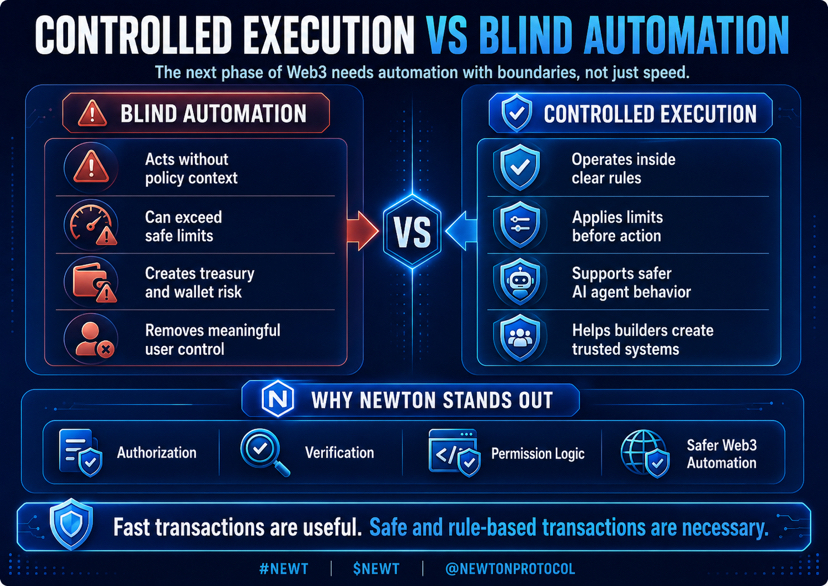
As Web3 moves toward AI agents, automated wallets, onchain trading systems, treasury tools, and DeFi strategies, users will not always be manually checking every step. More tasks will be handled by systems that act on instructions. This can make crypto more useful, but it also creates a serious question: who controls the limits?
A wallet signature alone is not enough for the next phase of onchain activity. Signing a transaction proves approval, but it does not always prove that the action fits the user’s rules, treasury policy, or risk limits. In a simple world, one approval may be fine. In a more automated world, one approval can become dangerous if there are no clear boundaries around it.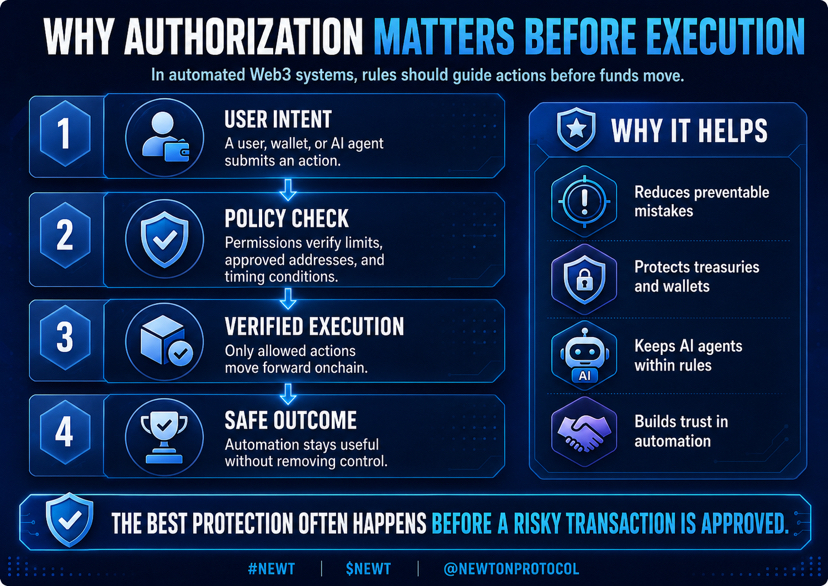
Newton Protocol focuses on this missing layer.
Instead of looking at automation as blind execution, Newton brings the idea of controlled execution. Transactions and actions can be guided by permissions, policies, and predefined rules before they move forward. These rules may include spending limits, approved addresses, timing conditions, treasury controls, or agent specific restrictions. This means automation does not have to act without supervision. It can operate inside a trusted structure.That difference matters.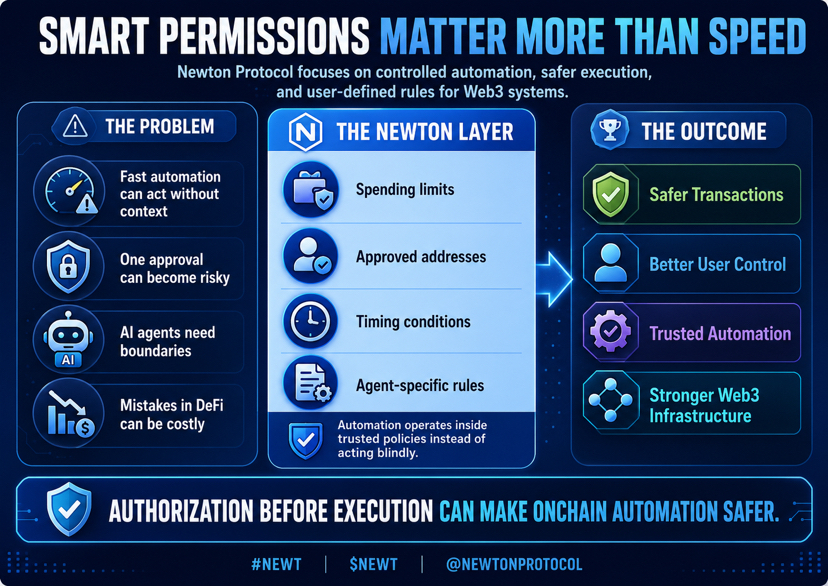
In DeFi, payments, RWAs, stablecoin activity, and AI agent workflows, mistakes can be costly. A wrong transaction, a risky approval, or an overpowered agent can create damage very quickly. The real value of a permission layer is that it can reduce risk before the mistake happens, not only after users are already trying to recover funds or explain what went wrong.
This is why I think Newton Protocol’s biggest strength may be permission quality.
Good infrastructure is often quiet. It does not always create hype. It does not always produce dramatic charts. Sometimes its best result is that nothing bad happens. A risky action is blocked. A treasury stays within limits. An automated agent follows the rules. A user keeps control even when the system is running in the background.
That kind of protection may not look exciting at first, but it can become very powerful over time.
Builders do not want to recreate every safety system from zero. If Newton can provide a reliable authorization layer that developers trust, then it can become useful across many parts of Web3. Projects may use it for treasury management, trading automation, AI agents, payment flows, and controlled access to onchain applications.
The bigger crypto becomes, the more important these rules become.
Fast transactions are useful, but safe transactions are necessary. AI agents may bring efficiency, but they also need limits. Automation can save time, but it should not remove user control. Newton Protocol is interesting because it focuses on the logic around execution, not just the execution itself.
For me, that is the real conversation around Newton.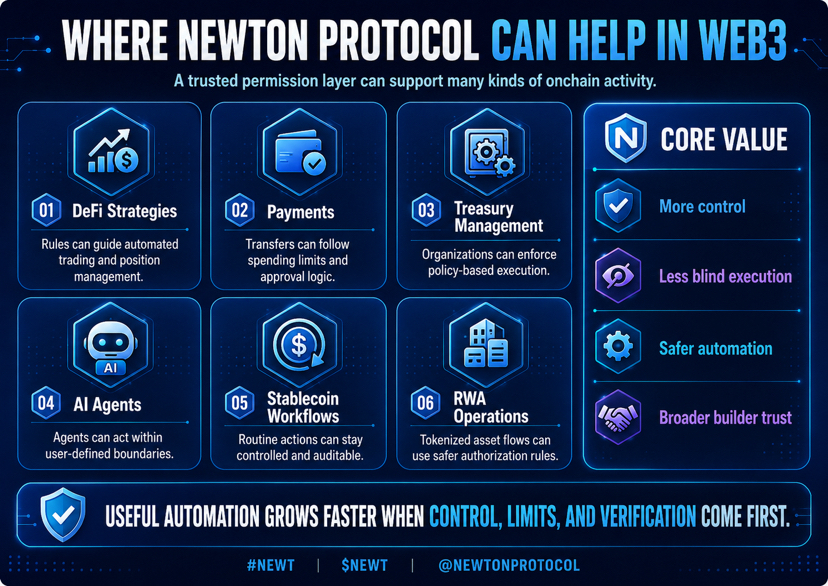
The future of onchain finance will not only depend on private keys. It will depend on the policies, permissions, and verification systems that protect those keys while automation becomes more common.
If Newton Protocol can make that layer reliable, flexible, and easy for builders to use, then its advantage may not come from being the loudest project in the market. It may come from becoming the quiet infrastructure that safer Web3 automation needs.