
A lot of crypto projects spend all their energy trying to make money move faster. Newton Protocol is interesting because it comes at the problem from a completely different direction. Instead of asking how quickly a transaction can be executed, it asks a more important question: should that transaction be allowed to go through in the first place? That one change in perspective is what makes Newton feel less like another short-term crypto narrative and more like a real piece of infrastructure. If blockchain is going to support serious capital, automated systems, compliance-heavy products, and institutional use, then speed alone will never be enough. There also needs to be a layer that can decide, verify, and authorize before anything is finalized.
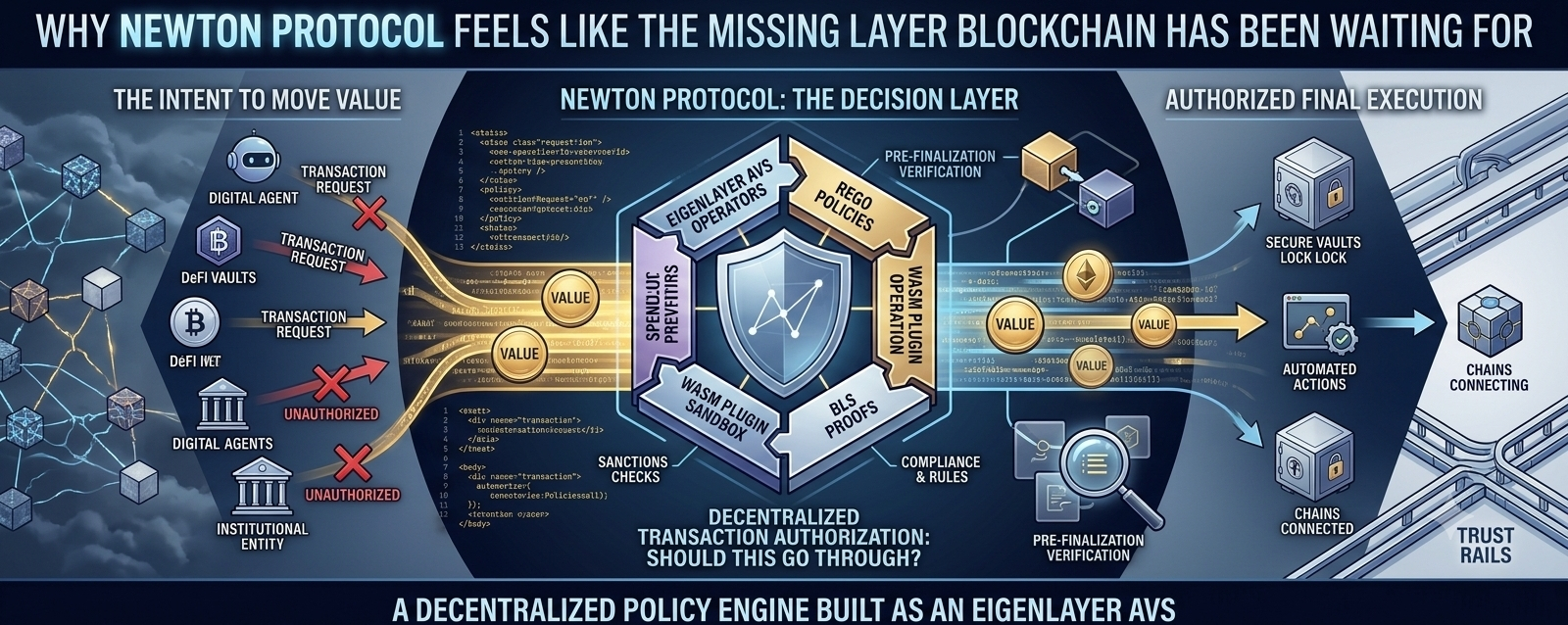
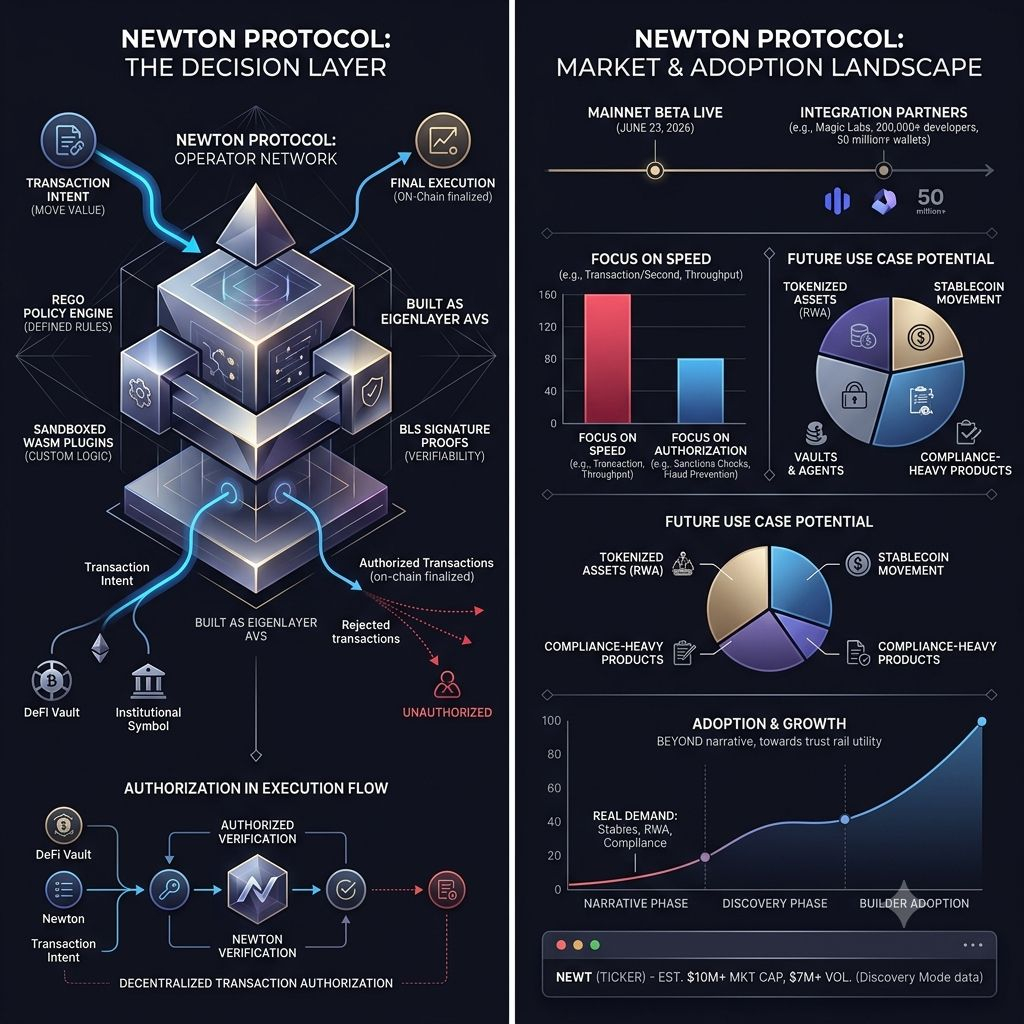
At its core, Newton Protocol is trying to become that layer. In simple terms, it sits between the intent to move value and the final execution of that move, checking whether the request matches the rules that have been set. The official documentation describes it as a decentralized policy engine for onchain transaction authorization, built as an EigenLayer AVS, with support for things like spending limits, sanctions checks, and fraud prevention. The whitepaper goes deeper and explains that applications send transaction intents into a decentralized operator network, which evaluates them against Rego policies and uses sandboxed WASM plugins along with BLS signatures to prove the outcome. That sounds technical, but the idea itself is easy to understand: before money moves, policy gets a say.
That matters because a lot of blockchain systems still rely on controls that are too weak, too late, or too easy to bypass. A front-end check can be skipped. Offchain monitoring can only react after something has already happened. Smart contracts are powerful, but they are not always the best place to handle evolving policy logic. Newton is trying to solve that gap by making authorization part of the execution flow itself instead of something attached afterward. That is a meaningful shift, especially if the future of crypto includes vaults, agents, institutions, payment systems, and automated financial products that need rules to change over time without rebuilding everything from scratch.
The timing also helps explain why people are suddenly paying attention. Newton’s mainnet beta went live on June 23, 2026, and the project said it launched on Base and Ethereum with an early focus on DeFi vaults. Around the same period, Magic Labs highlighted the integration to more than 200,000 developers and 50 million wallets, which gives Newton a real distribution angle instead of just a whitepaper story. That kind of reach matters because infrastructure only becomes important when builders actually start using it. A clever concept is nice, but adoption is what turns a concept into a market category.
What makes Newton feel different from a lot of other new crypto projects is that it is not trying to sell itself as just another token or just another DeFi play. It feels more like a trust rail. That is a much bigger idea. For years, the market has rewarded projects that reduce friction in execution, lower costs, or increase throughput. Those things matter, but they are only one part of the picture. As more real-world assets, stablecoins, automated strategies, and onchain agents enter the space, the question becomes how to give them permissioned flexibility without locking everything into rigid, hard-coded rules. Newton’s pitch is that policy itself should become programmable, modular, verifiable, and adjustable. If that idea catches on, it could become one of the more durable infrastructure themes in the market.
There is also a practical side to this story that makes it easier to take seriously. Newton is being framed around the places where real demand actually lives, such as stablecoin movement, tokenized assets, and compliance costs. Those are not flashy topics, but they are exactly the kind of problems that become more important as blockchain matures. If onchain finance keeps growing, then the need for smarter authorization should grow with it. That is why Newton does not feel like a random narrative invented for attention. It feels tied to a genuine shift in how people may want to use blockchain in the real world.
The token itself still looks early enough that the market has not fully decided what to do with it. CoinMarketCap has shown NEWT around the five-cent range with relatively modest volume and a small market cap, while CoinGecko’s historical data around June 30, 2026 points to a market cap a little above ten million dollars and daily volume in the mid-seven-million range. That usually suggests a project is still in discovery mode rather than already fully crowded. In other words, people are aware of it, but it has not yet reached the point where everyone feels they have already missed it. That is often where the most volatile and interesting phase begins, because narratives can still push price hard in either direction.
My view is that Newton works best as a narrative trade with a real utility backbone. It has a fresh catalyst, a clearly defined category, and enough distribution potential to matter. At the same time, the thesis is not just marketing language. There is a genuine product problem here, and it becomes more relevant as crypto gets more serious. If the market starts treating authorization layers the way it once treated modular infrastructure or AI-agent rails, then Newton could have room to rerate in waves. But that kind of move usually needs confirmation. Strong volume, steady price behavior, and continued builder adoption matter more than hype alone.
The biggest risk is adoption. A good idea can still fail if developers do not integrate it into real products. There is also execution risk around cross-chain support, user experience, and whether teams are willing to adopt policy-based systems instead of custom solutions built in-house. Regulatory complexity adds another layer, because Newton’s value proposition is tied to compliance, and compliance is never the same across every jurisdiction. That means the product has to stay flexible without becoming so complicated or centralized that builders lose interest. Like any early-stage token, NEWT can also remain highly volatile even if the broader thesis is strong.
Still, the larger point is hard to ignore. The next important blockchain primitive may not be faster execution. It may be smarter permissioning. That is the kind of infrastructure problem that becomes more valuable as the ecosystem matures, not less. Newton Protocol is trying to sit right at that intersection, where automation meets policy and where onchain systems need a reliable way to decide what should happen before value actually moves. That is a harder problem than speed, but in the long run it may be the more important one.