
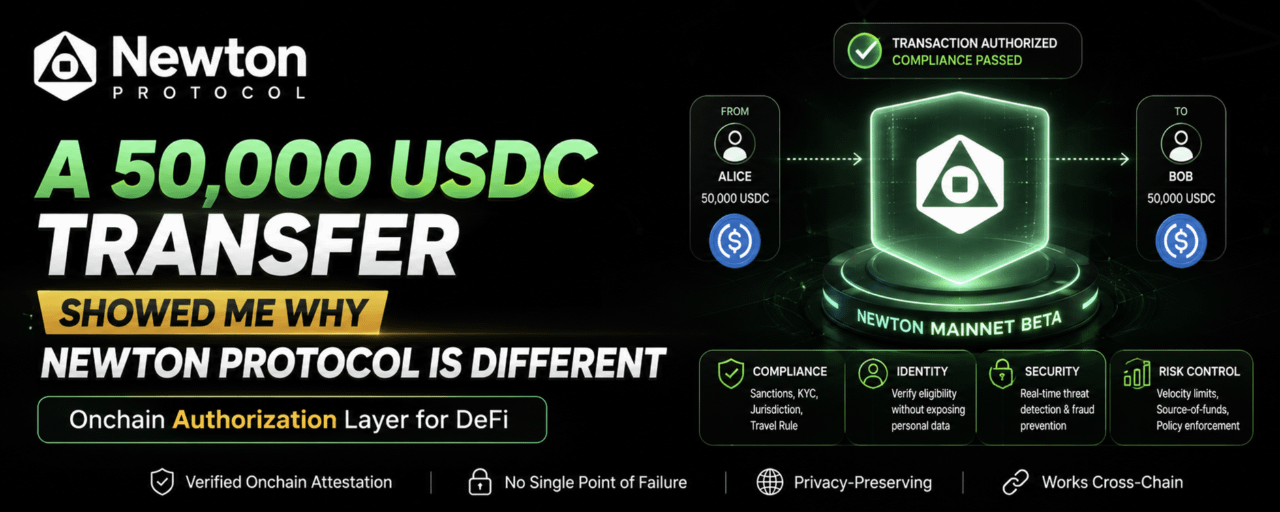

At 11 AM this morning, I opened my MacBook Pro M5 and revisited the @NewtonProtocol whitepaper. One particular scenario really stood out to me because it demonstrates how the project addresses one of the biggest challenges in the stablecoin industry: compliance.
My friend Alex works with a stablecoin issuer that needs to process a transfer of 50,000 USDC from Alice to Bob. This is far more than a simple transaction. The issuer must ensure that the recipient is not on any sanctions list, both parties belong to approved jurisdictions, the transaction does not exceed daily velocity limits, and all source-of-funds and Travel Rule requirements are satisfied.
In traditional systems, most of these checks happen through centralized infrastructure or off-chain APIs. Smart contracts have little ability to verify whether the required rules were actually enforced—they only see that the transaction has already happened.
This is exactly the gap Newton Mainnet Beta is designed to solve.
Instead of reviewing transactions after funds move, Newton acts as an authorization layer before settlement. Every transaction is evaluated against a predefined set of policies. Only when all policies pass does the transaction proceed and receive an on-chain attestation that can be independently verified.
What impressed me even more is the technology stack powering this process.
The first key innovation is Newton's Decentralized Operator Network combined with EigenLayer Restaking and BLS Aggregate Signatures.
Rather than relying on a single server, multiple independent operators evaluate policies simultaneously. Each operator generates a BLS signature, and an aggregator combines them into a compact aggregate signature representing stake-weighted quorum consensus. A smart contract only needs to verify a single signature to confirm network agreement.
This transforms authorization from a simple "Pass" or "Fail" API response into a verifiable attestation that smart contracts can directly enforce on-chain. Gateway rotation using VRF-based leader selection and a force-inclusion mechanism further reduces censorship risks and eliminates single points of failure.
The second major innovation is Programmable Policy Evaluation.
Newton uses Rego, the policy language behind Open Policy Agent, which is already widely adopted in enterprise environments. Developers can create modular policies covering sanctions screening, KYC, velocity limits, source-of-funds verification, and more.
Newton extends Rego with cryptographic built-ins such as ECDSA recovery, multi-signature validation, and cross-chain signature verification. Policies are content-addressed on IPFS through CIDs, ensuring every operator evaluates the exact same rule set. The result is deterministic, transparent, and fully auditable policy execution.
A Streaming Two-Phase Consensus model enables operators to fetch real-time data such as sanctions lists and oracle prices during the Prepare phase before executing policy evaluation in the Evaluate phase.
The third breakthrough is Privacy-Preserving Identity.
This is particularly important as institutional adoption of DeFi continues to grow.
Newton leverages the W3C Verifiable Credentials framework using an Issuer–Holder–Verifier architecture. Users can prove they belong to an approved jurisdiction or satisfy eligibility requirements without revealing unnecessary personal information.
Sensitive data is protected using HPKE encryption and threshold decryption, with a roadmap toward MPC and eventually Fully Homomorphic Encryption (FHE). TEE enclaves perform secure verification while the blockchain only receives proofs and attestations rather than personally identifiable information.
This allows credentials to remain portable across applications and blockchains while preserving user privacy.
According to the whitepaper, the stablecoin market has surpassed $298 billion in market capitalization, with monthly transfer volume exceeding $700 billion in 2026. As the industry scales, smart contracts alone are no longer enough. What the market increasingly needs is an authorization layer capable of enforcing compliance, identity, security, and risk controls before assets move.
In my view, this is where Newton Protocol stands apart. Rather than merely recording what happened, Newton creates an infrastructure layer that verifies and enforces policies before transactions settle. It brings the governance standards of traditional finance to blockchain while maintaining transparency, verifiability, and on-chain execution.
Love Newton Protocol