
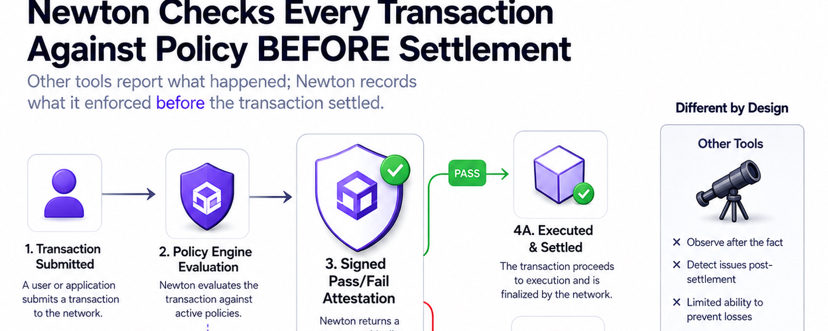
Most blockchain infrastructure assumes the transaction is already valid. The network focuses on ordering, executing, and finalizing it. Questions about whether the action should have happened are often left to applications, monitoring tools, auditors, or investigators after execution.
@NewtonProtocol Newton approaches this sequence differently.
Rather than asking "What happened?" after settlement, Newton asks "Should this transaction be allowed?" before settlement. Its architecture is built around evaluating transactions against predefined active policies and producing a cryptographically signed pass/fail attestation that can be referenced on-chain before execution proceeds. The important distinction is that enforcement becomes part of the transaction flow instead of becoming an external review process afterward.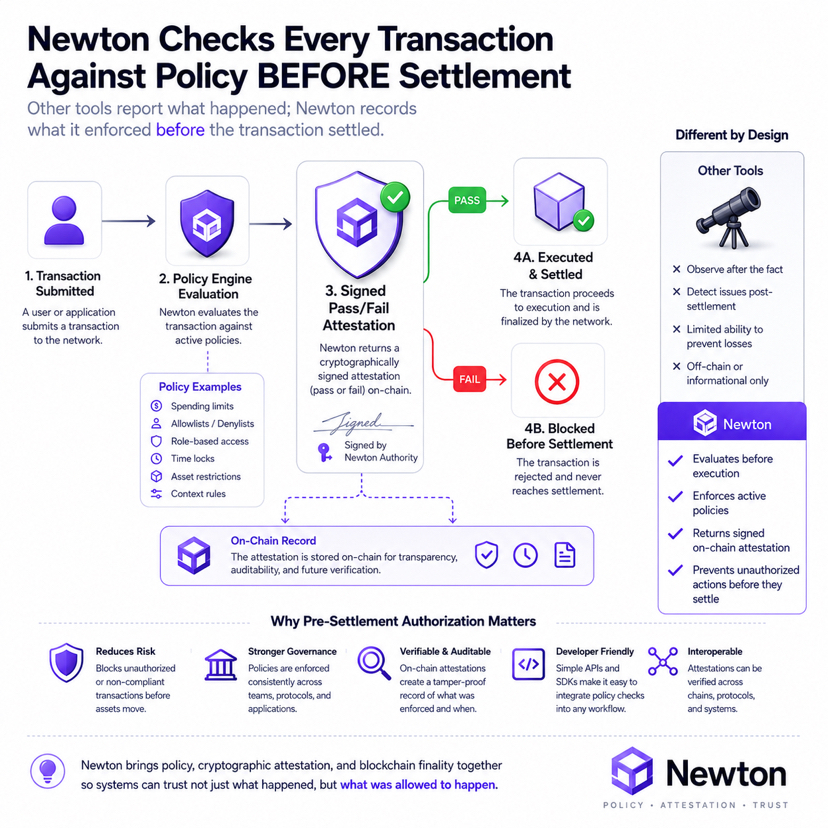
This design reflects a broader shift in blockchain infrastructure. As decentralized systems move beyond simple token transfers toward automated treasury management, AI agents, institutional operations, and programmable organizations, mistakes become increasingly expensive. In many cases, detecting an unauthorized action after execution offers limited practical value because the assets have already moved.
Newton attempts to move part of that decision-making process earlier.
At the architectural level, policies become programmable conditions rather than informal operating procedures. Instead of relying entirely on human operators or application-specific permission systems, transactions can be evaluated against predefined authorization rules before settlement. The resulting attestation provides verifiable evidence that the policy engine evaluated the request under the configured rules at that moment.
This should not be confused with replacing blockchain consensus.
Consensus still determines whether a transaction becomes part of the ledger. Newton instead introduces an additional authorization layer that operates before settlement. These are fundamentally different responsibilities: one determines canonical state, while the other determines whether a requested action satisfies organizational policy.
That distinction also changes incentives.
Traditional monitoring systems encourage rapid detection and response after an event occurs. Newton encourages participants to design clearer governance rules in advance because those rules influence whether transactions are approved at all. Whether this ultimately reduces operational complexity remains an open question. In some environments it may reduce downstream incidents. In others it may simply relocate complexity from incident response to policy design and maintenance.
The developer experience also introduces new considerations. Writing smart contracts is already difficult; writing secure authorization policies adds another layer of engineering responsibility. Policy conflicts, upgrade procedures, exception handling, and governance processes become critical operational concerns. Strong tooling, testing frameworks, and auditability may ultimately matter as much as the authorization engine itself.$NEWT
Security assumptions deserve equal attention. Newton's guarantees depend not only on blockchain security but also on the correctness of policy definitions, implementation quality, signer integrity, and governance controls surrounding policy updates. Poorly designed rules can authorize undesirable behavior just as effectively as well-designed rules can prevent it. In other words, programmable enforcement cannot compensate for poorly specified intent.
Interoperability may become one of the more interesting areas to watch. If signed authorization attestations become broadly understandable across applications and execution environments, they could eventually reduce duplicated compliance logic between protocols. However, widespread adoption would likely require common standards, consistent verification methods, and ecosystem acceptance—questions that remain unresolved.
Perhaps the most useful way to evaluate Newton is not by asking whether it makes blockchains faster.
A better question is whether pre-settlement authorization becomes a standard expectation for increasingly autonomous digital systems. If future blockchain applications routinely require verifiable evidence that predefined policies were satisfied before execution, Newton's model could represent an early example of a larger architectural direction rather than a standalone feature.
Whether that direction becomes widely adopted will depend less on technical novelty and more on whether developers find that enforcing policy before settlement creates systems that are easier to trust, operate, and govern over the long term.#Newt