
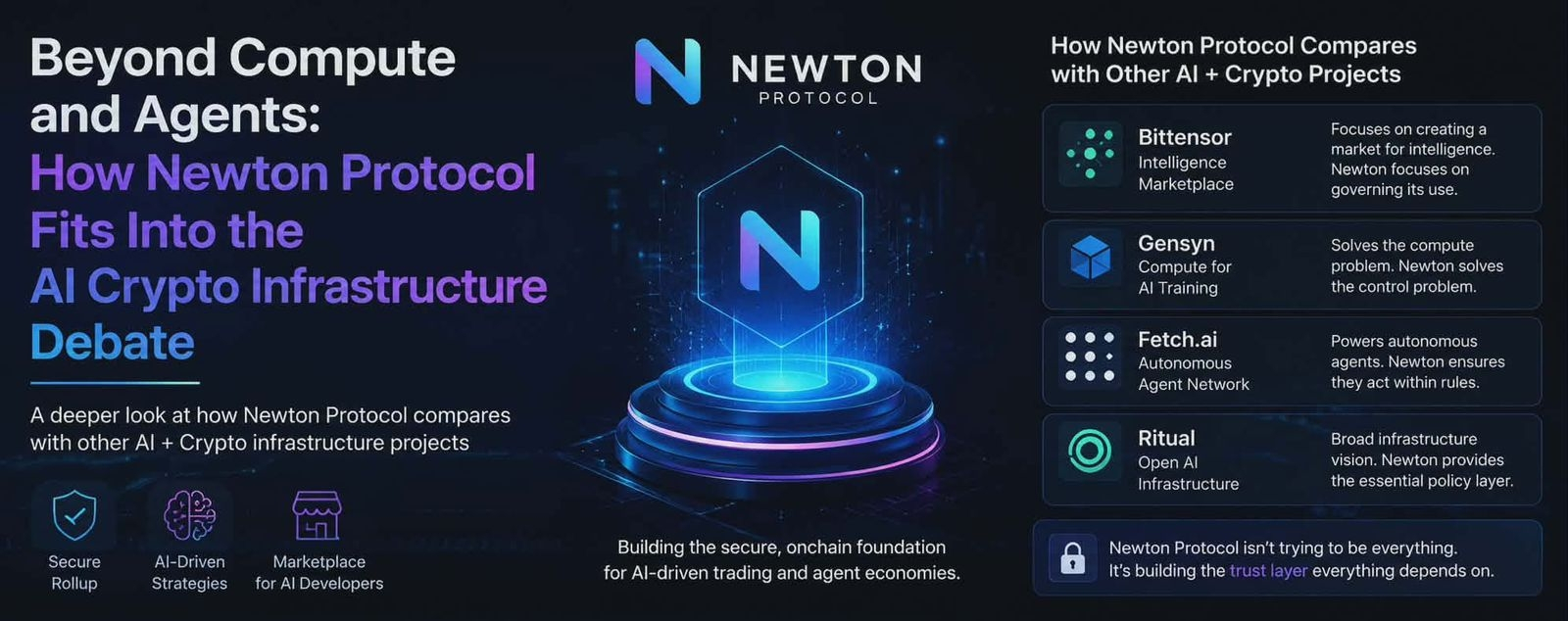
I’ve watched crypto long enough to know when a story is trying too hard. The language gets cleaner, the promises get bigger, and somehow every new project is supposed to be the one that finally makes the whole messy thing make sense. Most of the time, it does not. Most of the time, it is just another version of the same old rush to turn a complicated problem into a clean narrative.
That is why Newton Protocol caught my attention in a quieter way. Not because it sounds like the future, but because it does not feel like it is trying to scream one at me. A lot of the AI + crypto projects in this market are busy talking about intelligence, automation, decentralized compute, agent economies, and all the other words that sound strong in a pitch deck. Newton feels a little different. It seems more interested in the part people usually gloss over, which is what happens when AI systems are actually allowed to touch money.
That part matters more than people like to admit.
I keep noticing that the projects which look the flashiest are often the ones with the hardest time surviving contact with reality. Compute is easy to explain. Markets are easy to hype. Agents are easy to imagine. But once you get into permissions, policy, execution, and the mess of deciding what a machine is allowed to do before it moves funds, the story gets less exciting and much more real. Newton sits closer to that reality. At least that is how I read it.
What makes it stand out, to me, is that it feels more like a control layer than a grand invention. I’m not saying that makes it automatically better. I’m saying it makes it feel more grounded. There is a difference. A lot of projects in this space want to become the engine, the market, the layer, the standard, and the future all at once. That usually makes me nervous. I’ve seen this before. When a project wants to be everything, it often ends up becoming too abstract to matter.
Newton does not seem as interested in that kind of all-in ambition. It feels narrower. Sharper, maybe. It looks more focused on making sure onchain AI-driven activity can be governed properly, which is not the kind of thing that gets people excited in the same way as decentralized AI compute or autonomous agents, but it is the kind of thing that starts to matter once real value is involved.
That is where I start comparing it with the usual names people bring up in this corner of crypto.
Bittensor is a good example of the opposite instinct. It is much more about building a market around intelligence itself. The whole thing has that big, sprawling energy that crypto likes so much. I get why people are drawn to it. It feels like a category with ambition. But I also know how often those big category plays end up relying more on the idea than on the actual day-to-day usefulness. When a project starts talking like intelligence is a commodity that can be neatly priced and routed through a token system, I stop believing the easy version of the story.
Gensyn and io.net are different again. They are much more clearly on the infrastructure side, the compute side, the part of the stack that has to do with resources, training, verification, and access to actual machine power. That is a real need, and I do not think it is fake just because the market has overused the word “decentralized.” But it is still a different problem from what Newton is trying to do. Those projects are mostly about supply. Newton feels more like it is about permission.
And honestly, permission is usually the harder problem.
That is something I keep coming back to. Crypto has always loved the idea that the biggest problem is access to hardware, or liquidity, or coordination. And sure, those are hard. But the moment an AI system starts doing something with actual financial consequences, the question changes. It stops being “Can the system run?” and becomes “Should it be allowed to run this way?” That is a much uglier question. It is less fun. It is less marketable. It is also the question that matters more when the system is real.
Fetch.ai and Olas sit closer to the agent story. They are both leaning into the idea that software can act more like a participant than a tool, that agents can search, coordinate, trade, and operate with some level of autonomy. I understand the appeal. I really do. The whole agent narrative has that magnetic pull because it makes the future feel close. But I also think the word “agent” has become a little too easy to say and a little too hard to pin down. It gets used for everything. Sometimes that makes it meaningful. Sometimes it just makes it convenient.
Newton does not seem as interested in selling me on autonomous everything. It seems more interested in putting a leash, a boundary, or maybe just a set of rules around what those autonomous systems can actually do. That sounds less sexy, but I think that is exactly why it has some weight.
Ritual is another project that feels serious in a different way. It is broader, more ambitious in scope, and more willing to talk about the infrastructure around open AI, verification, privacy, and coordination. That kind of project usually draws attention because it feels like it could become a whole ecosystem. And maybe it could. But I’ve seen enough of these ecosystem dreams to know they can also become too large to test properly. The bigger the promise, the easier it is to keep living inside the promise instead of proving the thing in the wild.
Newton feels smaller than that. Maybe that is a weakness. Maybe it is a strength. I lean toward the second one, at least for now. Small things can sometimes survive because they stay close to a real need instead of chasing a full mythology. There is something almost refreshing about a project that seems to understand its place in the stack. Not the hero of the story. Not the whole story. Just the part that makes the whole thing less likely to fall apart.
That is the part I respect, even if I do not fully trust it yet.
Because I don’t. I’ve seen too many projects that made sense on paper and still went nowhere. In crypto, being conceptually right is not enough. A project can have a clean idea and still fail because the integrations are clunky, the incentives are off, the users do not care, or the market moves on before the thing has time to breathe. That has happened over and over. It is one of the few things in this industry I would almost call a law.
So when I look at Newton beside the other AI + crypto infrastructure projects, I do not see something trying to win by being the loudest or the broadest. I see something that might actually be trying to solve one of the messiest parts of the problem. The part where AI meets money and suddenly all the elegant theory becomes operational friction. The part where you need policy, not just performance. The part where the system has to know when to say no.
That is not a thrilling pitch. It is not the kind of thing people usually celebrate right away. But I have come to trust the less thrilling things a little more than the ones that arrive with too much confidence. The market has trained me that way.
And maybe that is why Newton stays interesting to me. It does not feel like it is trying to be the future in one giant motion. It feels like it is trying to make one very specific part of the future less stupid. That might not sound like much. In crypto, though, that is often where the real difference starts.
