
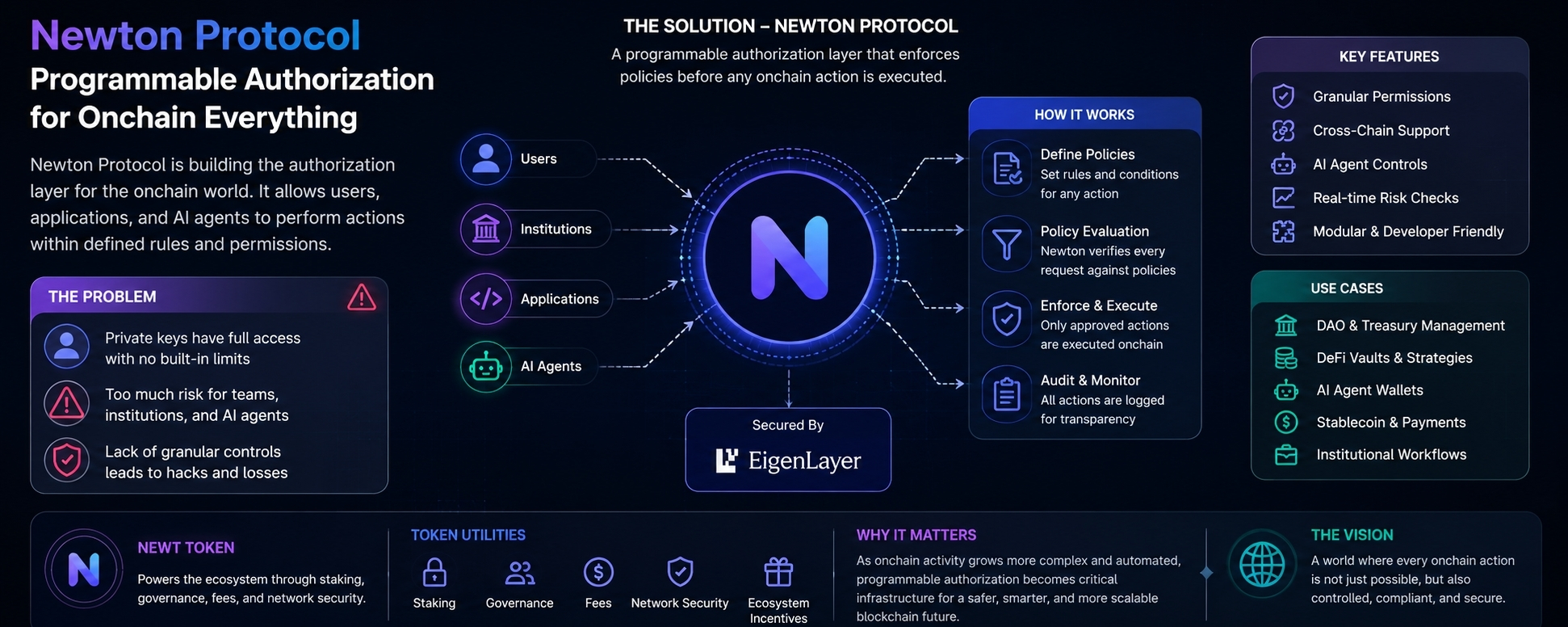
I’ve been looking into Newton Protocol for a while now, and the more I study it, the less I see it as another crypto project trying to benefit from the AI narrative. What keeps my attention is the problem Newton Protocol is trying to solve beneath the surface. Crypto has made it easy to move money, trade assets, and interact with applications without asking anyone for permission. But it still has a weak answer to a harder question: how do we control those actions once wallets, teams, institutions, and automated agents are involved?
I’ve seen too many situations in crypto where one signature carries far too much responsibility. A wallet owner can approve the wrong transaction, a team member can have more access than they should, or an automated strategy can keep operating even when conditions change. In the early days, that kind of risk was almost accepted as part of the culture. People valued speed and freedom more than structure. But as more serious capital enters the space, I think that mindset will have to change.
That is where Newton Protocol starts to become interesting to me. It is focused on programmable authorization, which sounds technical at first, but the idea is simple. Instead of giving a wallet or an application unlimited permission, users can create rules around what actions are allowed. Maybe an agent can only spend a certain amount. Maybe a treasury transaction needs approval from multiple people. Maybe funds can only move to approved addresses. Maybe an automated strategy should stop if market conditions become too risky.
The reason I think this matters is because crypto is slowly moving away from simple individual transactions. We are seeing more automated vaults, AI agents, treasury systems, stablecoin products, cross-chain tools, and institutional platforms. The more automated these systems become, the more dangerous it is to rely on unrestricted wallet permissions. A system that can act on its own needs boundaries. Without them, automation becomes less like efficiency and more like a risk waiting to happen.
I’m looking at Newton Protocol as a project that could sit in the background of this future. It may not be the type of protocol that users think about every day, but that does not mean it lacks value. Some of the most important infrastructure in crypto is invisible. People do not think about the security layer, the settlement layer, or the data layer every time they make a transaction. They only notice those things when something fails. If Newton Protocol can become a reliable permission layer for onchain activity, it could eventually become one of those quiet but necessary pieces of infrastructure.
Of course, that is easier to say than to build. There are already multisignature wallets, custodians, account abstraction systems, compliance tools, and various forms of transaction monitoring. Newton Protocol is not entering an empty market. It has to prove that its approach is flexible enough to work across different blockchains and applications, while still being simple enough for developers to use. If the system feels too complicated, many projects may prefer to build their own internal controls or use existing tools.
That is why I care more about developer activity than public excitement. A strong community is useful, but developers are the ones who turn infrastructure into real usage. I want to see whether builders actually use Newton Protocol for things that matter. Are teams using it to manage treasury permissions? Are vaults using it to limit risk? Are AI agents operating with clear rules instead of open-ended access? Are stablecoin platforms using it to create better controls around transfers? These are the kinds of signals that would tell me the project is moving beyond theory.
I’ve learned that crypto projects can look impressive on paper but still struggle to find a real place in the market. The technology may be solid, the team may be capable, and the idea may make sense, but adoption is never automatic. Newton Protocol will need to show that using its system is easier, safer, or more efficient than building custom solutions. The project does not need to win every use case. It just needs to become the obvious choice for certain types of high-risk or automated onchain activity.
The AI angle is also something I am watching carefully. There is clearly a lot of interest in AI agents managing tasks, trading assets, and interacting with blockchain applications. But I think the market is still early and often too optimistic about what agents can safely do. An agent that can access a wallet without limits is not really intelligent. It is just powerful. Newton Protocol could become more relevant if it helps create clearer boundaries around what those agents are allowed to do.
For example, an AI agent may be useful for managing yield strategies, moving funds between protocols, paying service providers, or executing routine treasury tasks. But no serious user should want that agent to have unlimited control over a wallet. There should be spending limits, approved destinations, emergency shutdown options, and conditions that prevent reckless behavior. That is the kind of practical use case where Newton Protocol could have real value. Not because it makes AI sound exciting, but because it makes automation safer.
The token side is where I stay more cautious. NEWT may play a role in staking, governance, network security, fees, and ecosystem incentives, but I do not think token utility should be assumed just because those terms appear in a project description. I always look for one thing: does the token become more important as usage grows? If developers, operators, and users genuinely need NEWT to interact with the network, secure it, or access important services, then the token has a stronger foundation. If it mainly exists for trading and rewards, the long-term picture becomes less clear.
I’m also paying attention to how supply enters the market over time. Token unlocks, ecosystem incentives, and staking rewards can all affect price behavior, even when the project itself is making progress. This does not mean Newton Protocol has a bad token structure. It simply means investors need to separate the project’s potential from the token’s market dynamics. A protocol can be useful and still face selling pressure if supply grows faster than demand.
The more important question for me is whether Newton Protocol can create organic demand. That demand would come from real usage, not just speculation. It would come from applications paying to use its services, operators participating in the network, developers building tools around it, and organizations trusting it with important workflows. That is the type of demand that tends to matter more over several years than short-term trading attention.
Security will also be critical. Newton Protocol is dealing with permissions, automation, and transaction rules. That puts it close to the point where mistakes can become expensive. If a policy fails, if an exploit is discovered, or if the system becomes too centralized, the project could lose trust quickly. I would be watching audits, security reviews, validator participation, network design, and how the protocol handles unexpected situations. This is not an area where the market will forgive many mistakes.
I think governance will matter too, especially as the network grows. A protocol that helps define how assets can move cannot rely on vague decision-making. There has to be a clear process for upgrades, emergency actions, security changes, and community involvement. I do not think decentralization should be treated as a marketing word. It should mean that the network can keep functioning even if a few early participants are no longer making every major decision.
Right now, I see Newton Protocol as a project with a serious idea behind it. It is trying to solve a problem that may become much more visible as crypto moves toward automation, institutional adoption, and AI-driven tools. The project is still early, and there are many reasons to stay cautious. Adoption could be slower than expected. Competition could be stronger than expected. The market may decide that existing wallet systems are good enough.
But I keep coming back to the same thought. If crypto is going to become more automated, more widely used, and more connected to real-world financial activity, then permission management will matter more than it does today. Newton Protocol is building around that possibility. What I will continue watching is whether it becomes a tool that people use because they have to, not because they are curious. That difference may decide whether Newton Protocol becomes a meaningful part of crypto infrastructure or simply another project with a good idea.