
The first time my card was declined for “security reasons,” I was annoyed.
I knew it was me.
I knew the purchase was real.
I just wanted the payment to go through.
But later I understood the point:
The system was not trying to explain the problem after the damage.
It was trying to stop the wrong transaction before the money moved.
That is the part of DeFi that still feels unfinished to me.
Onchain finance is transparent after execution.
You can see the transaction.
You can see the address.
You can see the history.
But seeing what happened is not the same as enforcing what should be allowed before it happens.
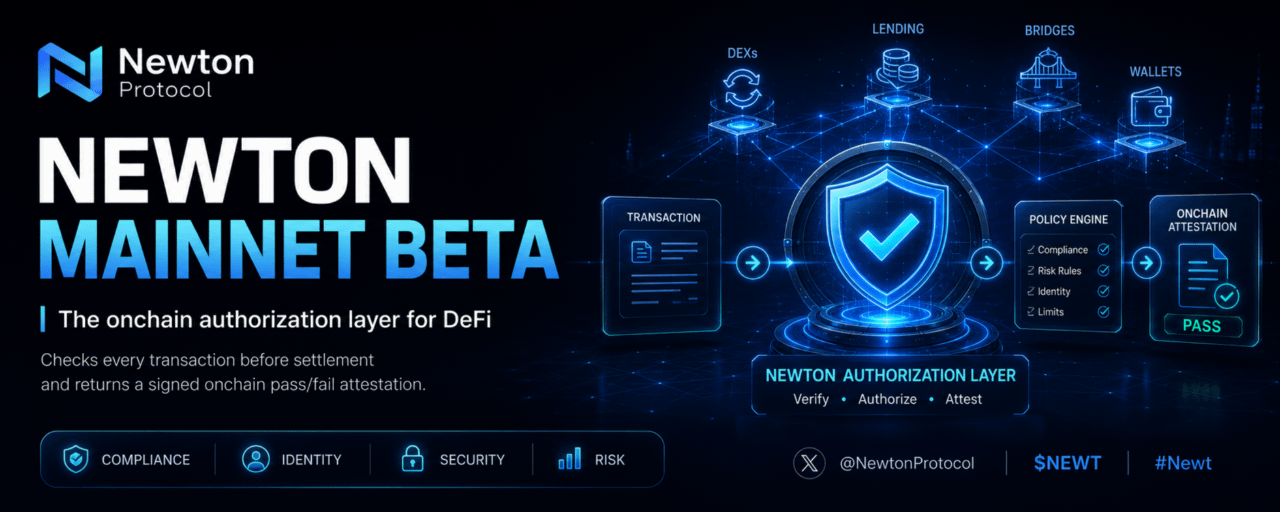
That is why Newton Mainnet Beta is interesting.
@NewtonProtocol is not only trying to report activity.
It is trying to create an authorization layer for onchain transactions.
A policy checks the transaction before settlement.
Then the system returns a signed pass/fail attestation onchain.
That difference matters.
Because vaults, RWAs, stablecoins, and AI agents will not scale on vibes alone.
They need rules.
Who is eligible?
Is the counterparty risky?
Is the oracle healthy?
Is the APY too good to be real?
Is the address allowed?
Is the transaction safe right now?
Those questions should not live only in spreadsheets, dashboards, private risk teams, or fragmented offchain processes.
They should become enforceable infrastructure.
That is the real Newton idea to me:
Crypto does not only need faster money.
It needs smarter permission before money moves.
Visa does this for cards.
#Newt is trying to bring that logic onchain.
And if DeFi wants institutional capital, real vaults, stablecoins, RWAs, and autonomous agents, this kind of authorization layer may become less optional over time.
I am watching $NEWT because the next phase of onchain finance will not just be about execution.
It will be about controlled execution.