
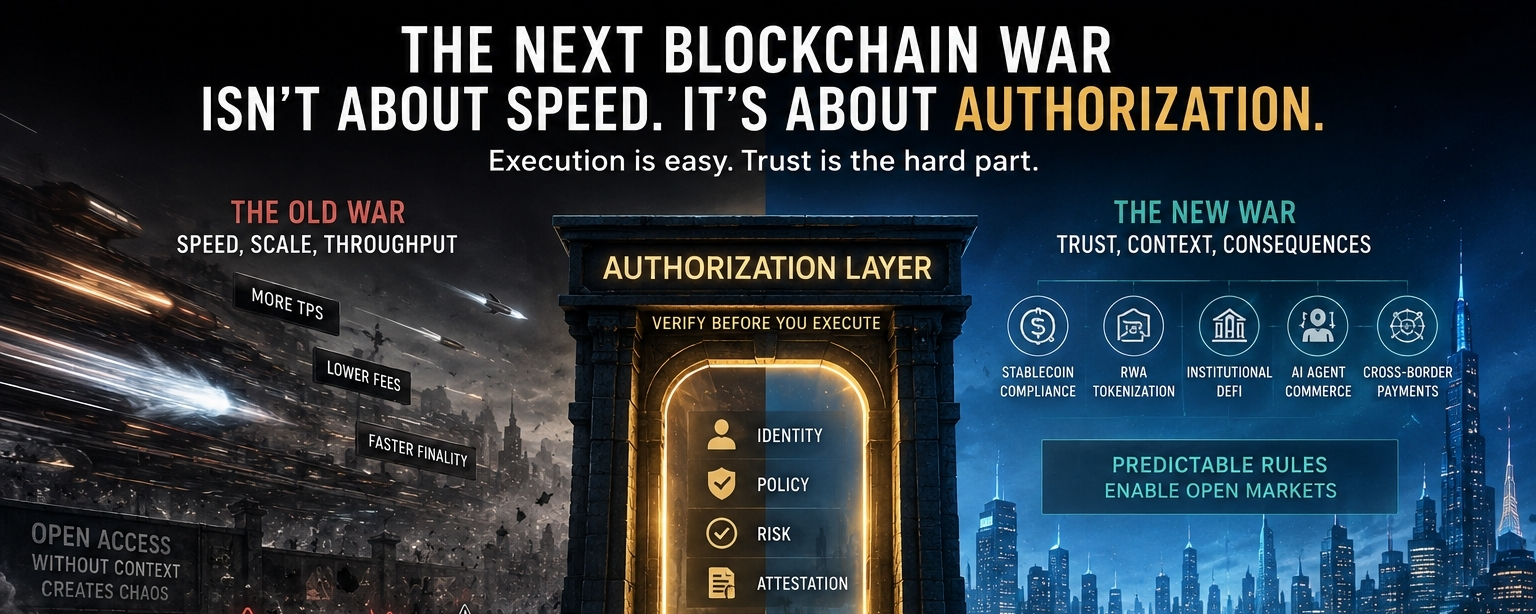
The more I think about it, the less convinced I am that blockchains are still competing on speed. That narrative made sense when the biggest question was how quickly transactions could settle. But lately it feels like settlement has quietly become the easy part. The harder question is something we rarely discuss: who gets to participate, under what conditions, and who gets to decide those conditions in the first place?
For years, crypto treated execution as if it were the only thing that mattered. Faster blocks. Cheaper fees. Better throughput. We assumed open access naturally produced better markets because friction looked like the enemy. But I'm starting to wonder whether removing friction simply moved it somewhere else. It didn't disappear. It shifted into trust, into reputation, into invisible decision-making happening before any transaction is ever signed.
That became more obvious once AI agents entered the conversation. People worry about intelligence, autonomy, or whether agents will outperform humans. I suspect those are secondary questions. The real tension begins when software gains the ability to move capital continuously. Suddenly execution isn't scarce anymore. Attention isn't scarce either. Judgment is.
At first I thought this was just another AI problem. Then I realized it isn't. Institutions entering onchain finance face almost the same uncertainty. They don't struggle because transactions are too slow. They struggle because every action carries hidden assumptions about identity, intent, responsibility, and accountability. Markets don't just move value. They move consequences. Those consequences become difficult to coordinate when nobody shares the same trust framework.
That's where my perspective shifted.
Maybe the next infrastructure race isn't about making transactions happen faster. Maybe it's about making decisions before transactions happen at all. Not centralized permission in the traditional sense, but systems capable of expressing rules without relying entirely on human discretion. That feels like a very different layer of infrastructure, one that sits between intention and execution rather than replacing either.
Projects like Newton Protocol caught my attention because they seem to emerge from this broader change rather than creating it. The interesting part isn't the protocol itself. It's what its existence quietly suggests about where the market is heading. If multiple teams begin treating authorization as infrastructure instead of policy, then crypto's architecture starts resembling something different entirely. Settlement becomes the final chapter, not the opening one.
There's also a subtle behavioral shift hiding underneath all of this. We've spent years celebrating permissionless systems, yet the market increasingly rewards environments where participants can predict outcomes before committing capital. That isn't necessarily a contradiction. Predictability and openness aren't opposites. Sometimes predictable rules are exactly what make open participation possible at scale.
I don't think this means crypto is becoming more centralized. If anything, it raises a more uncomfortable question. Perhaps decentralization was never just about removing intermediaries. Perhaps it was always about distributing the authority to verify decisions instead of concentrating the authority to make them.
If that's true, then the next competitive advantage won't belong to the fastest chain. It will belong to the ecosystem that quietly changes how trust forms before value ever begins to move. And I still can't tell whether that's simply the next stage of crypto, or the moment the entire conversation changes without most of us noticing.