

I’ve become a little numb to crypto narratives.
Every cycle has its favorite words. For a while it was DeFi. Then gaming. Then modular chains. Then restaking. Now it is AI agents.
And honestly, I get it. The idea sounds powerful. Software that can trade, rebalance, manage strategies, move between protocols, and act faster than any human could. It is easy to see why the market pays attention.
But I’ve also seen this market get excited about the wrong part of the story many times.
With Newton Protocol, the obvious angle is AI trading and automated strategies. That is what most people will notice first. A protocol built around AI-driven strategies, secure execution, and a marketplace for developers fits neatly into the current AI crypto conversation.
But that is not the part I find most interesting.
What catches my attention is something quieter.
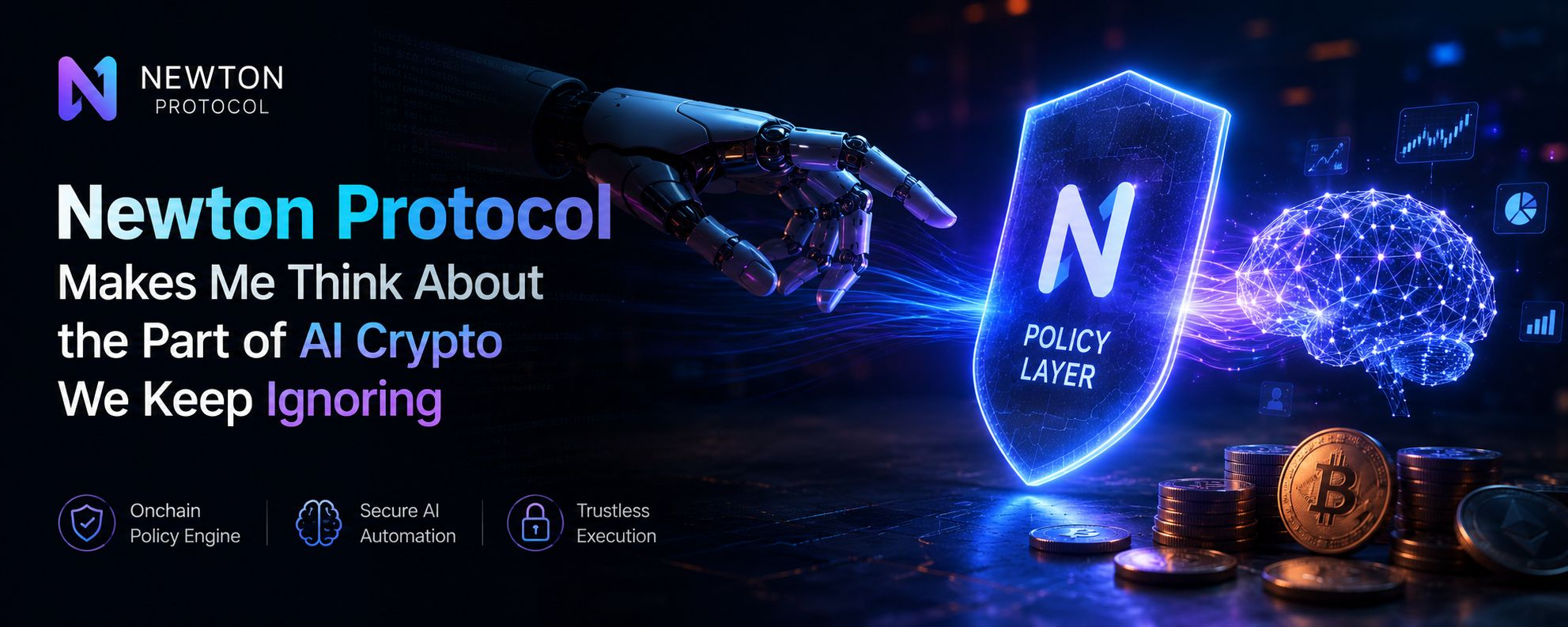
Newton seems to be focused on what AI agents are allowed to do, not just what they are capable of doing.
That matters more than it sounds.
Crypto already has enough tools that let money move quickly. Sometimes too quickly. We have seen wallets drained, vaults mismanaged, bridges exploited, strategies unwind badly, and users approve things they barely understood. A lot of the damage in crypto does not happen because execution is too slow. It happens because execution is too easy.
Now imagine adding AI agents into that environment.
An agent that can trade or manage funds is not just a helpful assistant. It becomes a kind of financial actor. It can make decisions, sign actions, follow strategies, and interact with smart contracts. That may be useful, but it also introduces a simple problem:
Who tells the agent no?
That is the part of Newton I keep coming back to.
The more I look at it, the more I see Newton less as an AI hype project and more as a control layer. A place where actions can be checked before they happen. Spending limits. Approved contracts. Risk rules. Human approval for certain actions. Restrictions around when, where, and how an agent can move funds.
None of that sounds exciting at first.
But after watching crypto for years, I’ve learned that the boring parts often matter the most.
People do not care about guardrails when everything is going up. They care after something breaks. They care after a bad signature, a bad trade, a bad integration, or a bad assumption costs real money. By then, everyone suddenly starts asking why there were not stronger limits in place.
That is why Newton feels worth watching to me.
Not because I think it has already proven everything. It has not.
And not because I think every AI-agent project needs to use it. That would be too easy of a conclusion.
It feels worth watching because it points to a problem the market has not fully priced in yet. If AI agents are going to touch real money onchain, they cannot simply be free to do whatever a model, signal, or strategy suggests. They need boundaries.
I know crypto people do not always like that word. Boundaries sound restrictive. They sound less open, less permissionless, less exciting.
But serious financial systems are built with limits everywhere. Traders have limits. Payment systems have limits. Risk desks have limits. Even experienced humans do not get unlimited freedom with capital.
So why would we give that freedom to software?
That is where I think Newton’s real idea sits.
The future of AI in crypto may not be about the smartest agent. It may be about the safest useful agent. The one that can act, but only inside rules. The one that can move fast, but not blindly. The one that can automate decisions, but still be stopped before doing something reckless.
I’m still skeptical.
I do not think a good idea automatically means a good token. I do not think integrations automatically mean adoption. I do not think “AI infrastructure” should be accepted just because the words sound timely. This market has a long history of turning real technical ideas into short-lived trading stories.
NEWT still has to prove that developers need it, users benefit from it, and the token actually matters inside the system. Those are not small questions.
But I like the direction of the question Newton is asking.
Most AI crypto projects want us to imagine what agents can do.
Newton makes me think about what they should not be able to do.
And honestly, that feels like a more mature conversation.
After enough cycles, I’ve stopped being impressed by projects that only promise more speed, more automation, and more complexity. I pay more attention to projects that reduce the chance of obvious mistakes.
Newton Protocol may not be the final answer. It may just be an early attempt at a problem the market will understand later.
But if AI agents are really going to manage capital onchain, then the biggest opportunity may not be giving them more freedom.
It may be teaching them where the line is.