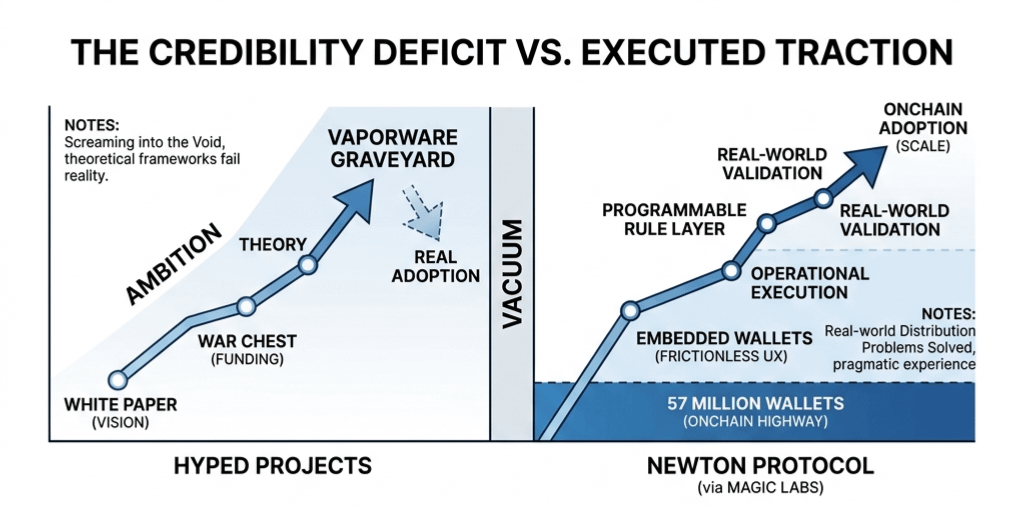
Every time a new crypto infrastructure project lands on my radar, I notice the exact same dance playing out. Some brilliant founders exit stealth with a beautifully polished whitepaper, a massive war chest, and a grand vision of onboarding the next billion users into the digital economy. They promise to solve the thorniest problems in decentralization, yet they spend the next three years screaming into the void, practically begging anyone to actually deploy code on their shiny new network. The brutal truth of this industry is that the vast vacuum between high-minded ambition and genuine user adoption is a graveyard where most of these projects quietly suffocate and disappear. We are drowned in a sea of theoretical frameworks built by people who have never actually had to handle the messy, chaotic reality of a massive, live user base.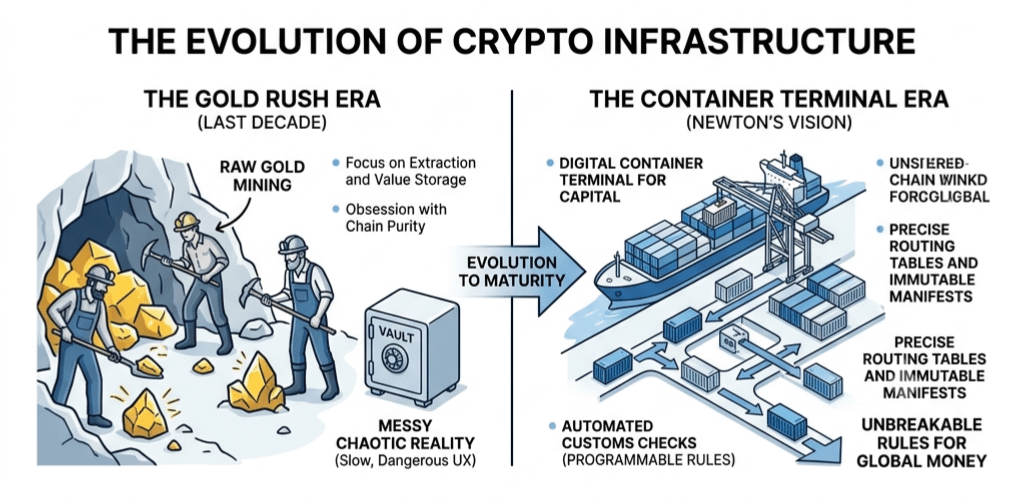
That is why my cynical, battle-hardened tech brain perked up when I looked into Newton. The protocol is taking a radically different path, and it all comes down to who is holding the tools. The core developer behind Newton is Magic Labs, and they did not kick off this journey by daydreaming about hypothetical millions of users. They do not need to imagine what scale looks like because they already built the digital highway that brought over fifty-seven million wallets onchain. If you have spent any time trying to convince a normal human being to set up a self-custody wallet, you know it is usually a masterclass in UX torture. Magic Labs changed the entire narrative by pioneering embedded wallets, essentially stripping away the cognitive friction that kept the masses locked out of the ecosystem. They looked at the old way of doing things, where users had to write down seed phrases on pieces of paper and panic over network configurations, and they replaced it with a seamless experience that normal people could actually navigate.
When a development team has already solved real-world distribution problems at that kind of scale, their entire psychological approach to building infrastructure shifts. They develop a bone-deep, practical understanding of what actually breaks when real retail capital starts sloshing through the pipes. They know the stark difference between a cryptographic protocol that looks bulletproof on an academic paper and a system that actually feels intuitive and safe to a regular person trying to move their hard-earned money. Most importantly, they have spent years in the trenches witnessing exactly how automation and smart contracts fail when there are no clear, programmable rules or real-time enforcement mechanisms to act as guardrails.
This collective scar tissue matters immensely for the specific problem Newton is attempting to solve. The upcoming phase of onchain finance is not going to be about chasing marginal improvements in transactions per second or spinning up yet another yield farming primitive. The real battleground is shifting toward control and sovereignty, specifically defining who gets to decide what happens with capital, under what precise cryptographic conditions those actions can occur, and who guarantees the enforcement of those choices. As we watch massive waves of institutional capital migrate into digital vaults, Real World Assets, and eventually into the hands of autonomous artificial intelligence agents making split-second decisions, the need for an unshakeable, programmable rule layer becomes a matter of survival. Newton is stepping into this gap to build a system designed to verify and enforce these complex, conditional rules before a single transaction can even think about settling on the ledger.
Unlike the endless parade of newer layer twos and modular execution environments that are designing their architecture inside an academic vacuum, Newton is being forged by engineers who understand the messy psychological reality of human behavior at scale. That distinction is not some minor marketing point. It is the absolute difference between writing traffic laws for an empty simulation and designing them with a granular understanding of how millions of real drivers actually behave when they are stressed, greedy, or confused. The typical infrastructure startup is still out here playing the venture capital circuit, desperately trying to convince developers and retail users to download their apps and trust their ecosystem. Magic Labs already did the heavy lifting of making crypto accessible enough for tens of millions of people to take their very first steps onchain.
Now, they are taking all of that hard-earned trust and channeling it into building the definitive guardrails for a far more complex, automated, and institutional paradigm. This is not just a story about a talented engineering team with a good pedigree. It is a story about operational execution. You cannot replicate this specific flavor of institutional credibility by reading whitepapers, studying historical market cycles, or paying millions to Web3 consulting firms. It only comes from the raw experience of building a product that millions of people actively chose to interact with every single day.
In a market entirely saturated with speculative noise and projects that promise to revolutionize the global financial system without a single user to show for it, Newton brings a rare, refreshing flavor of real-world validation. Their track record gives them a unique position in an industry known for vaporware, an authority earned through continuous shipping and verifiable execution rather than just lofty rhetoric. The ultimate survival of the onchain economy will not belong to the loudest visionaries or the most complex cryptographic math puzzles. It will belong to the pragmatists who understand both the bleeding edge of the technology and the actual humans who need to use it. Newton is being built by the very pioneers who proved they master both sides of that coin.
If we step back and look at the macro picture, the evolution of crypto infrastructure feels less like a sudden technological leap and more like the historic transition of global trade. For the last decade, we have been obsessed with building the digital equivalent of raw gold mines, focusing entirely on how much value we can extract from the earth and how fast we can store it in primitive vaults. We argued about the purity of our chains and the abstract security of our consensus mechanisms while the actual experience of moving that value remained slow, dangerous, and confusing for anyone without a technical degree.
What Newton is constructing feels fundamentally different. They are moving us past the gold rush era and designing the digital equivalent of a massive, automated container terminal for global capital. They are creating the precise routing tables, the automated custom checks, and the immutable shipping manifests that allow billions of dollars to move fluidly across borders without the risk of collision or catastrophic theft. It is a vision of the future where the underlying technology fades into the background, becoming as invisible and essential as the electricity powering the grid, while the rules governing our money remain unbreakable.