
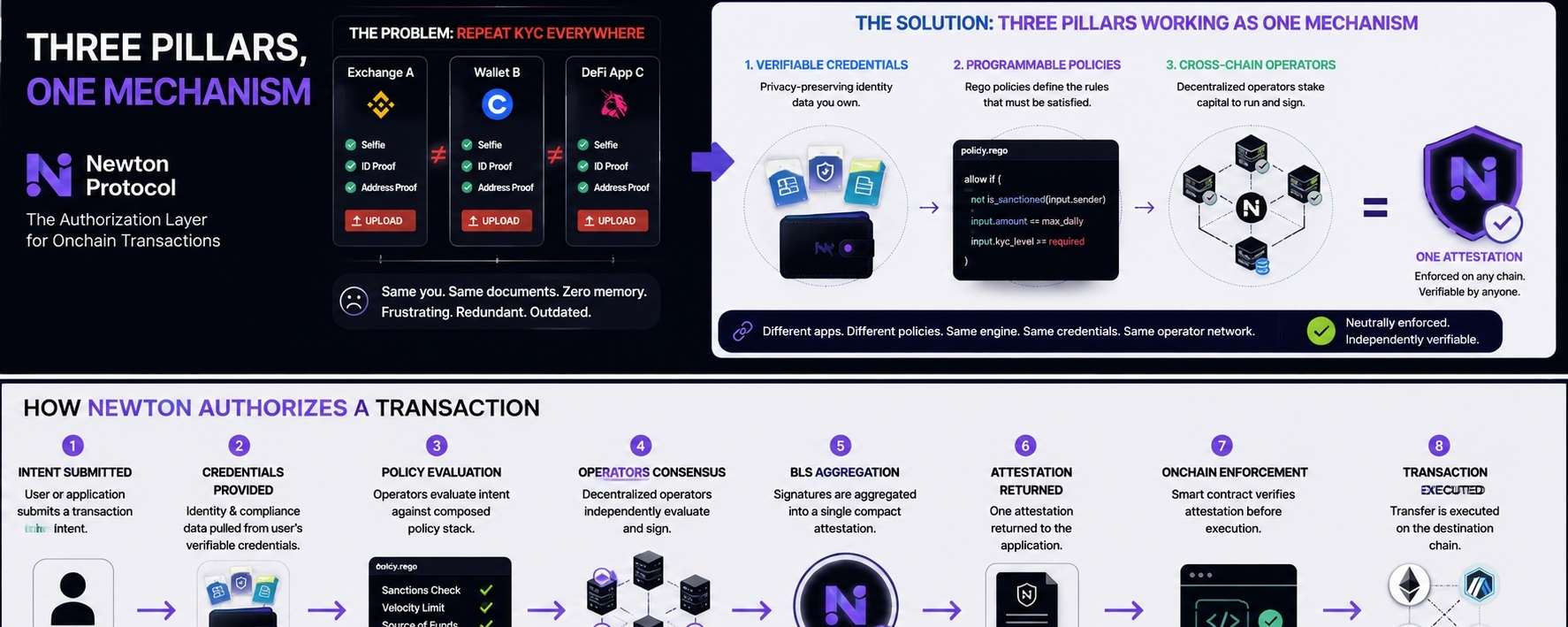

Three different apps asked me for the same KYC documents this month. Same selfie, same ID, same address proof, uploaded three separate times for three platforms that have nothing to do with each other. By the third one I was just annoyed, not because the process is hard, but because none of them remember me from the last one.
That frustration is basically why I kept rereading the "Three Pillars" section of Newton's whitepaper instead of skimming past it like I usually do with architecture sections.
My first read, I treated Verifiable Credentials, programmable policies, and cross-chain operators like three separate features you'd list on a comparison chart. Pick the one you need. Identity verification, that's pillar one. Rule writing, pillar two. Multi-chain support, pillar three. Three checkboxes.
Second read changed that completely.
None of these three actually do anything on their own. A verifiable credential sitting in your wallet proving you're KYC'd and not sanctioned is just data, it doesn't stop a transaction or approve one. It needs something to check it against. A Rego policy that says block sanctioned addresses, cap daily transfers, require accredited status is just a rulebook with nothing to evaluate, it needs identity data feeding into it before it means anything. And operators running consensus across Ethereum and chains like Arbitrum or Base are just validators with no job if there's no policy to evaluate and no credential to verify in the first place.
Pull any one leg out and the other two are dead weight.
The whitepaper's own walkthrough makes this obvious once you actually trace it. A $50k USDC transfer gets submitted, operators don't just check one thing, they pull the sender's jurisdiction and sanctions status from their credentials, run that data through the composed policy stack, sanctions check, velocity limit, source of funds, and only then sign off, BLS-aggregate the signatures, and hand back one attestation the smart contract can verify. That's not three products stacked on top of each other. That's one motion where credentials feed the policy and operators are the ones actually running it, across whichever chain the transaction happens to land on.
There's a neutrality piece that makes this click even harder. A bank running strict accredited-investor checks and a DeFi protocol that barely gates anyone can run on the exact same operator network, same credential system, same policy engine, just configured completely differently. That only works because the three pieces aren't bundled into one fixed product, they're more like three slots that get filled differently depending on who's plugging in. Same engine, different policy plugged in, different credential requirements checked, still one mechanism underneath both.
Where I land now is that the "three pillars" framing undersells it a bit. It's less like three pillars holding up a roof and more like one mechanism with three moving parts, take one out and the other two seize up.
What I'm still not sure about is the portability promise in practice. Verified once, reused everywhere sounds great on a whitepaper page, but getting competing platforms to actually accept someone else's verification instead of running their own is a business problem as much as a technical one. The crypto exchanges I deal with for my KYC headaches each have their own reasons to want my documents in their own system. Whether Newton's neutrality pitch is enough to get them trust a shared credential instead of hoarding their own data, that's the part the architecture diagram can't answer for me.
The real test for NEWT isn't whether the three pillars work together on paper, it's whether enough platforms actually plug into the same operator network instead of each building their own walled version of it.
Anyone else dealt with the repeat-KYC grind across multiple platforms this month? Curious if this kind of shared verification model would actually get adopted or if everyone just keeps hoarding their own user data anyway
