
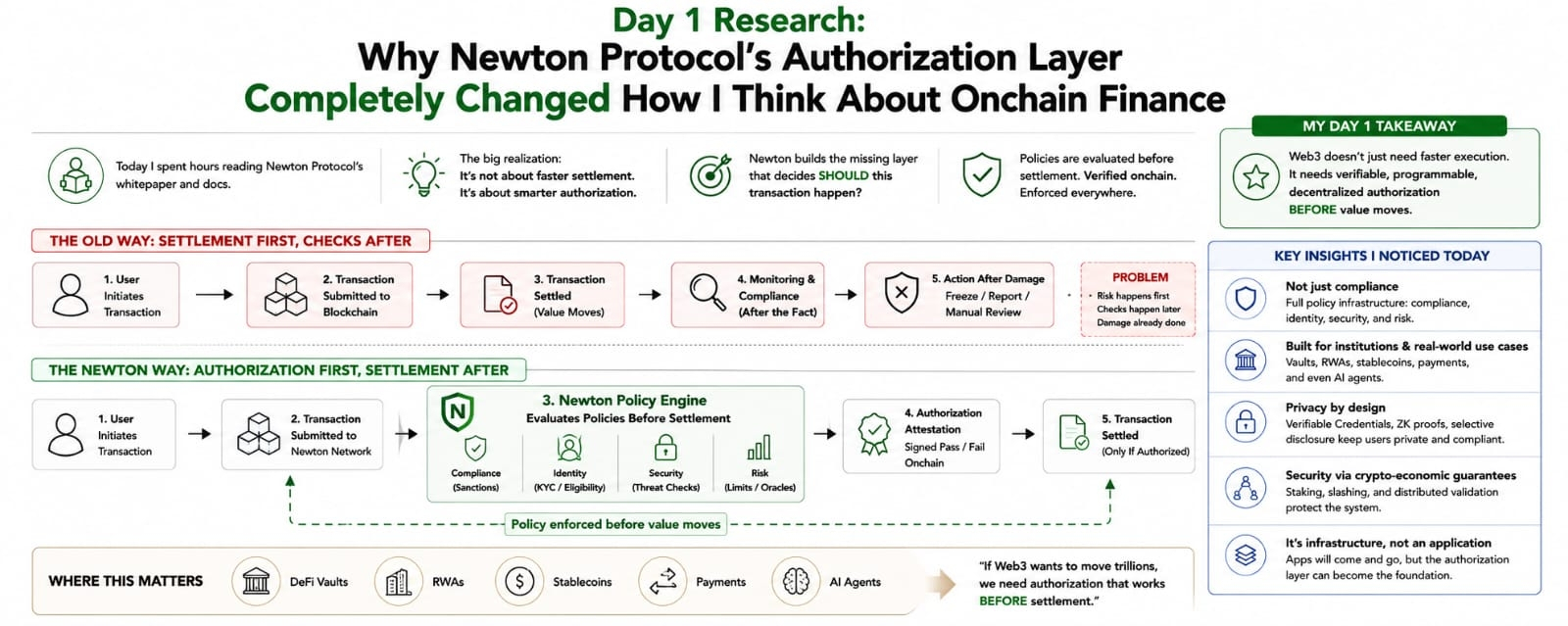

Today I finally sat down and actually read Newton Protocol’s whitepaper and their developer docs.
Honestly, I didn’t expect to find something that would totally change how I see onchain infrastructure. Most of what I come across just piles onto the usual claims faster, cheaper, scales better, handles more transactions per second. You know the routine.
So when I opened Newton’s docs, I had this basic question in my head:
What, if anything, makes Newton stand out structurally from all the noise in Web3 right now?
After going through the whitepaper, one clear idea stuck with me.
Newton isn’t focused on building a better settlement layer. It’s building an authorization layer.
At first, that seemed like a tiny difference. Almost a technical nuance. But the more I thought about it, the bigger that gap became.
Crypto folks have been obsessed with settlement for years. Block times, TPS, how much it costs to transact, and how quickly it all wraps up. Sure, those things matter. But as I started really reading Newton’s architecture, I realized maybe we’ve been paying attention to the wrong end of the process.
A fast transaction isn’t valuable because it settles quickly.
It’s valuable because you can actually trust the decision to settle in the first place.
That flipped my whole perspective.
Here’s the analogy that made it click for me. When I use my debit card, the payment doesn’t just fly through the second I tap. Behind the curtain, a network checks all sorts of stuff
rules, limits, risk, maybe even a bit of compliance before the money can move. Only after that do you get settlement.
Newton’s docs made me realize blockchains do the reverse. Onchain, the transaction just flies through immediately. All the compliance stuff gets tacked on afterward, offchain, in separate services — identity, risk, whatever. Settlement gets celebrated. The decision process is almost ignored.
Newton’s aiming to move those key decisions back to the start, right where they belong — before anything settles.
That right there is the big takeaway from today.
Another part that grabbed me was Newton’s take on policy enforcement.
Instead of watching transactions and hoping they behave, the protocol runs programmable policies upfront. Then it issues a kind of onchain proof an attestation that smart contracts can actually check. So, instead of just trusting some offchain process happened, every app can verify that the right policy got enforced before anything executes.
That’s a much more robust security model. You’re not just hoping every player sticks to the rules you prove it onchain.
As I kept digging, I started linking this to institutional adoption. There’s always this question: big financial firms are interested in DeFi, but they’re still wary, even though there’s plenty of liquidity. Why’s that?
After today, I think the missing piece isn’t money. It’s confidence in operations.
Big organizations run on policy identity checks, compliance, security, risk controls. Right now, those are scattered across different tools and internal checklists.
Newton’s asking: what if those policies lived in code? What if they became programmable infrastructure instead of paperwork and bureaucracy?
Personally, that’s a way more interesting question than just trying to break another TPS record.
This is just Day 1 for me. There’s a ton more to explore stuff like Newton’s privacy design, their developer ecosystem, and how this all hooks into real-world use.
Still, if there’s one big lesson from today, it’s this:
Maybe the real future of onchain finance isn’t about who settles the fastest. Maybe it’s about who can transparently and cryptographically prove why a transaction was allowed in the first place before anything hits the ledger.
That shift in thinking is what set Newton Protocol apart for me.
I’m excited to dig more because, honestly, I think this authorization-first approach could end up being one of the biggest infrastructure changes in Web3.