
I used to measure blockchain networks by three things: speed, liquidity, and security. Those were the visible metrics. Faster settlement meant better infrastructure. Lower fees meant more adoption. Deeper liquidity meant healthier markets. It all felt tangible and easy to compare.
Lately, I've been watching something much harder to measure.
Not the transaction itself. The decision that happens before the transaction ever reaches the chain.
Crypto has become remarkably good at execution. Billions of dollars move every day with minimal human intervention. That's an incredible achievement. But as AI agents begin managing wallets, treasuries become increasingly automated, and institutions explore onchain infrastructure, I keep asking myself whether execution is quietly becoming the easy part. The harder question is whether the transaction should happen in the first place.
That question feels less glamorous. Nobody posts screenshots of successful authorization logic. People celebrate trades, not permissions. Yet most expensive mistakes I've watched over the years weren't caused because a blockchain failed to settle. They happened because someone, or increasingly something, made a bad decision before settlement even started.
I remember following several protocol exploits where everyone focused on the smart contract bug. Fair enough. Those bugs mattered. But after reading through the postmortems, I often found myself asking a different question. Why was that transaction allowed at all? Why did one signature have enough authority to move that much value? Why wasn't there another layer of reasoning before execution?
Those questions stayed with me longer than the exploit itself.
Maybe that's why Newton Protocol caught my attention.
At first glance, it almost sounds like another automation project. Crypto has no shortage of those. Every few months there seems to be another protocol promising smarter agents, autonomous finance, or programmable workflows. After a while they begin sounding interchangeable.
Newton feels slightly different to me, although I'm still cautious about saying that too confidently.
What interests me isn't simply automation. It's the idea that authorization itself becomes programmable infrastructure. Instead of every important decision depending on one wallet approval or one private key, a transaction can be evaluated against predefined policies before it executes. Those policies might include spending limits, approved counterparties, timing restrictions, governance rules, or conditions designed specifically for AI agents.
Execution starts inheriting judgment. I think that's a much bigger shift than it first appears.
Traditional finance has always separated authority from movement. A company accountant doesn't usually have unlimited freedom just because they have access to banking software. Payments pass through internal controls. Investment firms create risk committees. Banks operate under layers of compliance that sometimes frustrate customers, but those layers exist because mistakes become more expensive as organizations grow.
Crypto removed much of that complexity, which was part of its appeal. Now I'm starting to wonder whether we're slowly rebuilding parts of it. Not because decentralization failed. Because automation changes the problem.
There's something slightly ironic about the current conversation around AI agents. People spend enormous amounts of time debating how intelligent they'll become. Far fewer people ask how disciplined they'll remain after thousands or millions of independent decisions. Intelligence without boundaries has never been particularly reassuring. A highly capable trading agent that ignores treasury policy isn't impressive. It's dangerous.
That's where permission quality starts becoming an interesting concept.
I don't mean permission in the old Web2 sense where centralized platforms decide what users are allowed to do. That's a completely different discussion. I'm talking about the quality of the rules governing financial behavior. Not every authorization policy is equally valuable. Some are rushed together. Some are difficult to audit. Others become so complicated that nobody fully understands why they approve one transaction while rejecting another. Eventually people stop trusting the system, even if it technically works.
Good authorization feels different. It becomes predictable without becoming rigid. That's surprisingly difficult to design.
The more I think about it, the more I wonder whether high-quality permission frameworks eventually begin accumulating value the same way audited software libraries or respected security providers already do. Developers rarely enjoy rebuilding infrastructure that somebody else has already proven reliable. If a permission framework consistently protects treasury operations, survives difficult market conditions, adapts to governance changes, and develops a strong operational history, why wouldn't people reuse it?
Maybe that's the overlooked asset. Not the transaction. Not even the smart contract. The decision architecture.
Of course, there are reasons to stay skeptical. One concern I keep returning to is measurement. How exactly do we recognize permission quality? Transaction throughput is easy to compare. Gas costs are public. Validator uptime produces clear statistics. Authorization quality is much less visible because success often looks like nothing happened. A dangerous transaction never executed. An exploit failed before it started. A treasury remained within policy. Those aren't dramatic events. They're invisible ones. Markets don't always price invisible work very well.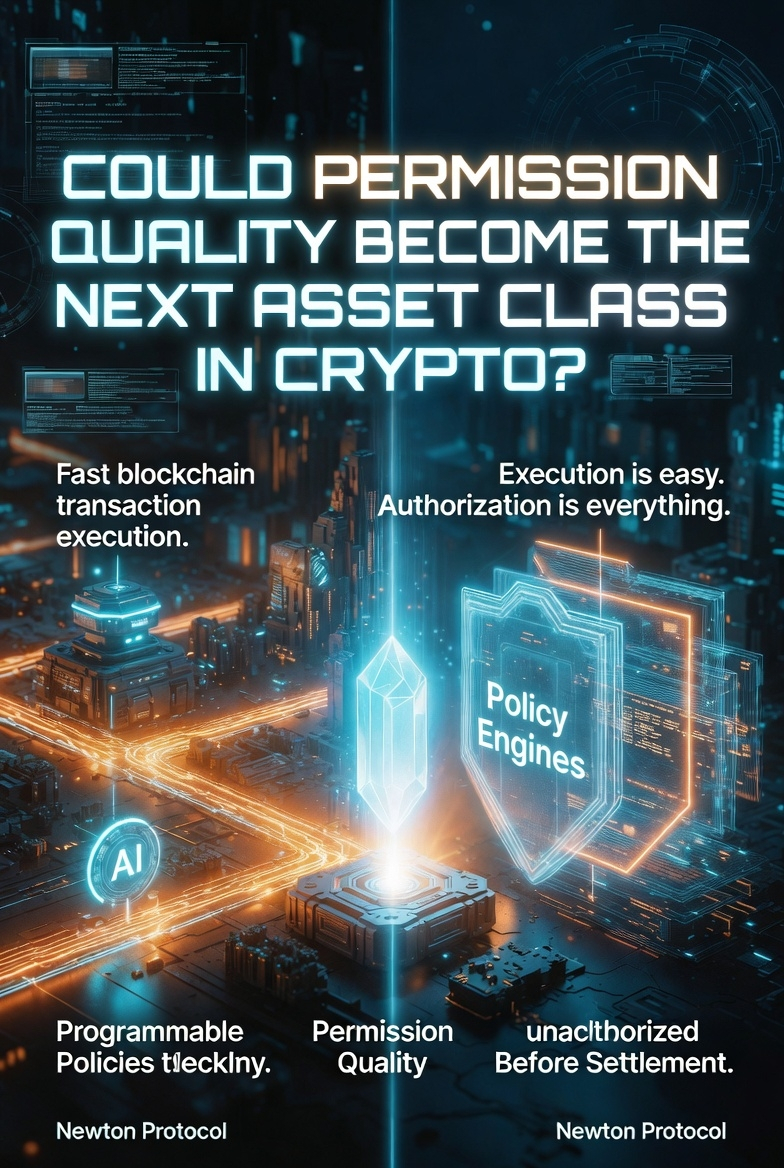
Then there's governance. Rules change. Regulations evolve. Organizations grow. AI systems improve. Any authorization framework that refuses to adapt eventually becomes obsolete, but one that changes too frequently introduces uncertainty of its own. Finding that balance won't be easy.
I also suspect adoption won't happen where many people expect. Retail users probably won't wake up tomorrow demanding programmable permission policies for their wallets. Most people simply want transactions to work. Institutions are different. DAOs managing hundreds of millions of dollars are different. Autonomous financial agents are definitely different. As systems become less dependent on individual humans making every decision manually, confidence shifts away from private keys alone and toward the quality of the rules surrounding those keys.
That's a subtle change, but subtle changes often reshape infrastructure more than dramatic announcements do.
The longer I study projects like Newton, the less convinced I become that the next competition in crypto revolves around processing more transactions every second. We're getting pretty good at that already. Instead, I find myself watching something much quieter. Who designs the rules? Who verifies them? Who keeps improving them? And perhaps most importantly, who earns enough trust that other people stop writing their own and simply build on top of existing permission systems?
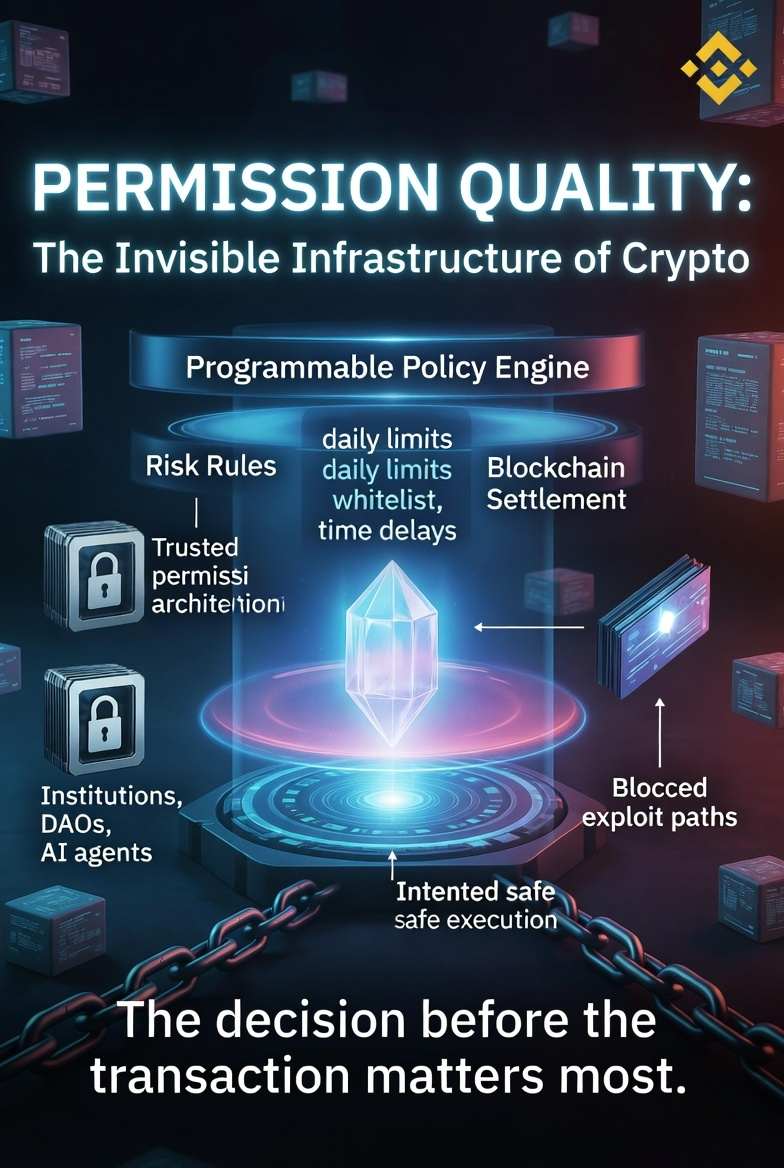
If that starts happening, permission quality stops looking like software. It starts looking like infrastructure. Whether it eventually becomes a genuine asset class is still impossible for me to answer with confidence. Markets have a habit of discovering value only after they've become dependent on it.
Right now, permission still feels like background machinery that most people barely notice.
Then again, that's exactly how every important piece of infrastructure tends to look before everyone realizes they can't operate without it.