
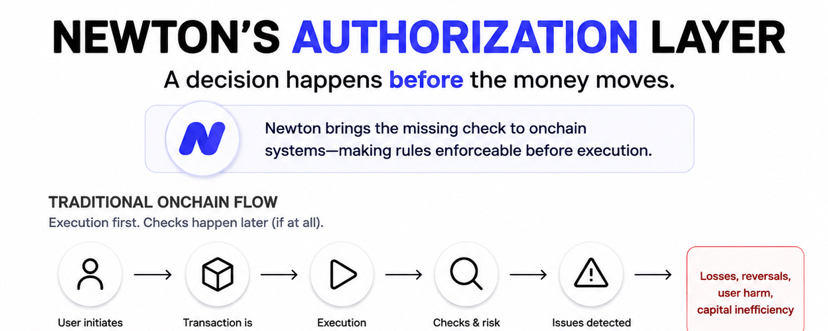
I thought the biggest challenge for onchain systems was making transactions faster. After spending time watching the conversations around the @NewtonProtocol Newton Mainnet Beta, I started noticing a different pattern. People rarely focused on speed alone. More often, the discussion shifted toward what should happen before an action is allowed to happen at all.
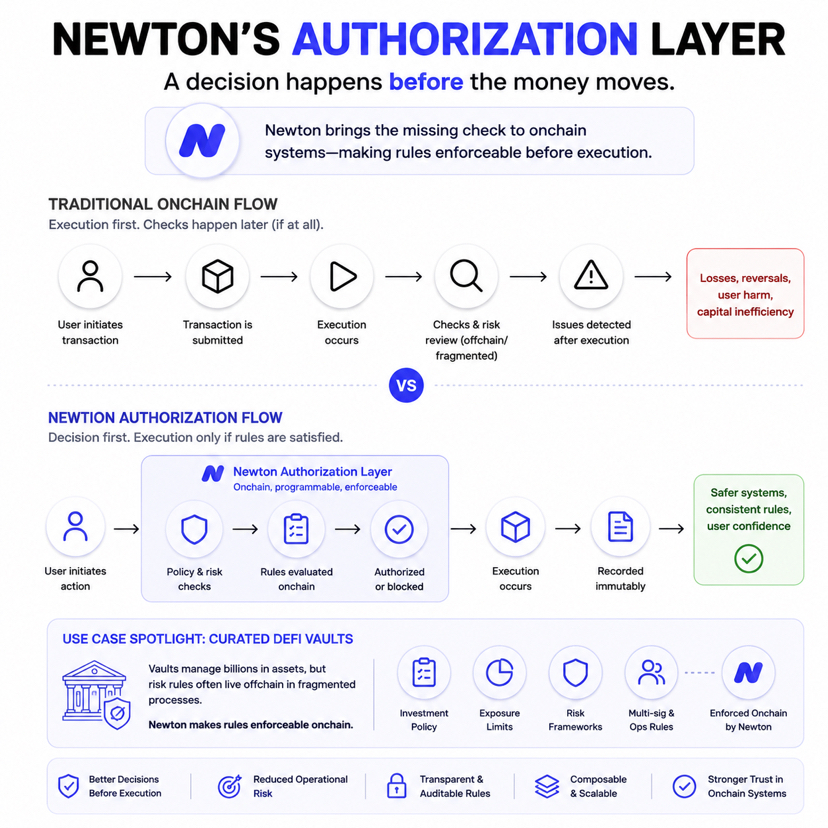 That changed how I looked at the system. The comparison that kept coming back to me was that Newton seems to play a role similar to an authorization layer in traditional payments. The interesting part is not that funds move, but that a decision happens before they move. It feels less like adding another step and more like making an invisible checkpoint visible.
I also found the example of curated DeFi vaults interesting. Many of these vaults manage significant liquidity, yet their risk limits often depend on fragmented, offchain processes. Watching how Newton Protocol approaches making those rules enforceable onchain made me think more about behavior than technology. When participants know that rules are applied consistently, they may spend less effort questioning the process and more effort evaluating the outcome. That shift is subtle, but it changes how attention is distributed.
I occasionally see $NEWT mentioned within these discussions, but usually as part of a broader conversation about system design rather than as the center of attention. That feels more meaningful than constant visibility because it reflects people reacting to observed mechanics instead of narratives.
The question I keep coming back to is whether participants will continue valuing these authorization checks once the Mainnet Beta becomes familiar, or whether convenience eventually becomes the stronger incentive. I'm continuing to watch how participation, confidence, and usage habits evolve over time rather than assuming the first wave of attention tells the whole story. @NewtonProtocol
Paid Partnership