
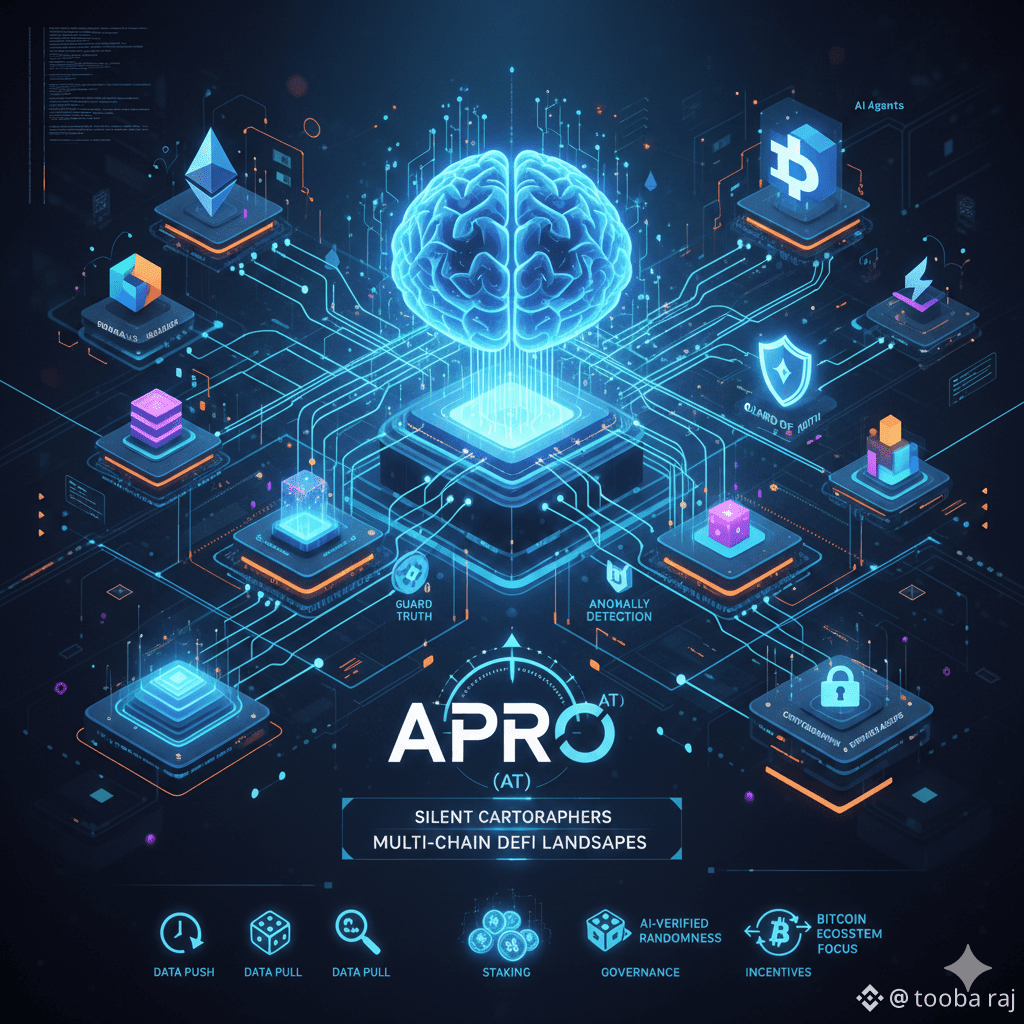
@APRO Oracle :In every financial system, there are actors who draw attention and actors who quietly make everything else possible. In decentralized finance, smart contracts often receive the spotlight—elegant, autonomous, and immutable. Yet beneath them lies a quieter layer that determines whether these contracts act wisely or blindly. Oracles sit there, translating the outside world into on-chain truth. As DeFi spreads across chains and environments, this translation task has grown complex enough that traditional oracle design begins to show its limits. This is the terrain where APRO operates—not as a loud disruptor, but as a careful mapmaker.
DeFi no longer lives on a single chain with predictable assumptions. Liquidity fragments, assets migrate, and protocols depend on data that shifts by the second. Prices, risk metrics, and behavioral signals arrive from different ecosystems, each with its own latency and failure modes. In such an environment, oracles are not merely messengers. They shape outcomes. An oracle that lags or misreads context can destabilize lending markets, misprice derivatives, or trigger liquidations that ripple outward. The role has quietly evolved from data relay to systemic stabilizer.
APRO approaches this evolution with a notable restraint. Instead of treating oracles as static pipes, it treats them as adaptive systems. Artificial intelligence here is not decoration; it is a response to uncertainty. In multi-chain environments, no single data source is always correct, and no fixed rule can anticipate every anomaly. APRO’s architecture reflects the idea that truth in DeFi is probabilistic, not absolute. Signals must be weighed, cross-checked, and interpreted in context before they are trusted on-chain.
This is where the cartographer metaphor becomes useful. A map is not the territory; it is an interpretation designed to help travelers navigate safely. APRO’s AI-driven oracles do something similar. They do not merely forward raw data. They observe patterns across chains, evaluate confidence levels, and adjust responses when conditions change. When markets are calm, the system behaves conservatively and efficiently. When volatility spikes or data sources diverge, the system becomes cautious, prioritizing integrity over speed. This adaptability is subtle, but it matters precisely because users rarely notice it unless something goes wrong.
Another quiet strength lies in how APRO treats the oracle trilemma—accuracy, decentralization, and latency. Many oracle systems implicitly sacrifice one for the other two. APRO instead frames the problem dynamically. Decentralization remains structural, but accuracy and speed are balanced in real time using machine-learning models that learn from historical behavior and current network conditions. This does not eliminate risk, but it changes how risk is managed. Rather than assuming perfect data, the system assumes imperfect inputs and focuses on resilience.
In a multi-chain future, composability depends less on flashy features and more on dependable coordination. Protocols borrowing across chains, synthetic assets referencing off-chain values, and automated strategies reacting to global events all depend on a shared understanding of reality. APRO’s role in this ecosystem is understated because it is infrastructural. Like good plumbing, it is only noticed when it fails. Its ambition is to make failure rarer, smaller, and more recoverable.
What makes this approach compelling is its philosophical maturity. APRO does not promise omniscience. It accepts that uncertainty is permanent in open systems and designs accordingly. By embedding learning and contextual awareness into oracle logic, it shifts the conversation from “Is the data correct?” to “How confident should the system be in acting on this data right now?” That question is far closer to how real financial systems operate, even if they pretend otherwise.
As DeFi continues to sprawl across chains and jurisdictions, the importance of such silent cartographers will only grow. Users may never interact directly with APRO. They may never know when its AI models intervened to smooth a data spike or prevent a cascading error. Yet the stability they experience—the absence of sudden, inexplicable failures—is often the result of this unseen work. In that sense, APRO’s success is measured not by visibility, but by how rarely its presence needs to be explained.

