

When people talk about blockchain infrastructure the conversation usually revolves around transaction speed network security and finality. These discussions often treat the entire transaction process as a single event but in reality two very different responsibilities exist within every financial system authorization and settlement.
For a long time I assumed they were simply different names for the same process. The more I explored financial infrastructure the more I realized they solve entirely different problems.
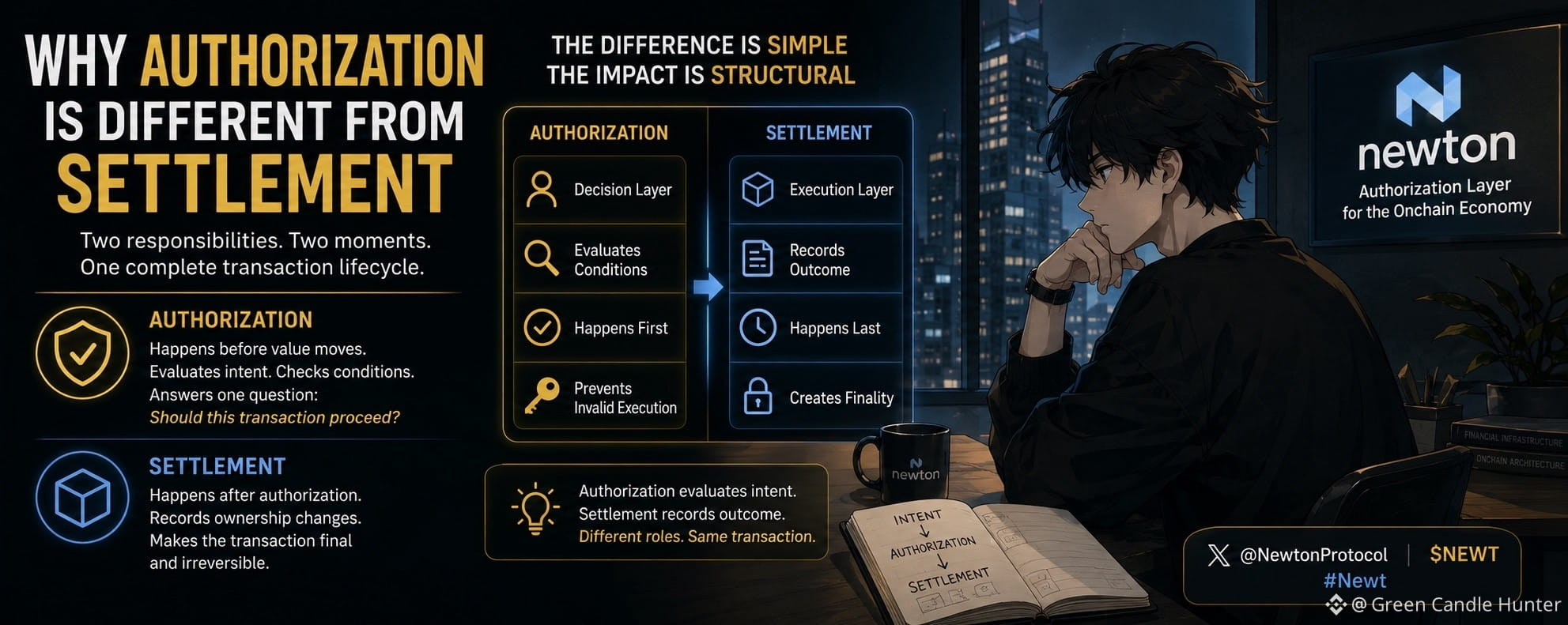
Settlement is the final movement of value. It records ownership changes updates balances and makes a transaction irreversible according to the rules of the network. This is the area where blockchains have demonstrated remarkable success. They provide transparent deterministic settlement without requiring a central intermediary.
Authorization however happens before any value moves.
Its purpose is not to record a transaction but to determine whether the transaction should proceed under a predefined set of conditions. It represents a decision making stage rather than an execution stage.
Traditional payment systems have operated this way for decades.
When someone uses a payment card the transaction does not immediately settle. The payment network first evaluates the request confirms it satisfies the required conditions and only then allows settlement to continue. Authorization and settlement work together but they perform completely different jobs.
Blockchain networks were designed with a different objective.
Their primary responsibility is executing valid transactions according to protocol rules. Once a transaction satisfies consensus requirements and carries the correct signatures the network focuses on recording the resulting state change. This design created efficient decentralized settlement but it also compressed multiple financial responsibilities into a single execution flow.
As blockchain applications expand beyond simple transfers that distinction becomes increasingly relevant.
Many financial activities require more than technical validity. A transaction may satisfy blockchain rules while still requiring additional evaluation before execution. The challenge is not whether settlement functions correctly. The challenge is recognizing that settlement alone does not represent the entire transaction lifecycle.
This is where Newton Protocol introduces a different architectural perspective.
Instead of redefining settlement Newton separates authorization from execution. Applications submit a transaction intent for authorization receive a verifiable response, and only then continue to blockchain settlement. Settlement continues performing its existing role while authorization becomes an independent layer responsible for evaluating transactions before they execute.
I find this separation interesting because it changes how we think about blockchain infrastructure.
For years improvements have largely focused on optimizing settlement. Networks became faster transaction costs declined, and scalability increased. Those developments strengthened execution but they did not fundamentally distinguish between deciding and recording.
Newton suggests these responsibilities deserve their own infrastructure.
Authorization becomes responsible for evaluating a transaction.
Settlement becomes responsible for finalizing it.
Neither replaces the other.
Instead each performs the task it is naturally suited to handle.
This separation also creates a cleaner architectural model.
Applications no longer need to treat every financial decision as part of settlement itself. Instead authorization becomes a dedicated stage where predefined requirements are evaluated before execution continues. The blockchain remains responsible for immutable settlement without absorbing every responsibility that modern financial systems require.
Viewed this way settlement is not diminished.
It remains one of blockchain’s greatest strengths.
What changes is the understanding that settlement represents the conclusion of a transaction rather than its entire lifecycle.
Authorization exists earlier in that journey.
It evaluates intent.
Settlement records outcome.
That distinction seems simple yet it introduces a more structured way of thinking about decentralized finance. Rather than expecting blockchains to perform every financial responsibility simultaneously different infrastructure layers can specialize in different stages of the transaction process.
This also explains why Newton does not position itself as another blockchain.
Its purpose is not to compete with settlement networks but to complement them. Existing blockchains continue doing what they already do exceptionally well while Newton introduces an authorization stage before execution begins.
The relationship between these layers reminds me that mature financial infrastructure is rarely built around a single component. Reliable systems often separate responsibilities so each layer can evolve independently without replacing the others.
Settlement remains essential because every transaction eventually needs a final record.
Authorization becomes equally valuable because every important transaction begins with a decision.
Understanding that difference changes how I view onchain finance.
The conversation is no longer only about moving value efficiently.
It is also about recognizing that deciding whether value should move is a different responsibility altogether.
Perhaps the next stage of blockchain infrastructure is not replacing settlement.
It is allowing authorization and settlement to work together as separate complementary layers within the same transaction lifecycle.