
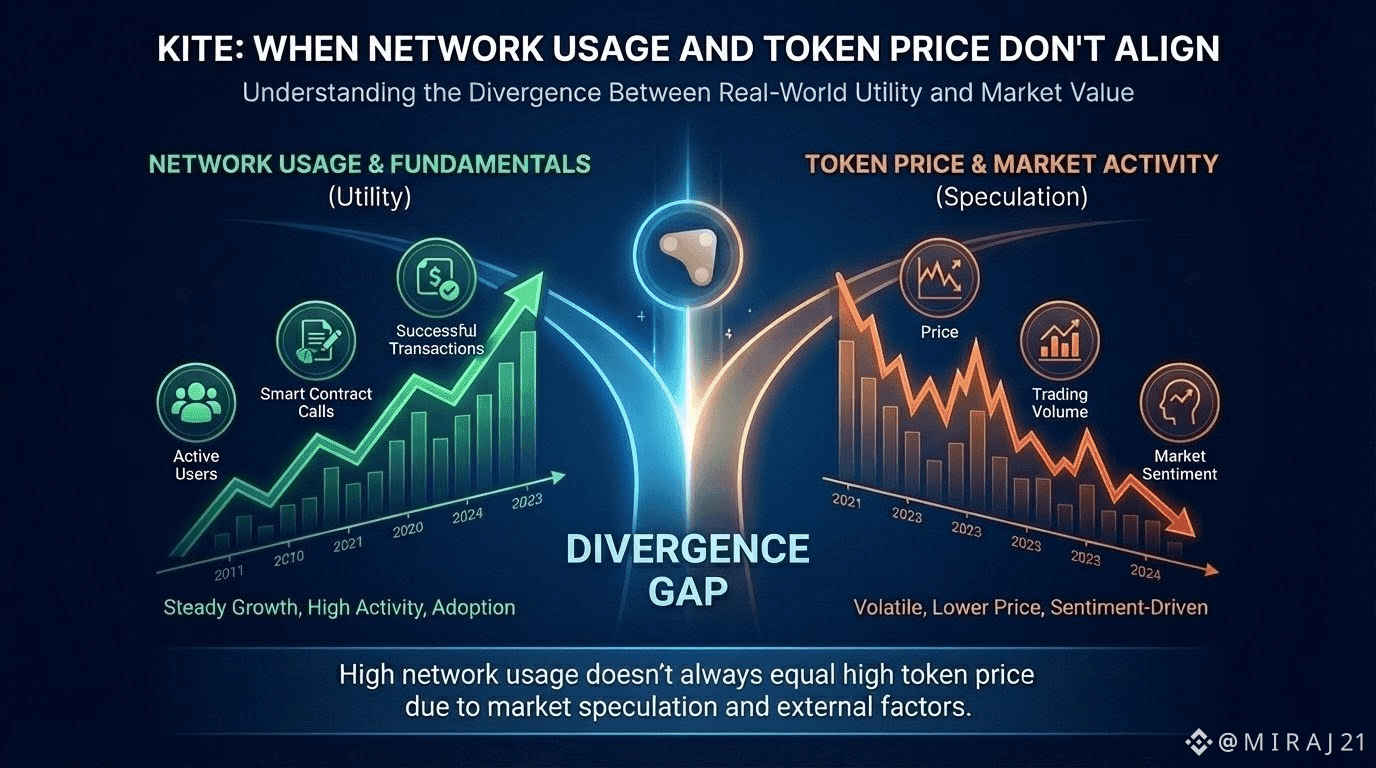
 Not all the network communicates its truth via price, but some via usage.
Crypto market narratives will reduce complex systems to a single data point: token price. However, with more complex on-chain infrastructures, the less complex solution will be less and less apt. KITE Network finds itself right in the middle of this conundrum, with increased activity on the network and unsustainable token value trends. It is important to note this phenomenon for those seeking to differentiate noise and signal.
Usage and price measure different things and they rarely peak together.
Token price reflects marginal demand for a scarce asset.
Network activity reflects productive demand for blockspace, execution, and coordination.
In speculative phases, price often leads usage. In infrastructure phases, usage quietly compounds while price lags. KITE belongs to the latter category: a system designed to power autonomous agents, machine commerce, and policy-driven execution none of which require speculative velocity to grow.
KITE’s activity is structural, not cyclical.
Unlike consumer-facing DeFi or GameFi, KITE’s usage is driven by:
agent-to-agent task execution
automated instruction routing
policy-governed treasury actions
machine-native payment flows
background compute and data coordination
These activities generate consistent transaction volume without the reflexive buy sell behavior that inflates token price. As a result, on-chain metrics may trend upward while market attention remains muted.
This is not weakness it is a sign of infrastructural maturity.
Why token demand doesn’t automatically track network demand.
In many modern chains, the token’s primary roles are:
security and staking
governance
fee abstraction or settlement
economic alignment, not consumption
KITE is engineered so that applications and agents can function without forcing speculative interaction with the token. Fees may be abstracted. Execution may be policy-controlled. Payments may be predictable and machine-scaled.
The result:
High usage does not require high velocity trading and that is intentional.
Autonomous systems dampen speculation by design.
Human users speculate emotionally.
Autonomous agents optimize economically.
When agents dominate network activity, behaviors change:
fewer impulsive transactions
fewer narrative-driven spikes
more repetitive, utility-driven execution
stable demand curves instead of hype cycles
This shifts value creation away from visible price action and into invisible productivity a dynamic that often confuses markets trained to chase volatility.
Price divergence often appears before narrative convergence.
Historically, infrastructure networks experience three phases:
Build Phase usage rises quietly, price stagnates
Recognition Phase analysts notice non-price metrics
Repricing Phase valuation adjusts to structural demand
KITE appears to be operating squarely in phase one. Agents are executing. Policies are enforcing behavior. The system is working even if the chart does not yet reflect it.
Speculation struggles to price machine economies.
Markets are good at pricing stories humans understand.
They are less effective at pricing systems that:
operate autonomously
scale invisibly
generate value without marketing loops
grow through background coordination
optimize away friction (and hype)
KITE economic model prioritizes resilience and predictability over reflexive excitement, which naturally delays speculative repricing.
Usage-driven networks invert the traditional “attention → value” model.
In many crypto systems:
Attention → Volume → Price → Temporary Usage
In KITE model:
Usage → Reliability → Integration → Long-term Value
This inversion means value accrues before attention, not after.
For short-term traders, this feels like stagnation.
For long-term allocators, it looks like accumulation of fundamentals.
The most dangerous mistake is assuming divergence equals failure.
When usage grows without price response, two interpretations emerge:
the market is wrong
or the architecture is misunderstood
History favors the second explanation more often than the first especially in cases where networks prioritize utility over narrative.
KITE divergence is not a red flag.
It is a diagnostic signal.
Eventually, economic gravity asserts itself.
As autonomous applications scale, demand concentrates around:
staking for security
governance for policy control
alignment with machine economies
participation in execution layers
When these pressures converge, price tends to catch up often abruptly and without warning.
The key insight is simple:
price reacts; usage accumulates.
Understanding divergence is how serious capital stays early not how it chases tops.
KITE challenges the habit of equating value with visibility. Its network activity reflects a system being used, not promoted. That distinction matters more with every generation of blockchain infrastructure.
In a future dominated by autonomous execution, machine commerce, and policy-driven capital, the most valuable networks may look quiet right until they aren’t.
Markets price excitement quickly, but they price infrastructure slowly. The divergence between usage and price is often where long-term opportunity hides.

