
The more time I spend following blockchain innovation, the more I feel that the industry's biggest breakthrough won't come from making networks a little faster or transactions a little cheaper. Those improvements still matter, but they've become expected. Most modern blockchains already process transactions in seconds and handle enormous amounts of activity every day. That makes me wonder if the next stage of progress lies somewhere else.
Lately, I've been thinking about what happens before a transaction is sent to the blockchain.
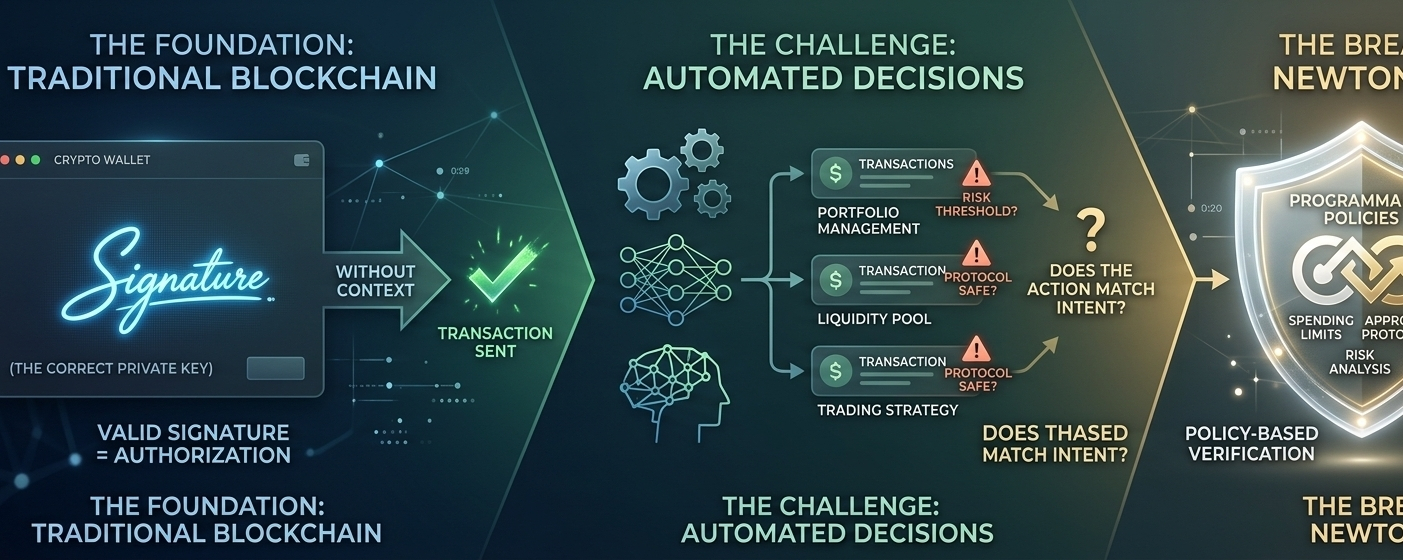
For years, crypto has relied on a simple idea. If the owner of a wallet signs a transaction with the correct private key, the network accepts it and moves the assets. That system has worked well because most decisions have been made directly by people. The signature has always been treated as proof that everything is fine.
But the way we use blockchain is changing.
Smart accounts are becoming more advanced, and AI-powered agents are starting to manage portfolios, move liquidity, execute trading strategies, and interact with multiple protocols automatically. These systems can work around the clock without waiting for a person to approve every single action.
While that opens the door to incredible efficiency, it also creates a new challenge.
A valid signature only confirms that permission exists. It doesn't tell us whether the action actually matches the user's intentions, follows predefined rules, or exposes unnecessary risk. In other words, authorization and good decision-making are not always the same thing.
That's one reason Newton Protocol has caught my attention.
Instead of treating execution as the first step, Newton introduces another layer before assets are allowed to move. Every transaction can be checked against programmable policies chosen by the user or an organization. These policies might include spending limits, approved protocols, risk thresholds, compliance requirements, or other conditions that reflect the owner's intentions.
Only after those requirements are satisfied does the transaction continue toward settlement.
To me, that's an important shift in thinking.
The blockchain industry has spent years building systems that verify identities, wallets, and digital signatures. Newton seems to focus on something different by helping verify whether a decision follows the rules that were defined beforehand.
As automated systems become responsible for larger amounts of capital, that distinction could become increasingly valuable.
Another part that stands out is the way the protocol combines Trusted Execution Environments with Zero-Knowledge Proofs. Sensitive policy checks can happen inside a secure environment while still producing cryptographic proof that every required rule was followed. That means automation doesn't have to rely on blind trust. The process itself can be verified without exposing confidential information.
I find that idea especially interesting because the future of finance will likely involve far more automation than we see today. AI systems will continue making decisions faster than humans ever could, but speed alone isn't enough if those decisions can't be trusted.
What makes Newton different, in my view, isn't simply that it supports automation. Many projects are building tools for automated finance.
The more meaningful goal is making automated decisions accountable.
If AI is going to manage meaningful value across decentralized finance, then protecting private keys won't solve every problem. We'll also need systems that help ensure every transaction reflects the policies and intentions set by the people who own those assets.
That's why I don't think of NEWT as just another automation protocol or wallet solution.
I see it as infrastructure built for a future where intelligence comes before execution, where policies guide every decision, and where verified intent becomes just as important as a verified signature. If blockchain continues moving toward an AI-native financial world, that extra decision layer could become one of the most valuable pieces of infrastructure the industry builds.