

For years, decentralized finance has promised a future where financial systems operate without centralized gatekeepers. The technology delivered transparency, composability, and permissionless access. Yet one question has continued to surface whenever banks, asset managers, regulators, or large enterprises consider moving meaningful capital onchain.
How do you prove that the rules were actually followed?
Not that a transaction succeeded.
Not that a smart contract executed correctly.
But that every compliance requirement, every risk check, every security policy, and every authorization decision was evaluated exactly as intended.
That distinction is where Newton Protocol stands apart.
While many conversations focus on Newton's ability to block risky transactions before they happen, I think the protocol's most significant innovation is what happens after a decision is made.
It leaves behind evidence.
Not a vague log.
Not a centralized database entry.
A cryptographically verifiable attestation that explains why a transaction was approved or rejected.
That seemingly small design choice may become one of the most important pieces of infrastructure for bringing institutional finance onchain.
Blockchains Record Transactions, Not Decisions
A blockchain is exceptionally good at recording what happened.
Wallet A transferred assets to Wallet B.
A vault executed a trade.
A smart contract changed state.
Those facts become permanent.
What blockchains do not naturally preserve is the reasoning behind those actions.
Suppose a stablecoin issuer screens every transfer against sanctions lists.
Six months later, an auditor asks how a particular transaction was evaluated.
The blockchain cannot answer.
It only proves that the transaction occurred.
It does not reveal which compliance policy was applied, which external data sources were consulted, when the screening happened, or whether the evaluation followed the correct procedure.
That missing context has always created a gap between decentralized finance and the operational standards expected in traditional financial systems. Financial institutions are often required to maintain detailed evidence showing not only what decisions were made but also how and why those decisions were reached.
Without that evidence, compliance becomes a matter of trust instead of verification.
Newton was designed to close that gap.
A Receipt Instead of a Promise
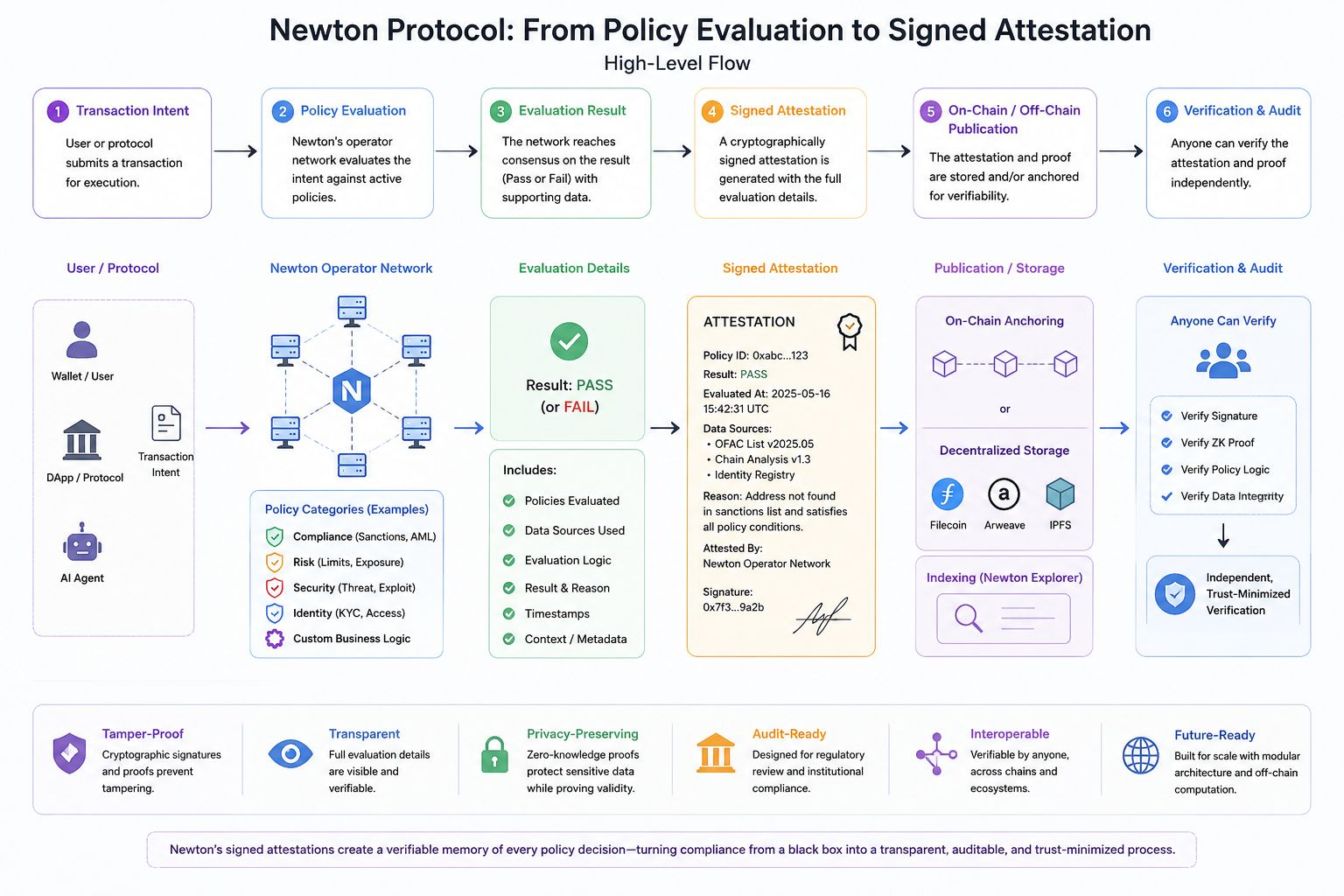
Newton operates as a decentralized policy engine that evaluates transaction intents before execution.
Developers can define programmable rules covering sanctions screening, identity verification, spending limits, fraud prevention, AI guardrails, jurisdictional restrictions, or custom business logic.
When someone submits a transaction, Newton's distributed operator network evaluates the request against those policies before anything reaches the blockchain.
Most people stop thinking there.
The transaction either passes or fails.
The interesting part comes next.
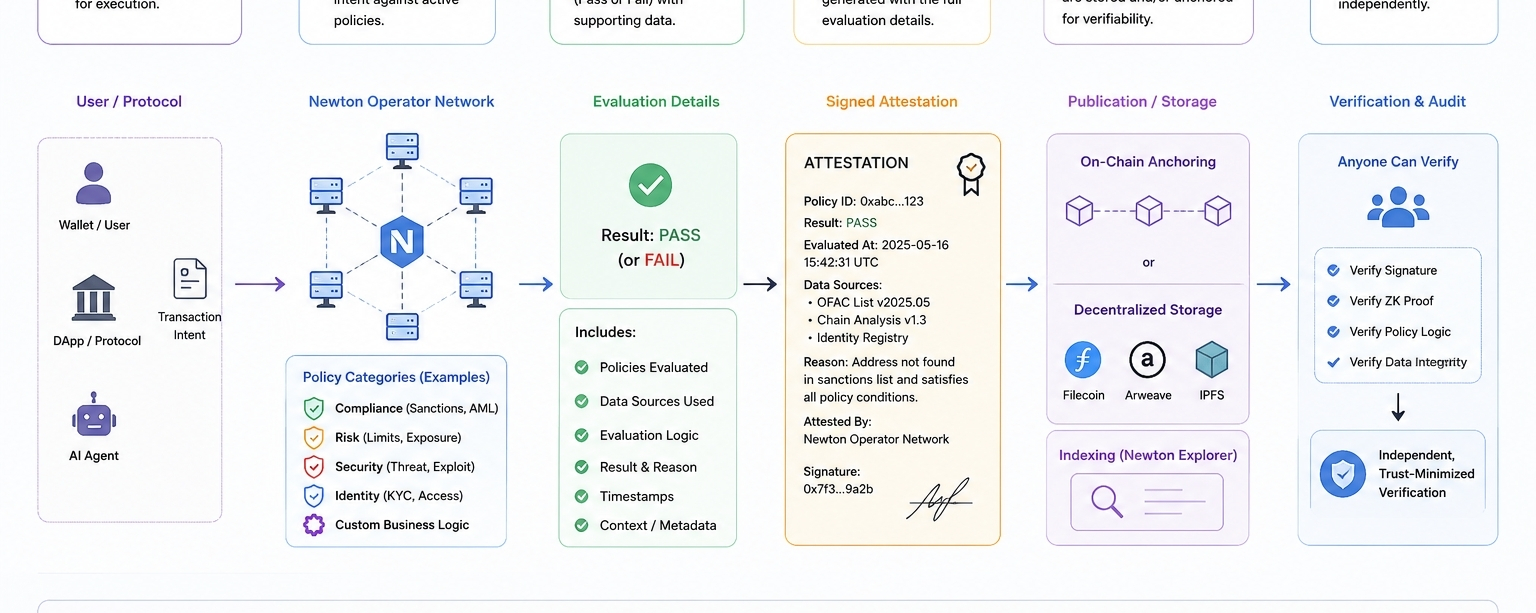
Each evaluation produces a verifiable record describing the policy that was executed, the evaluation result, supporting policy data, timestamps, and the cryptographic proof generated by the network. These evaluation records can also be viewed through the Newton Explorer, making policy decisions understandable instead of hidden behind opaque contract errors.
That changes the conversation completely.
Instead of saying,
"We run compliance checks."
A protocol can now say,
"Here is the exact record proving this transaction satisfied every required policy."
Those are very different levels of assurance.
Trust Is Replaced With Verification
Traditional compliance systems often depend on centralized providers.
A screening service performs an evaluation.
The institution trusts the provider.
The regulator trusts the institution.
Everyone trusts that the logs are accurate.
Newton takes a different approach.
Policy evaluations are performed by decentralized operators and supported through cryptographic techniques including Trusted Execution Environments, signature aggregation, and zero-knowledge-based verification models, allowing policy outcomes to be independently validated instead of simply accepted on faith.
That architecture matters because trust becomes measurable.
Instead of believing an operator followed the rules, participants can verify that the evaluation happened according to the protocol.
In regulated finance, evidence almost always carries more weight than reputation.
Why This Matters for AI
Newton is often described as infrastructure for AI-driven finance.
That description is accurate, but it also undersells the protocol.
AI agents can already trade, rebalance portfolios, manage treasury operations, and execute complex financial strategies.
The problem is not whether they can act.
The problem is whether anyone can later prove that every action respected predefined constraints.
Imagine an autonomous trading agent managing institutional assets.
An investor doesn't simply want profitable trades.
They want proof that every transaction respected exposure limits, jurisdictional rules, approved counterparties, and internal governance requirements.
Signed attestations provide exactly that missing accountability layer.
The result is not merely autonomous execution.
It is accountable autonomy.
That distinction may become essential as AI systems take on larger financial responsibilities.
Human Readability Matters Too
Compliance is not only a technical challenge.
It is an operational one.
Many blockchain tools expose errors as contract reverts, hexadecimal values, or developer-oriented logs.
Engineers may understand them.
Compliance teams usually cannot.
Newton's Explorer presents evaluation details in a structured and readable format, including task status, policy information, evaluation results, timestamps, and supporting policy data. That makes investigations significantly easier for operational teams that need understandable records rather than raw blockchain data.
Good infrastructure should reduce ambiguity.
Readable evidence does exactly that.
Scaling Raises Interesting Questions
One aspect that deserves continued discussion is scale.
If every evaluated transaction produces an attestation, data volumes could become substantial for applications processing millions of operations each month.
Questions naturally follow.
How efficiently can historical attestations be indexed?
What are the long-term storage costs?
How quickly can institutions retrieve years of compliance records during audits?
These are engineering challenges rather than conceptual weaknesses, but they will become increasingly important as Newton expands into enterprise-scale environments.
The encouraging part is that Newton appears to have designed its architecture with modular verification and offchain computation specifically to reduce unnecessary onchain overhead while preserving cryptographic guarantees.
A Different Philosophy of Compliance
Perhaps the most interesting thing about Newton is not the technology itself.
It is the philosophy behind it.
Many systems treat compliance as a gate.
Newton treats compliance as evidence.
That shift sounds subtle.
It is not.
Institutions rarely struggle to create policies.
They struggle to demonstrate that those policies were consistently enforced.
Evidence solves that problem.
Evidence survives audits.
Evidence builds confidence across organizations that do not automatically trust one another.
As decentralized finance continues moving toward institutional adoption, the biggest competitive advantage may no longer be transaction speed or lower fees.
It may be the ability to answer difficult questions months or years after a transaction occurred.
Why was this approved?
Which rule allowed it?
Who verified it?
Can anyone independently confirm the result?
Newton's signed attestations are designed to answer those questions with cryptographic proof rather than organizational promises.
That is why I believe they represent far more than another compliance feature.
They represent an attempt to give decentralized finance something it has always lacked: a verifiable memory of its own decisions.
If that vision succeeds, signed attestations may ultimately become the invisible infrastructure that allows institutions, regulators, AI systems, and open blockchain networks to operate with the same confidence—even when none of them fully trust one another.