

@Lorenzo Protocol For a long time, “Bitcoin in DeFi” mostly meant one thing: wrap it, bridge it, and hope the plumbing holds. That approach worked well enough to bootstrap lending markets and liquidity pools, but it also created a quiet tension. People wanted their BTC to stay BTC-like—simple, conservative, easy to reason about—yet the moment it entered DeFi, it turned into an instrument with assumptions baked in: custodians, bridges, smart contract risk, liquidity quirks, governance changes. Even if you accepted those tradeoffs, you still ran into the same emotional snag: why does the most valuable asset in crypto often feel like it’s just sitting there? Babylon’s push for native Bitcoin staking, with time-bound locks and explicit penalty mechanics, is one reason the conversation shifted in 2024–2025 from “wrapped BTC as a bridge asset” to “BTC as economic security.”
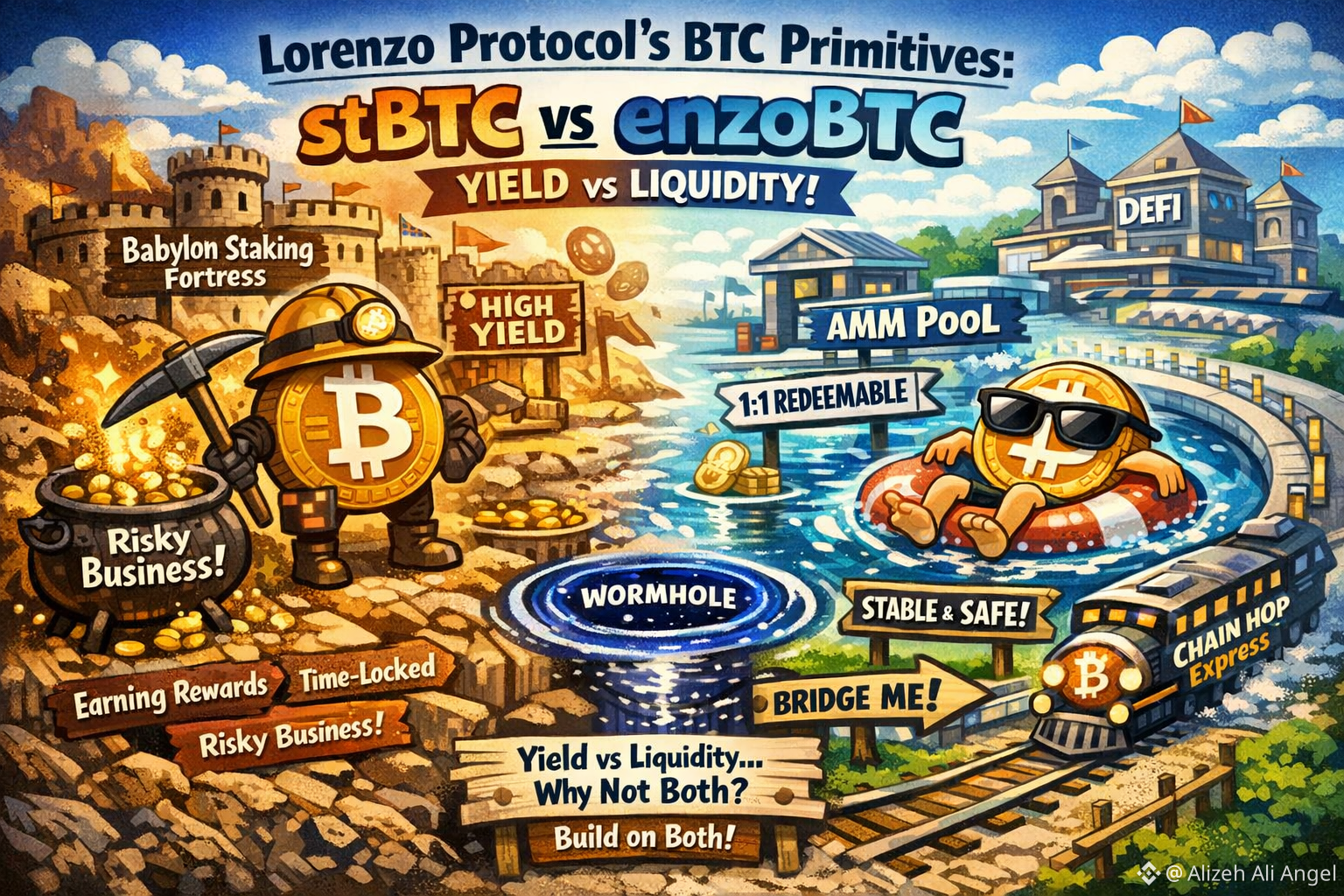
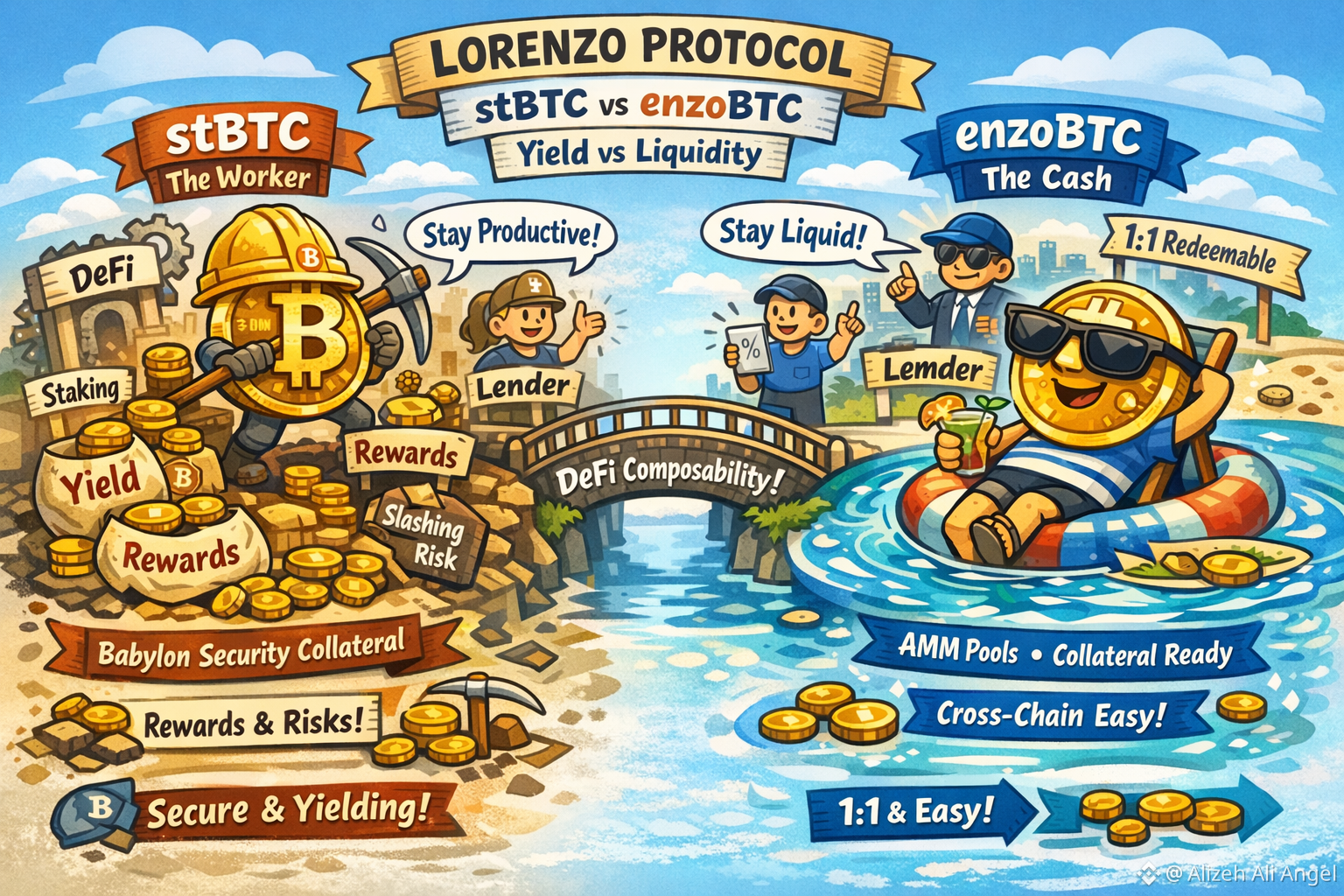
That shift helps explain why Lorenzo Protocol’s stBTC and enzoBTC have been showing up in more discussions lately. Lorenzo frames itself as a Bitcoin liquidity layer and on-chain asset management platform, and the key design choice is pretty human: don’t force one token to do every job. Instead, split the responsibilities. enzoBTC is the “cash-like” piece—a wrapped BTC standard meant to be redeemable 1:1, intentionally not rewards-bearing, and designed to move around DeFi without changing character. stBTC is the “work” piece—the reward-bearing token representing BTC staked via Babylon, meant to carry yield while still staying liquid and redeemable 1:1 back to BTC.
The difference sounds subtle until you picture what people actually do on-chain. Liquidity wants predictability. Traders, market makers, and protocols building pools or perps want an asset that behaves like a clean unit of account: it shouldn’t surprise you with reward mechanics, shifting balances, or changing claim structures at awkward moments. That’s the quiet appeal of enzoBTC. If it’s meant to be “cash,” it can sit in an AMM pool, be posted as collateral, or be routed across chains with fewer weird edge cases. Lorenzo’s own language makes that point directly: enzoBTC is redeemable 1:1 and non-yield-bearing by design, so it can act as a base liquidity primitive.
Yield, on the other hand, is rarely free, and it’s rarely clean. With Babylon-style staking, you’re explicitly using BTC as security collateral for other networks, and the system relies on enforcement—slashing rules and other constraints—to make that security credible. That’s not a moral judgment, just a reality: the moment BTC earns, it’s because it’s doing something. stBTC is Lorenzo’s way of packaging that “doing something” into a token you can still move around. Binance Academy’s overview describes stBTC as Lorenzo’s liquid staking token for BTC staked with Babylon, redeemable 1:1, with rewards potentially handled through additional yield-accrual mechanisms. Lorenzo’s documentation and blog materials go further and talk about splitting principal-like and yield-like claims (the LPT/YAT framing), which is basically an attempt to keep accounting honest: principal is principal, yield is yield, and you can trade them separately if you want to.
This is where “DeFi composability” stops being a buzzword and starts being a design constraint you can feel. A yield-bearing token tends to create second-order questions: does its value drift relative to BTC as rewards accrue? Is yield paid out in place, or does it require claims? Can lending markets price it cleanly? Does it introduce liquidation weirdness? By separating stBTC (yield-bearing) from enzoBTC (cash-like), Lorenzo is trying to give protocols a clearer surface to build on: one token optimized for circulation and collateral plumbing, another optimized for earning. I find that separation refreshing because it admits something people often ignore: “one BTC token” can’t satisfy every use case without compromising somewhere.
It also lands at a moment when the broader Bitcoin liquid staking and restaking narrative is clearly accelerating. Babylon publicly shows substantial BTC staked through its system, and its docs emphasize that staking is time-bound and governed by explicit security rules. Meanwhile, projects like Lombard have pushed the idea of yield-bearing BTC into new venues; Blockworks’ reporting around LBTC’s expansion highlights how quickly “yield-bearing Bitcoin” is becoming a standard pitch for integrations across high-activity DeFi ecosystems. You don’t need to love the pitch to notice the pattern: there’s pressure to make BTC productive, and there’s also pressure to do it in a way that doesn’t feel like you’re swapping Bitcoin’s simplicity for a fragile stack of dependencies.
Cross-chain movement is part of that dependency story, and Lorenzo has leaned into it. The protocol has described integrating Wormhole to give stBTC and enzoBTC multichain mobility, explicitly framing it as a way to move liquidity to where DeFi demand is rather than trapping it on one network. In practice, that’s where the “liquidity primitive” idea gets tested. It’s one thing to say a token is cash-like; it’s another to see whether it becomes the thing pools, money markets, and trading venues actually want to hold.
None of this is a free lunch, and it’s worth saying that plainly. With enzoBTC, the core question is the wrapping and redemption trust model, plus the operational reality of liquidity: can you get in and out at size, in stressed markets, without ugly slippage or delays? Independent dashboards show meaningful activity around Lorenzo’s enzoBTC footprint, but numbers alone don’t remove the need for caution. With stBTC, you’re adding staking-specific risks on top—rules, enforcement, and the indirect risks of the networks being secured. Babylon’s own materials are straightforward that slashing exists as a mechanism, which is the right kind of honesty, but it also means stBTC is not “just BTC.”
Still, I get why people are paying attention right now instead of five years ago. The industry has matured past the phase where wrapping BTC was novel. Now the questions are sharper: can BTC be collateral for security, not just liquidity? Can yield be packaged without turning the base asset into a messy instrument? Can DeFi treat Bitcoin less like a visitor and more like a foundation? Lorenzo’s stBTC and enzoBTC don’t answer all of that on their own, but the split is a thoughtful step. It treats yield and liquidity as different jobs with different requirements—and it gives the rest of the ecosystem clearer building blocks to work with. In DeFi, that kind of clarity tends to compound.
@Lorenzo Protocol #lorenzoprotocol $BANK

