
Last month, I almost sent money to the wrong bank account.
The scary part was not the transfer speed.
The scary part was how normal the confirmation screen looked.
The name looked close enough.
The amount looked normal.
The app did not feel dangerous.
It simply asked me to confirm.
That moment made me think differently about onchain finance.
Everyone talks about faster settlement.
Stablecoins move faster.
Onchain markets run 24/7.
Vaults can reallocate capital without waiting for banks, brokers, or back-office teams.
But faster money creates a strange problem.
The wrong payment also becomes faster.
The wrong vault action also becomes faster.
The wrong transaction also becomes final faster.
So maybe the next important question is not only:
“How quickly can value move?”
Maybe it is:
“Was this value allowed to move in the first place?”
That is where @NewtonProtocol becomes interesting to me.
Newton is not just another “AI + crypto” story.
The cleaner way to understand it is this:
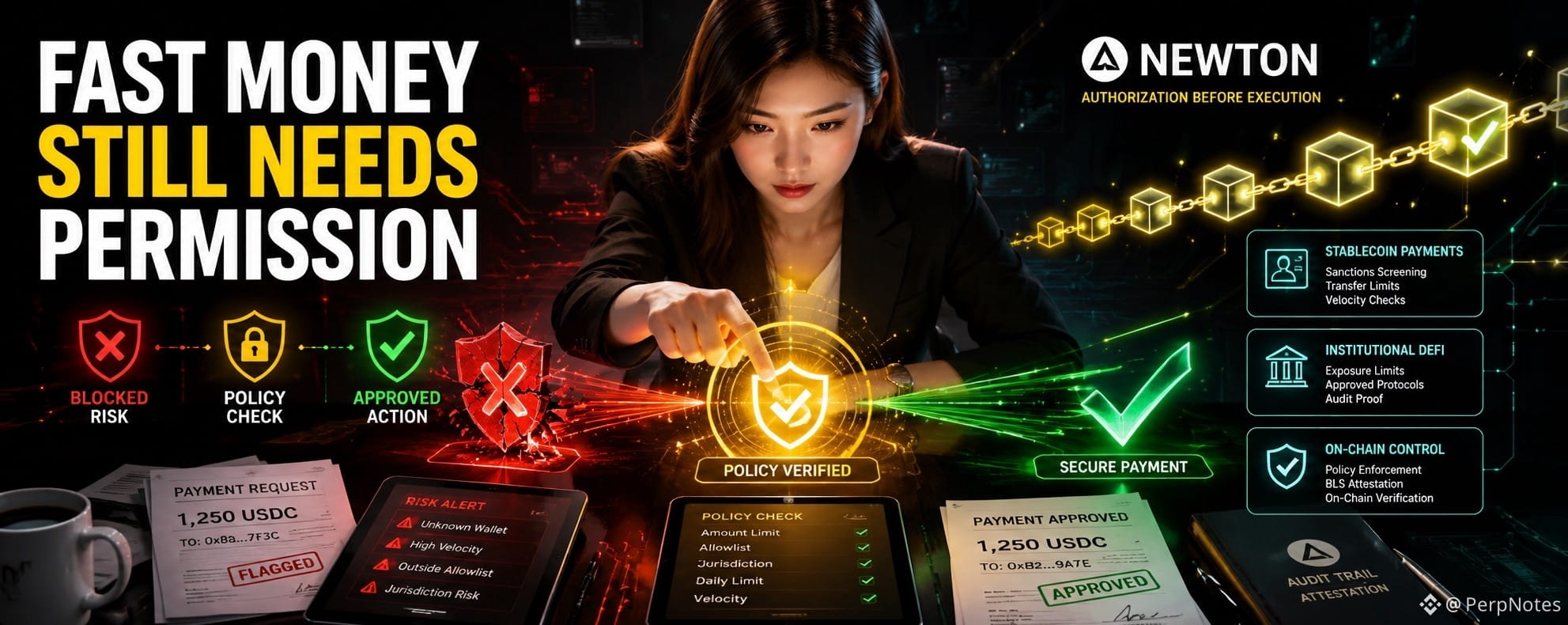
Newton adds a policy layer before execution.
A transaction is not only checked for whether it is technically valid.
It can also be checked against rules.
Who is sending?
Who is receiving?
How much is being moved?
Is this address allowed?
Is this jurisdiction allowed?
Has this wallet already sent too much in the last hour?
Is this contract approved?
Does this action exceed the limit?
That sounds simple, but it changes the shape of onchain finance.
Take stablecoin payments.
People usually describe stablecoins as faster dollars.
That is true, but incomplete.
A payment network does not only need speed.
It also needs permission.
Imagine a business paying vendors in USDC.
A 1,250 USDC payment to a known vendor may be fine.
A 1,250 USDC payment to a fresh wallet may need review.
Four payments in 17 minutes may be normal for one merchant, but suspicious for another.
A transfer to an address outside the approved list may need to be blocked before it leaves.
Without a policy layer, many of these controls happen outside the transaction path.
Someone writes rules in a dashboard.
Someone checks reports later.
Someone notices risk after the money has already moved.
That is not the same as enforcement.
Newton’s model is more interesting because the policy check happens before execution.
The transaction intent can be evaluated against predefined rules.
If it satisfies the policy, it can receive a cryptographic attestation.
If it does not, the action should not go through.
That may sound boring compared with the usual crypto narratives.
But boring controls are exactly what large payment systems need.
The same idea becomes even more important in institutional DeFi.
A vault rule written in a PDF is still just a promise.
A curator may say:
“We will not allocate more than 30% to one protocol.”
“We will only use approved markets.”
“We will avoid certain counterparties.”
“We will keep exposure within a defined range.”
Those are good rules.
But if they only live in documents, governance posts, or private procedures, they depend on trust.
The user still has to believe that the manager will follow them.
The institution still has to believe that every action matches the mandate.
The auditor still has to reconstruct what happened after the fact.
Newton points toward a different model.
A vault action can be checked before it executes.
If a manager tries to allocate beyond a limit, the policy can reject it.
If a strategy touches a non-approved protocol, the policy can block it.
If an action requires multi-party approval, the transaction should not move forward until that condition is satisfied.
That turns a rule from a promise into a checkpoint.
This is why I think Newton’s strongest idea is not “automation.”
Automation alone is not enough.
Fast automation without permission can create faster mistakes.
AI agents can act too broadly.
Stablecoin systems can move value too easily.
Vaults can reallocate capital before users understand the risk.
The missing layer is authorization.
Not authorization as a vague word.
Authorization as something enforced before execution.
That is the difference between saying:
“Trust us, we followed the policy.”
And proving:
“This action passed the policy before it moved value.”
Newton Mainnet Beta matters because it brings this idea closer to real onchain use.
It is not only about building another protocol around transactions.
It is about asking a more mature question:
What should be allowed to happen before settlement?
Crypto has spent years making value movement faster, cheaper, and more programmable.
Now the harder part begins.
Making programmable value obey programmable rules.
For stablecoins, that could mean safer payments.
For institutions, that could mean clearer vault controls.
For DeFi, that could mean policies that are not just written somewhere, but enforced in the transaction path itself.
The future of onchain finance may not be only about faster settlement.
It may be about proving that settlement was allowed in the first place.
