
If you’ve spent enough time in the blockchain space, you eventually run into a hard reality that no amount of hype can hide. Blockchains are excellent at enforcing rules and executing logic in a closed environment, but the real world doesn’t live on-chain. Prices change, events happen, APIs update, and systems evolve outside the blockchain’s native visibility. Smart contracts, for all their precision, are blind without external input. This is where oracles come in, and this is exactly where @APRO Oracle has positioned itself with quiet confidence.
Rather than trying to reinvent the blockchain itself, APRO-Oracle focuses on one critical mission: delivering reliable, verifiable, and decentralized data from the outside world to on-chain applications. That may sound simple on the surface, but anyone who understands oracle design knows how complex and high-stakes this problem really is. A single faulty data point can liquidate positions, break financial protocols, or undermine trust in an entire ecosystem.
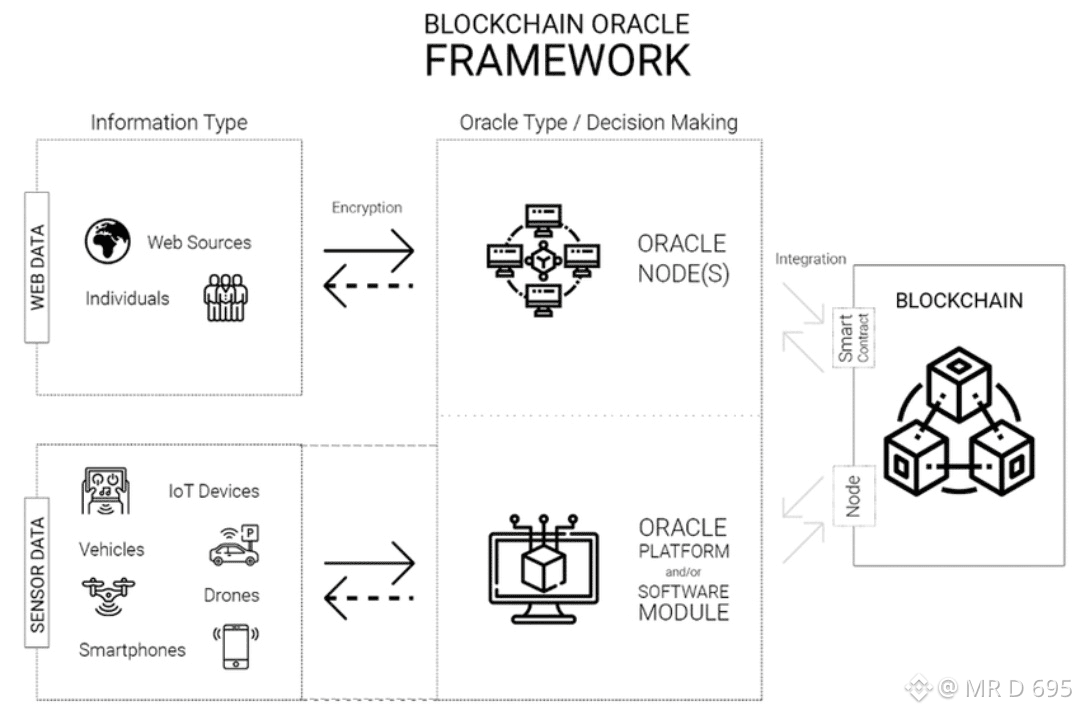
APRO-Oracle was built with that responsibility in mind. At its core, it is a decentralized oracle network designed to eliminate single points of failure and reduce data manipulation risks. Instead of trusting one source or one validator, the system aggregates information from multiple independent providers. These inputs are processed through a validation layer where oracle nodes independently verify accuracy before consensus is reached and the final data is delivered on-chain.
One of the defining features of APRO-Oracle is how it treats oracle nodes as accountable participants rather than passive relayers. Node operators are required to stake value, and their rewards are tied directly to performance. Accurate, timely data is rewarded. Faulty, delayed, or malicious submissions are penalized. Over time, this creates a natural quality filter where reliable operators thrive and unreliable ones are pushed out by economic pressure rather than centralized enforcement.
From an architectural standpoint, APRO-Oracle takes a modular approach. Data sourcing, aggregation, validation, and on-chain delivery are clearly separated. This design choice matters more than it might appear. It allows the protocol to evolve without disrupting existing integrations. New data providers can be added, validation logic can be upgraded, and performance optimizations can be introduced without forcing developers to rewrite their applications.
Off-chain computation is another area where APRO-Oracle shows practical thinking. Heavy data processing happens off-chain, handled by oracle nodes that specialize in computation and verification. Only the finalized, consensus-backed result is sent to the blockchain. This keeps gas costs under control while preserving the integrity of the data. It’s an approach that respects real-world constraints instead of pretending they don’t exist.
While price feeds remain the most common oracle use case, APRO-Oracle goes well beyond that. The protocol supports event-based data, API responses, cross-chain state verification, and custom data requests defined by decentralized applications themselves. Developers aren’t boxed into predefined feeds. They can design data requests that match the logic and risk profile of their specific application.
A notable recent update is the refinement of APRO-Oracle’s dynamic data request system. Instead of relying solely on fixed-interval updates, smart contracts can now request data conditionally. For example, a contract might only trigger an update when a price crosses a certain threshold or when an external event occurs. This reduces unnecessary data traffic, lowers costs, and improves responsiveness where it actually matters.
Security has also seen meaningful upgrades. Beyond staking and slashing, APRO-Oracle now leverages cross-verification between independent oracle clusters. If one cluster produces an abnormal result, its output can be compared against others before finalization. This layered defense model makes coordinated attacks significantly harder and improves overall data reliability.
Interoperability is another strong focus. APRO-Oracle is designed to be chain-agnostic, offering standardized interfaces that allow it to integrate with multiple blockchain networks. As multi-chain applications become the norm rather than the exception, this flexibility becomes essential. Developers can deploy across ecosystems without rebuilding their oracle infrastructure from scratch.
Developer experience has improved significantly as well. Updated SDKs and APIs make oracle integration feel like a natural part of application development rather than a separate infrastructure challenge. Testing tools, clearer documentation, and better error handling reduce friction and shorten development cycles. These improvements may not grab headlines, but they directly impact real-world adoption.
Governance plays a meaningful role in the APRO-Oracle ecosystem. Token holders and network participants can influence protocol upgrades, economic parameters, and data source policies. This governance structure isn’t decorative. It shapes how the network adapts to new use cases, emerging threats, and changing market conditions. Over time, this creates a protocol that evolves with its users instead of being locked into early assumptions.
Economically, APRO-Oracle emphasizes long-term sustainability. Rewards are structured to favor consistent performance over short-term activity spikes. Node operators who contribute reliable data over time are the ones who benefit the most. This aligns incentives with what matters most for an oracle network: accuracy, availability, and trust.
The range of applications using APRO-Oracle continues to grow. In decentralized finance, it supports lending platforms, derivatives protocols, stablecoins, and synthetic assets that depend on accurate market data. In gaming and NFT ecosystems, it enables verifiable randomness and real-world event integration. In enterprise and infrastructure use cases, it acts as a secure bridge between traditional systems and decentralized applications.
What makes APRO-Oracle stand out is its flexibility. Developers can tune validation thresholds, update frequencies, and security assumptions based on their needs. High-value financial contracts can opt for stricter validation, while experimental applications can prioritize speed and cost. This adaptability is a strength, not a compromise.
Recent improvements to monitoring and analytics provide greater transparency for both developers and node operators. Performance metrics, response times, and anomaly detection tools make it easier to identify issues before they become failures. In systems that manage real value, visibility is not optional, it’s essential.
Cross-chain oracle messaging is another area of active development. APRO-Oracle is moving toward a unified data layer where validated data can be shared securely across multiple blockchains. As cross-chain applications become more common, consistent data across networks becomes a necessity rather than a luxury.
Stepping back, APRO-Oracle represents a broader shift in the blockchain space. Early infrastructure focused on proving decentralization was possible. Today, the focus is on making decentralized systems reliable enough for real-world use. Oracles are central to that transition, and APRO-Oracle approaches the challenge with a clear emphasis on resilience and accountability.
The success of an oracle protocol isn’t measured by marketing noise. It’s measured by how rarely things break. When smart contracts can trust the data they receive, when developers can build without friction, and when users don’t have to worry about hidden failure points, the oracle has done its job. APRO-Oracle is clearly aiming for that standard, and its recent updates show a commitment to getting there the right way.

