

One of the quiet lessons many builders learn only after deploying real applications on-chain is this: smart contracts can be mathematically correct and still produce broken outcomes. The issue rarely lies in the code itself. It lies in the assumptions made about the data that code depends on.
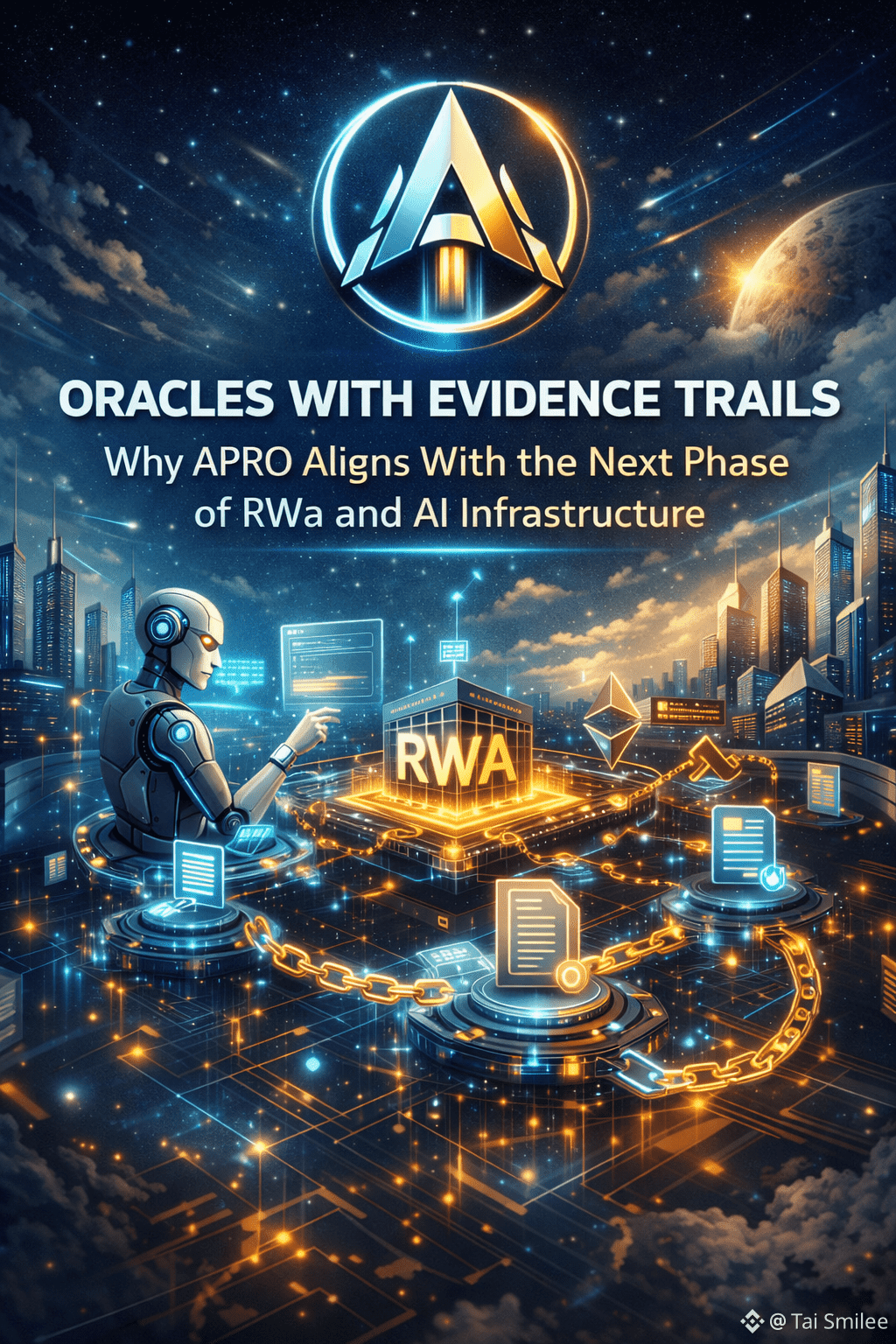
Blockchains are deterministic systems. They execute exactly what they are told. But the information they consume comes from a world that is anything but deterministic. The real world is shaped by documents, reports, screenshots, web pages, human signatures, delayed updates, and conflicting records. Turning that messy reality into something a smart contract can safely rely on is far more difficult than publishing a price feed.
This is where the conversation around oracles starts to change. The next generation of oracle infrastructure is no longer defined by how fast it delivers numbers, but by how well it can justify why those numbers should be trusted.
This is the direction where APRO Oracle begins to feel meaningfully different.
The Real Oracle Problem Is Not Prices, It Is Proof
When most people hear the word “oracle,” they still think of price updates for DeFi protocols. Prices were the first obvious need, but they are not the hardest problem. Prices are abundant, highly liquid, and continuously refreshed across many venues.
The more complex challenge appears when contracts need to verify real-world facts.
Ownership records. Invoices. Shipping confirmations. Certification documents. Audit statements. Inspection reports. These are not clean numerical feeds. They are human artifacts. They exist as PDFs, images, emails, spreadsheets, or structured websites. Humans can read and interpret them intuitively. Smart contracts cannot.
For an on-chain system to act on such information, someone has to translate these materials into structured outputs. More importantly, the system must later be able to answer a critical question: how do we know this translation was accurate?
Without traceable evidence, on-chain representations of real-world assets become fragile social agreements rather than verifiable financial instruments.
From Results to Receipts
A useful way to think about the next stage of oracle design is this: data should not arrive alone. It should arrive with a receipt.
In everyday life, claims are rarely trusted without context. When someone makes an assertion, the natural follow-up is “based on what?” What source was used? What document supports it? Which part of that document mattered?
Most oracle systems stop at delivering a result. They do not preserve the reasoning path that led to that result. This makes auditing difficult and dispute resolution even harder.
APRO’s emerging approach treats data delivery more like professional reporting than raw transmission. The goal is not just to provide an output, but to maintain an evidence trail that can be inspected, challenged, and re-evaluated over time.
This distinction becomes essential once real-world assets and legal claims enter the picture.
Where AI Becomes Practical, Not Promotional
Artificial intelligence is often discussed in abstract terms within Web3, but its most immediate value appears in handling unstructured information.
AI systems excel at extracting structured fields from messy inputs. They can identify names, dates, amounts, conditions, identifiers, and relationships embedded inside documents and images. They can compare multiple sources, detect inconsistencies, and highlight areas that require closer inspection.
In an oracle context, this capability allows raw real-world materials to be converted into standardized outputs that smart contracts can consume.
However, AI alone does not solve the trust problem. Models can make mistakes. Sometimes they do so confidently. If AI-generated outputs are treated as unquestionable truth, the system merely replaces one fragile assumption with another.
This is why verification and incentive design matter as much as extraction.
Separation of Roles and Economic Accountability
One of the more promising directions in oracle architecture is the separation between those who produce reports and those who validate them.
Instead of assuming that every submission is honest and correct, the system is designed with the expectation that errors and manipulation attempts will occur. Reports are checked. Evidence is reviewed. Discrepancies can be flagged.
Economic incentives reinforce this behavior. Participants who consistently submit accurate, well-supported data are rewarded. Those who submit low-quality or misleading outputs face penalties. Over time, reliability becomes a competitive advantage rather than a marketing claim.
This mirrors how professional verification works in traditional systems. Auditors, inspectors, and certifiers operate under standards, accountability, and reputational pressure. The difference is that on-chain systems can encode these dynamics directly into protocol rules.
Why This Matters for Real-World Assets
Real-world assets are fundamentally claims. A token representing an off-chain object or right is only as credible as the proof behind it.
Users want to know what exactly is being represented. They want to understand whether the representation is still valid, whether conditions have changed, and whether disputes can be resolved transparently.
Without robust evidence trails, tokenized assets risk feeling closer to social media posts than financial instruments. Trust becomes narrative-driven instead of verifiable.
An oracle system that preserves source references, extraction logic, and validation history moves the ecosystem closer to traditional finance standards — without relying on centralized intermediaries.
This shift is subtle, but it is foundational.
Unflashy Use Cases That Actually Scale Markets
Not all valuable applications sound exciting. Many of the most important workflows in real markets are operational rather than speculative.
Settlement processes that require confirmation a document was signed and filed. Payment reconciliations where invoices must match transfers. Inspection results supported by reports and photos. Compliance checks that depend on dated certifications.
These use cases rarely trend on social media, but they are what allow capital to move at scale. Systems that can handle them reliably unlock entire categories of enterprise and institutional participation.
Oracle infrastructure that focuses on evidence and repeatable standards is far better suited to these demands than systems optimized solely for speed.
Tokens With Function, Not Just Narrative
In this context, the AT token gains meaning only if it is tied to real work and real accountability.
A healthy oracle economy does not reward noise. It rewards evidence gathering, accurate extraction, careful validation, and dispute resolution. Tokens become part of the mechanism that pays for these services and enforces quality.
When dishonest behavior is penalized and consistent reliability is rewarded, the token stops being a badge and starts being an economic tool. Its value becomes linked to the usefulness of the network rather than speculative cycles.
This alignment is particularly important for long-term infrastructure, where trust is built gradually through performance rather than announcements.
Toward Proof Packages and Dispute-Native Systems
One compelling way to imagine the future of on-chain verification is through compact proof packages.
Instead of presenting a single output, each claim could be accompanied by a bundle containing source references, extracted fields, validation steps, and historical updates. When challenged, the system does not appeal to authority — it presents evidence.
Another promising idea is treating disputes as a first-class feature rather than a failure. Disagreement is expected in real-world reporting. Systems that openly handle disputes through transparent rules tend to produce higher-quality outcomes over time.
In such environments, reputation is earned through consistency, not volume. Validators who repeatedly resolve disputes correctly gain standing. Poor performers are filtered out by economics rather than social conflict.
Why This Direction Feels Sustainable
What makes APRO’s trajectory feel organic is not hype or speed, but alignment with how serious systems operate.
Reliable infrastructure is boring by design. It values process over spectacle, clarity over shortcuts, and auditability over vibes. These qualities rarely generate immediate excitement, but they are what allow ecosystems to compound.
If APRO continues strengthening evidence standards, extraction quality, and verification incentives, its long-term value may lie in becoming a quiet dependency for many applications rather than a loud standalone product.
The strongest oracle networks are not the ones people talk about daily. They are the ones people rely on without thinking.
In a Web3 environment that increasingly touches real assets, legal structures, and autonomous execution, that kind of reliability may be the most valuable feature of all.

