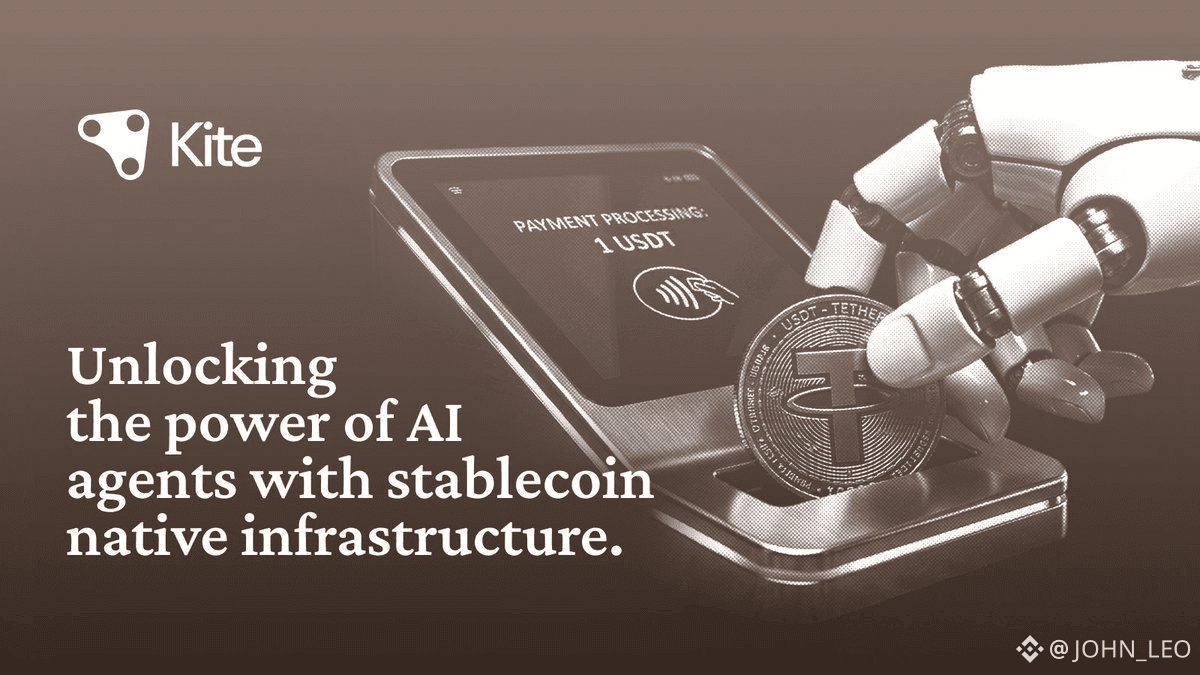
Kite is one of those projects that looks simple on the surface but becomes far more interesting once you examine what is actually happening under the hood. At its core, Kite is not trying to be another generic Layer-1 chasing DeFi liquidity or NFT hype. Its entire design is centered on a single idea that most blockchains still cannot handle properly: allowing autonomous AI agents to transact with each other securely, cheaply, and at high speed, without constant human intervention. That focus is what separates Kite from dozens of other new networks launched this cycle.
The recent launch of the KITE token made this difference very visible in the market. When trading opened across major venues, liquidity came in fast and heavy. Within the first trading window, combined volume across Binance, Upbit, Bithumb, and secondary venues crossed roughly two hundred and sixty million dollars. That is not retail noise. That level of volume, especially so early, typically reflects market makers, funds, and infrastructure players positioning themselves ahead of future utility. The initial circulating market capitalization hovered around one hundred and fifty million dollars, while the fully diluted valuation sat close to nine hundred million. Those numbers matter because they signal expectations. The market is not pricing KITE like a meme or a short-term trade. It is pricing it as infrastructure that could become embedded in future AI-driven systems.
Price action since launch has followed a familiar early-cycle pattern. KITE quickly moved toward the nine-cent range and has spent time consolidating there. This volatility is not a weakness; it is a feature of price discovery. Early holders are rotating, short-term traders are testing liquidity, and long-term participants are quietly accumulating. Compared with speculative tokens that collapse once hype fades, KITE’s behavior looks more like a network token finding a base rather than burning out. The presence of spot, margin, and perpetual futures on exchanges like HTX has accelerated this process by giving both hedgers and directional traders the tools they need.
What actually supports this market interest is the ongoing technical progress. Kite’s Layer-1 is EVM-compatible, which lowers friction for developers, but its real innovation lies in identity separation. Users, agents, and sessions are treated as distinct entities. This means an AI agent can be authorized to perform narrow tasks, such as making micro-payments or settling usage fees, without exposing the full wallet or user identity. From a security and compliance perspective, this is a major step forward. It also aligns with how real AI systems operate, where agents act continuously and autonomously rather than waiting for manual approvals.
Recent development updates confirm that Kite is pushing beyond theory into execution. Cross-chain work with integrations such as Pieverse is focused on allowing agents to move value across ecosystems while retaining identity context. In practical terms, this means an AI service running on one chain could pay for compute, data, or storage on another chain without breaking workflow or requiring a human to step in. Alongside this, the protocol is refining gasless micropayment mechanisms. These are critical for agentic economies because AI agents often need to transact in tiny increments at high frequency. Traditional fee models make that impossible. Kite’s upgrades are explicitly designed to remove that bottleneck.
Stablecoin execution has also been a priority. AI agents do not speculate; they settle obligations. Faster and more predictable stablecoin transfers on Kite reduce operational risk for automated systems. This is not glamorous work, but it is exactly what determines whether a blockchain becomes real infrastructure or remains a whitepaper experiment. The fact that these upgrades are happening alongside exchange expansion suggests a coordinated rollout rather than a rushed token launch.
Market sentiment around KITE remains mixed in the short term, largely because the broader crypto environment is still cautious. Risk assets across the board have seen pullbacks, and even strong narratives are not immune. However, this hesitation cuts both ways. Projects with shallow fundamentals tend to fade quickly in such conditions. Projects building real systems tend to keep shipping quietly. Kite’s continued development during volatility is a positive signal, not a negative one.
Looking forward, the most important milestones are not price targets but functionality. Mainnet maturity, staking activation, and governance mechanics will determine whether KITE transitions from a traded asset into a working economic tool. If staking secures the network while aligning incentives for long-term holders, and if governance gives real influence over protocol parameters, then KITE’s valuation framework will change entirely. At that point, it will be judged less like a token and more like a utility layer for machine-to-machine commerce.
In simple terms, Kite is betting on a future where software pays software. That future does not arrive overnight, and it does not reward hype alone. It rewards networks that are built to handle scale, security, and autonomy from day one. The recent token launch, exchange listings, and infrastructure upgrades suggest Kite understands this reality. Whether the market fully prices it in now or later is secondary. What matters is that the foundation is being laid while most competitors are still arguing about narratives.