
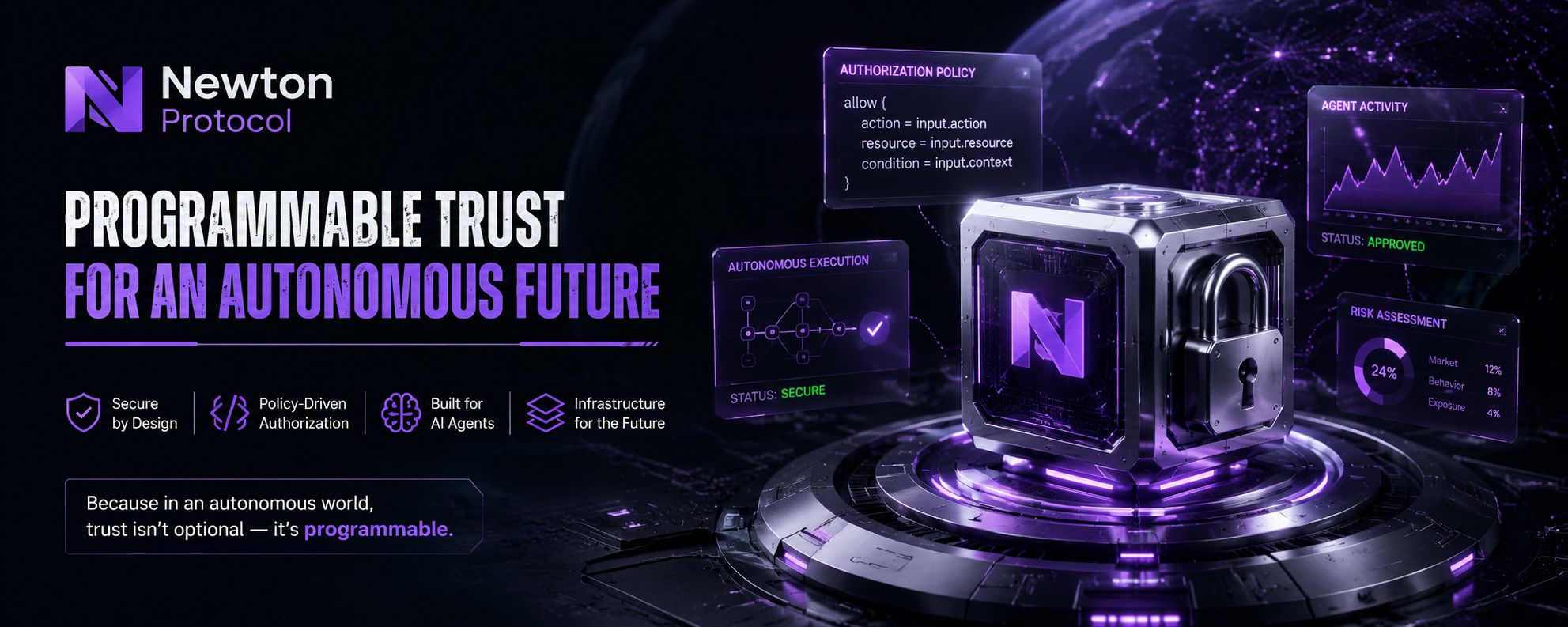
The more time I spend reading about Newton Protocol, the less I think it's really an AI story. To me, it's a trust story. We spend a lot of time talking about what AI agents will eventually be able to do—trade, manage portfolios, move assets, coordinate across protocols—but I don't think we ask often enough who gets to decide what those agents are allowed to do in the first place.
That shift in perspective is what kept me interested. Newton isn't trying to build the smartest AI agent. It's looking at the layer underneath and asking whether authorization itself needs to evolve as software becomes more autonomous. I find that idea surprisingly compelling because crypto has always been obsessed with execution. Faster transactions, cheaper fees, better automation. But execution isn't usually where mistakes begin. They begin when too much power is given away without enough control over how it's used.
Still, I can't ignore the timing. Most people in crypto aren't relying on AI agents to manage meaningful amounts of capital today. They still want to review transactions themselves, even if it's slower. There's something reassuring about pressing the final confirmation button. So I keep wondering whether Newton is solving tomorrow's problem while most users are still focused on today's workflow.
That isn't necessarily a criticism. Some of the most valuable infrastructure was built long before anyone realized they would eventually depend on it. The difficult part is surviving that gap. Building early means asking developers to integrate something they may not immediately need, while asking investors to believe demand will eventually catch up. That's a much harder challenge than simply having good technology.
One thing I appreciate is that Newton seems to recognize that rules shouldn't always be frozen forever. Markets change. Risks change. Even user expectations change. Separating authorization from execution makes intuitive sense because it allows policies to adapt without rebuilding everything from scratch. The concept feels practical the more I think about it. At the same time, flexibility usually comes with complexity, and complexity has a habit of slowing adoption, especially when users don't immediately understand why it matters.
I also think Newton faces a communication challenge that many infrastructure projects struggle with. It's much easier to explain a protocol that promises higher yields or lower fees than one that promises better authorization. Good security rarely creates excitement because, when it works, nothing dramatic happens. The value is often invisible. That makes adoption depend less on marketing and more on whether developers genuinely believe the additional layer is worth integrating.
Then there's the competitive landscape. Almost every AI project in crypto seems to be racing toward the same future, but they're taking different paths to get there. Some believe compute is the bottleneck. Others focus on data, identity, coordination, or agent frameworks. Newton is betting that permissioning becomes one of the most important pieces of that puzzle. It could be right. It could also turn out that users don't feel the need until much later than many expect.
I don't think the biggest question is whether Newton's architecture is impressive. It probably is. The question I keep asking myself is much simpler: will people actually change the way they interact with crypto because of it? That's a much harder question to answer because technology alone has never guaranteed adoption.
In the end, I see Newton Protocol as an interesting idea that's trying to prepare for a future that hasn't fully arrived yet. Maybe that future comes sooner than most people expect. Maybe it takes years. Either way, the market won't decide based on technical elegance or ambitious narratives. It will decide when real users find themselves facing a problem they can't ignore—and choose this solution because it genuinely makes their experience better.


