
In the early days of online gaming, players had to take a leap of faith. You clicked a button, a chest opened, and you either got a legendary sword or a piece of charcoal. But deep down, every player asked the same question: “Is this actually random, or is the house just winning?”
In the Web3 era, "trust me" isn't an option. For GameFi and NFT projects, randomness isn't just a mechanic—it’s the backbone of their economy. This is where APRO Oracle and its Verifiable Random Function (VRF) come in. It’s not just a random number generator; it’s a cryptographic receipt that proves the "dice" weren't loaded.
The Problem: The "Black Box" of Randomness
Most traditional games use Pseudorandom Number Generators (PRNGs). These are algorithms that look random but are actually predictable if you know the "seed" (the starting value). In a decentralized world, if a developer or a malicious miner can predict that seed, they can "snipe" the rarest NFTs or win every lottery.
APRO solves this by ensuring randomness is:
• Unpredictable: No one knows the result until it’s published.
• Unbiasable: Neither the developer nor the oracle nodes can change the outcome.
• Verifiable: Anyone can look at the math on-chain and see it was done fairly.
Case Study 1: The "Fair Mint" Revolution
Imagine a highly anticipated NFT drop. There are 10,000 items, but only 10 are "Ultra-Rare." In a standard mint, savvy bots often track block data to predict when those rares will appear.
How APRO VRF changes the game:
1. The Request: When a user mints, the smart contract sends a request to APRO.
2. The Calculation: APRO’s decentralized nodes generate a random value along with a cryptographic proof.
3. The Reveal: The smart contract verifies the proof. Only then are the NFT traits assigned.
Result: The rarity is decided after the transaction is confirmed, making it impossible for bots to "pick" the winners.
Case Study 2: High-Stakes GameFi Lotteries
Lotteries are the ultimate test of trust. If a player loses a $5,000 jackpot, they want to know it wasn't an inside job.
The APRO Implementation Flow:
Step 1: The Ticket Phase > Players buy tickets; the total pool is locked in a vault.
Step 2: The Entropy Trigger > Once the timer hits zero, the contract "pulls" a random seed from APRO.
Step 3: The Winner Selection > WinnerIndex = RandomOutput \pmod{TotalTickets}
This simple math, powered by APRO’s proof, ensures the winner is chosen by the universe, not a developer.
Why APRO? (The Technical Edge)
While other oracles exist, APRO stands out for its dual-layer verification. It doesn't just deliver a number; it runs that data through a "Verdict Layer" that uses AI-driven checks to sniff out anomalies.
Visualizing the Flow:
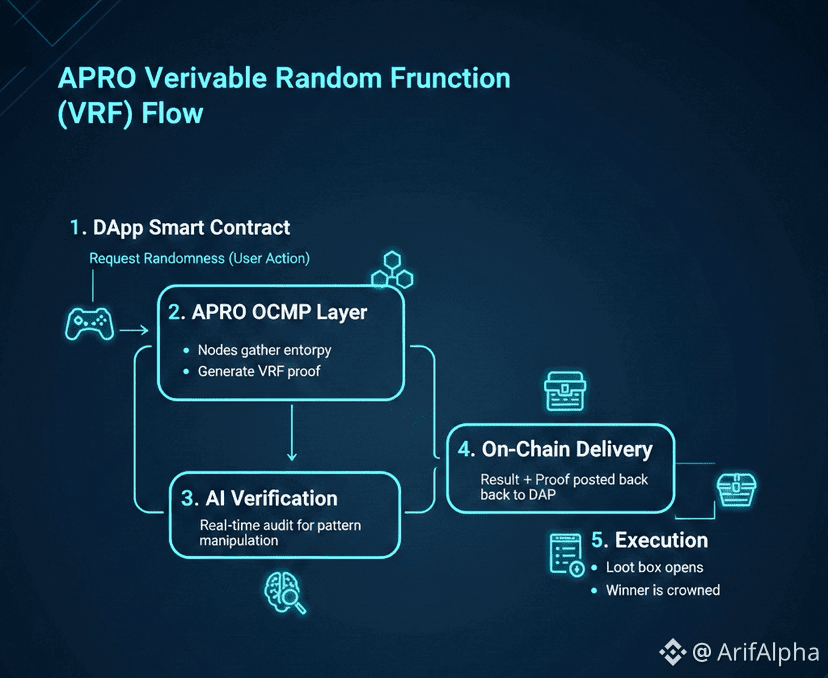
Real-World Scenario: The "Boss Drop"
Think of a MMORPG where a world boss drops a rare item once a week. Without APRO, a developer could technically "gift" that item to a specific wallet. With APRO, the drop is tied to a VRF request triggered the moment the boss dies. The entire community can see the transaction hash and the APRO proof, confirming that the lucky winner truly earned it through pure, unadulterated luck.
The Bottom Line
For GameFi teams, integrating APRO VRF isn't just a technical upgrade; it's a marketing tool. It tells your community: "We don't have the keys to the casino. The math is in charge." In a market where trust is the most valuable currency, verifiability is the ultimate competitive advantage.
If you were building a Web3 game today, would you prioritize lower gas fees or a 100% transparent "fair play" guarantee for your players?

