
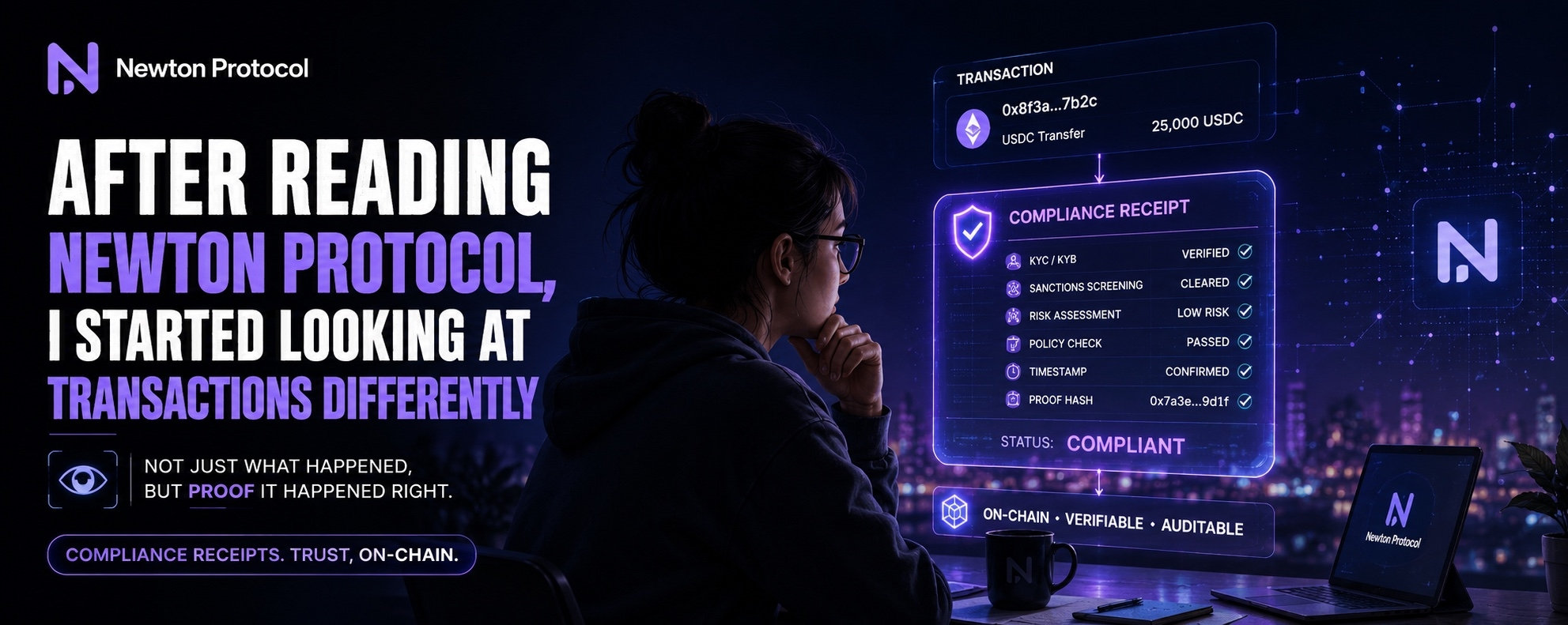
I opened the @NewtonProtocol whitepaper thinking I would skim a few sections before bed.
That never really happened.
I made coffee, read a couple of pages, got distracted by one of the diagrams, checked the $NEWT chart for no particular reason, then went back to the document. Somewhere in the middle I realized I had stopped looking for token-related details and started thinking about one sentence that kept showing up in different forms
The idea wasn’t faster settlement.
It wasn’t AI agents either.
It was compliance receipts.
I honestly expected to dislike the concept.
Maybe that’s because compliance usually sounds like extra paperwork dressed up as infrastructure. In crypto conversations it often feels like the part everyone tolerates rather than the part anyone wants to build.
But the more I sat with it, the more I started wondering if I had been thinking about the problem backwards.
For a long time I treated settlement as the important event.
Funds move.
The transaction is finalized.
Everyone can verify what happened.
That always felt like enough.
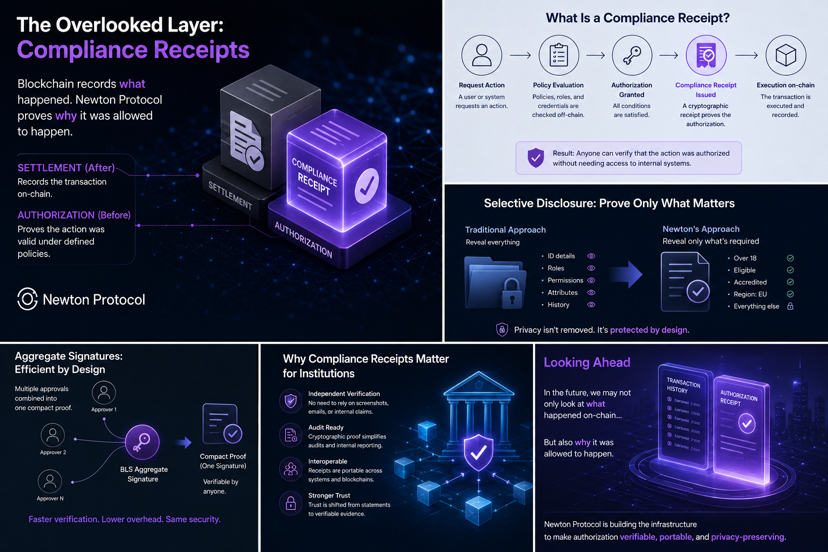
Newton Protocol made me pause because it spends time on something that happens before execution instead of after it. Not settlement itself, but proving that the action was actually authorized under a defined policy before it was allowed to happen.
At first I thought those were basically the same thing.
Then I realized they really aren’t.
Blockchain is already very good at recording that something happened.
It doesn’t automatically explain why that transaction was allowed to happen or whether it matched the rules an institution intended to enforce.
That distinction felt surprisingly practical.
The whitepaper describes authorization as its own layer rather than treating it as something hidden inside wallet software or internal company processes. Policies can be evaluated before execution, and once the required conditions are satisfied, a cryptographic receipt can be produced showing that authorization occurred.
I had to reread that section.
Not because it was especially complicated.
Because I kept asking myself whether anyone would actually care.
Then I thought about how institutions already work outside crypto.
Most organizations don’t simply ask whether a payment happened.
Someone usually wants evidence that approvals were collected correctly, internal rules were followed, required credentials were checked and the process matched policy.
That evidence often lives somewhere completely separate from the payment itself.
Newton seems to be asking whether authorization evidence should become portable and cryptographically verifiable instead of remaining scattered across internal systems.
That surprised me.
I don’t know if compliance receipts become common.
I do think I underestimated why someone might want them.
One detail I kept coming back to involved selective disclosure.
The whitepaper doesn’t frame compliance as exposing every piece of information to everyone. Instead, it discusses verifiable credentials and selective disclosure so that only the information required for a particular authorization needs to be revealed.
That felt like an important distinction.
I’ve seen plenty of debates where privacy and compliance get treated like complete opposites.
Either you reveal everything or you hide everything.
Real life usually isn’t that simple.
If an institution only needs proof that a participant satisfies a specific policy, revealing unrelated personal information doesn’t necessarily improve security.
Maybe I’m simplifying it too much, but selective disclosure seems closer to proving exactly what needs to be proven and nothing more.
I scribbled something in my notebook that probably only made sense because I had been reading for an hour.
Receipts don’t replace privacy.
A few minutes later I crossed it out.
Then I wrote another version.
Receipts prove policy without necessarily revealing everything behind it.
That felt closer to what I thought the paper was saying.
Maybe not perfect.
Closer.
Another part I found interesting was the use of aggregate signatures.
Normally when I read about cryptography in protocol papers, I understand enough to follow the direction without pretending to understand every mathematical detail.
This was one of those moments.
Newton describes using BLS aggregate signatures so multiple approvals can be combined into a compact proof.
I liked that because it wasn’t presented as cryptography for its own sake.
It supports the broader idea that authorization itself should remain efficient even when multiple parties or conditions are involved.
I appreciated that connection more than the cryptography itself.
One thing I still wonder about is adoption.
Technology is one thing.
Institutional processes are another.
Creating a standardized authorization receipt sounds practical on paper, but practical ideas still need organizations to agree on workflows, policies and credential systems.
That part feels much harder than implementing signatures.
Maybe I’m missing something.
Maybe standards develop faster than I expect once enough participants see value in shared verification.
Or maybe every institution insists on building its own version.
I’m honestly not sure.
I also kept thinking about tokenized real world assets.
People spend a lot of time discussing settlement, custody and liquidity.
Those topics matter.
But if regulated assets continue moving across different blockchains, someone eventually has to answer another question.
Who approved this movement, according to which policy, and can another participant verify that approval without trusting screenshots, emails or proprietary databases?
That isn’t the most exciting question in crypto.
It might become one of the most important ones.
I don’t think compliance receipts make decentralized systems less decentralized by default.
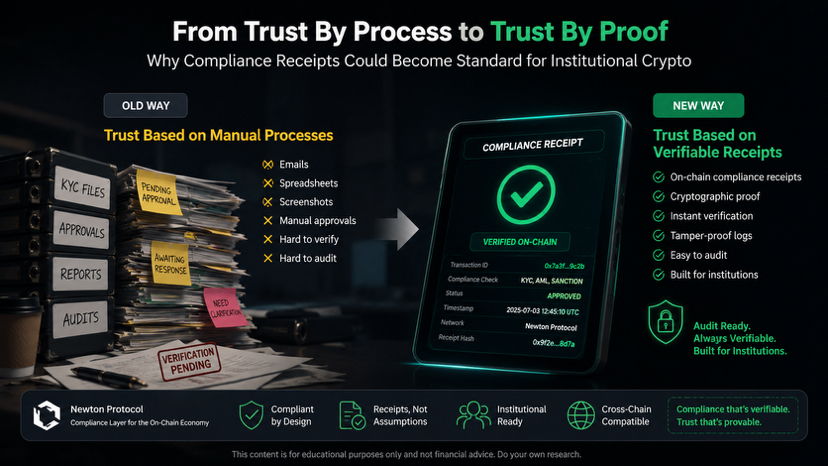
If anything, I see them as shifting trust away from private statements and toward cryptographic evidence.
That’s a different conversation.
Trust still exists.
Policies still exist.
Organizations still decide what rules they follow.
The difference is that authorization can become independently verifiable instead of remaining an internal claim.
I hadn’t really thought about it that way before reading the paper.
It’s funny because I started the evening expecting to spend most of my time thinking about AI agents.
#Newt talks about agent authorization, identities and programmable policies, and those topics are interesting.
Instead I kept returning to the receipt produced after authorization succeeds.
Not because receipts sound exciting.
Because they quietly answer a question I don’t think crypto has always handled well.
How do you prove the rules were followed before execution without asking everyone else to simply trust you?
Maybe compliance receipts stay mostly inside institutional infrastructure where ordinary users never notice them.
Maybe they become as ordinary as transaction hashes eventually became.
Or maybe another approach solves the same problem more cleanly.
I honestly don’t know.
I just know that when I closed the whitepaper, I wasn’t thinking about settlement anymore.
I was thinking about authorization.
And I keep wondering whether a few years from now, we’ll look at transaction history and expect to see not only what happened, but cryptographic evidence explaining why that action was permitted in the first place.
