I used to think the biggest competitive advantage in blockchain was simple.
Build a faster network.
Lower the fees.
Increase throughput.
Problem solved.
The more time I spend reading about institutional finance, though, the less convinced I am that speed is the real bottleneck.
Banks rarely wake up worried that a blockchain needs another thousand transactions per second.
They're usually thinking about something much less exciting.
Control.
Not control over the blockchain itself, but control over how value moves through their own organization.
That difference completely changed the way I looked at Newton Protocol.
At first, I assumed it was another infrastructure project trying to make transactions more efficient. Crypto has plenty of those already. But after digging deeper, I realized the more interesting question isn't how fast a transaction settles.
It's what happens before the transaction is even allowed to exist.
That feels like a surprisingly overlooked part of the conversation.
Imagine a large financial institution processing millions of dollars every day.
No one simply presses "Send."
Risk teams review limits.
Compliance checks regulations.
Internal approval policies determine who can authorize what.
Sometimes those rules change several times a year, even when the underlying payment system stays exactly the same.
The infrastructure doesn't necessarily change.
The policies do.
And maybe that's where blockchain has been looking in the wrong direction.
For years we've competed on speed, scalability, and lower costs.
Those improvements absolutely matter.
But if institutions hesitate because adapting internal policies is difficult, another improvement in transaction speed won't magically solve that problem.
Newton Protocol approaches this from an angle I find genuinely interesting.
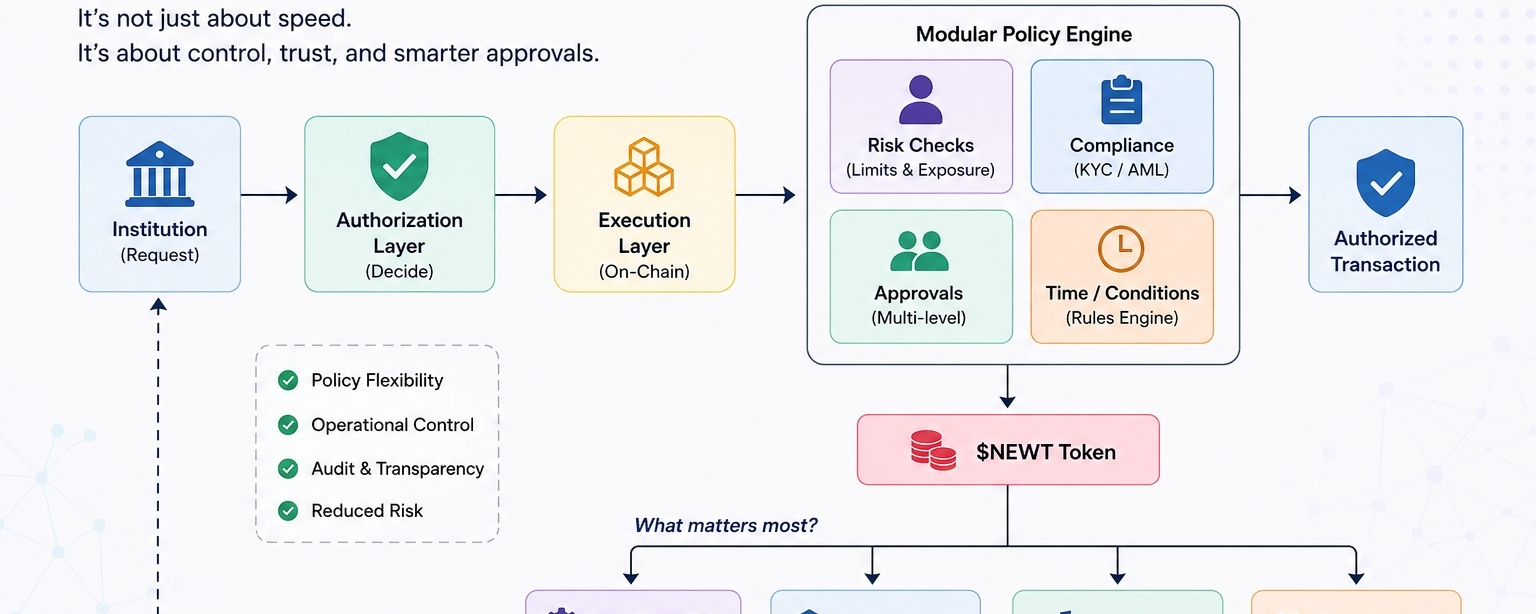
Instead of focusing only on execution, it separates authorization from execution.
That might sound like a technical detail.
I don't think it is.
Authorization is where organizations decide whether a transaction should happen.
Execution is simply carrying out that decision.
Once those two layers become independent, something important changes.
Updating internal policies no longer has to feel like rebuilding the entire system.
Organizations can evolve their rules while keeping the underlying infrastructure stable.
That's exactly how traditional finance has operated for decades.
Banks rarely replace their payment rails because regulators publish new guidance.
They adjust approval workflows.
They strengthen internal controls.
They update policies.
The foundation keeps running.
Crypto, on the other hand, has often tied business logic, permissions, and execution together so tightly that even relatively small policy changes can feel like technical upgrades.
Maybe that isn't the model institutions have been waiting for.
Another thought stayed with me while researching this.
Experience has value.
Developers already trust software libraries that have been tested thousands of times.
Why couldn't authorization frameworks earn trust the same way?
Imagine permission systems that consistently prove themselves across hundreds of organizations, regulatory environments, and real-world financial workflows.
Over time, their biggest strength wouldn't be innovation.
It would be reliability.
That feels incredibly valuable in institutional finance.
The conversation also becomes even more interesting when AI enters the picture.
AI agents may eventually execute trades, manage treasury operations, or rebalance portfolios far more efficiently than humans.
But intelligence alone isn't enough.
Every autonomous action still needs boundaries.
Someone has to define what the AI can approve, what requires additional review, and what should never happen at all.
Without trusted authorization, automation simply creates faster mistakes.
There is also an economic side that shouldn't be ignored.
Infrastructure only becomes durable if people actually choose to build on it.
Reusable authorization frameworks sound compelling, but developers still need a reason to adopt them instead of creating their own systems.
Institutions need confidence that standardized permission layers reduce operational risk rather than introducing another dependency.
If that confidence grows over time, adoption could compound quietly.
Not through hype.
Not through headlines.
But through repeated everyday use.
Of course, none of this guarantees success.
Institutional adoption has never moved quickly.
Different industries, jurisdictions, and regulators may prefer different authorization standards.
Custom-built solutions will always exist.
Those are real challenges.
Still, I can't help thinking the industry is starting to ask better questions.
For years, blockchain projects competed on technical performance.
The next generation may compete on operational trust.
Maybe the strongest infrastructure won't be the one that processes transactions the fastest.
Maybe it'll be the one that makes every important transaction easier to approve, easier to audit, and easier to trust before it ever reaches the blockchain.
Whether Newton Protocol ultimately becomes that layer remains to be seen. But I think it's asking one of the most important questions institutional Web3 still needs to answer.
But I do think it's exploring an idea that's becoming increasingly difficult to ignore.
Perhaps the future of institutional blockchain won't be defined by speed alone.
Perhaps it'll be defined by how intelligently trust is built before execution even begins.