For years, most crypto infrastructure conversations focused on one thing: execution.
Faster chains. Lower fees. Better scalability.
And to be fair, that made sense. Early blockchain systems were still struggling with basic performance. Moving assets efficiently was the main challenge.$OPN
But the more I watched how stablecoins are actually being used inside businesses, the more I realized the bigger issue may not be transaction speed at all.The real issue is control.
Not control in the centralized sense. More like operational control.
Who is allowed to move funds?
Under what conditions?
Who approved the transaction?
How can a company prove those rules were followed?
Crypto became very good at moving money. A business can already send stablecoins globally within seconds. Liquidity moves across chains constantly. Treasury operations are becoming increasingly automated.
But behind the scenes, many companies still manage approvals through spreadsheets, internal chat messages, manual wallet coordination, and fragmented compliance processes.
That disconnect becomes much more visible once larger amounts of money are involved.
This is the part that made Newton interesting to me.Not because it claims to move transactions faster. Almost every infrastructure project says that.
What stands out instead is the focus on authorization infrastructure the systems that determine whether a transaction should happen before it gets executed.
At first glance, that sounds less exciting than scalability or high-speed settlement.
But for businesses, it may actually matter more.
Traditional finance has always relied on approval systems and internal controls before money could move.
Crypto made transfers faster and removed many middle layers, but it also took away some of the structure businesses normally depend on to manage risk and oversight.That creates flexibility, but it also creates risk.@NewtonProtocol #Newt
A single wallet can sometimes control millions of dollars with very little oversight. For individual users, that may be acceptable. For institutions, it becomes much harder to manage.
Imagine a logistics company paying suppliers across several countries using stablecoins.The treasury team might need:
* regional approval systems,
* automated payroll execution,
* transaction limits,
* compliance screening,
* and complete audit records for regulators.
Most blockchain infrastructure was not originally built around those requirements.It was built around permissionless execution.
Newton seems to be exploring how to add programmable authorization on top of decentralized financial systems without completely removing the open nature of crypto itself.
That balance is important.A lot of institutional crypto adoption runs into the same problem sooner or later:How do you keep financial systems open while still meeting regulatory requirements?
Permissionless finance prioritizes accessibility.
Regulatory systems prioritize accountability.
Those two models often clash.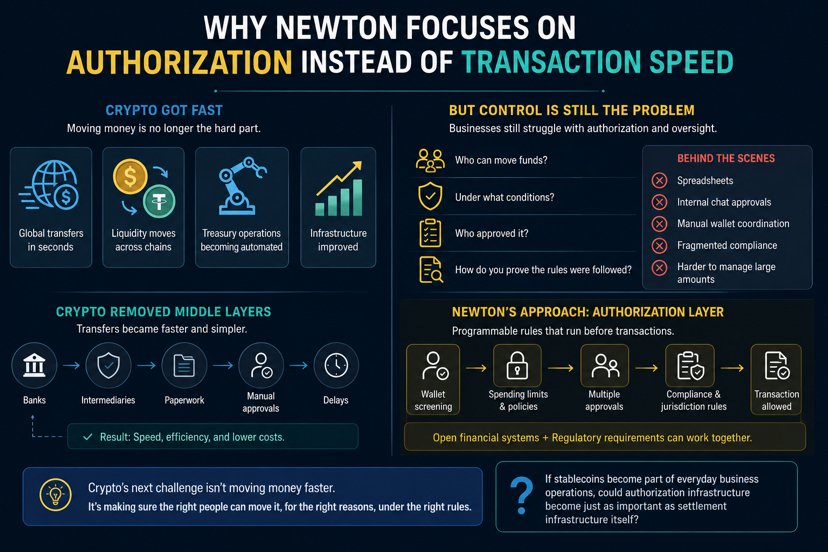
What Newton appears to be doing is trying to create a middle layer where rules can be programmed directly into transaction flows.
For example, a treasury wallet could potentially execute transfers only if certain conditions are met:
* the destination wallet passes screening,
* spending limits stay within policy,
* multiple approvals are completed,
* jurisdiction rules are satisfied.
Instead of relying entirely on manual oversight, some of the authorization logic becomes part of the infrastructure itself.$MSTRB
That could become increasingly important as stablecoin activity grows inside real businesses.
Especially with automation becoming more common.A lot of crypto discussions now involve AI agents managing treasury activity, handling recurring payments, moving liquidity between chains, or interacting with DeFi protocols automatically.The automation sounds efficient.
But it also creates another layer of risk.If automated systems can move large amounts of money, then the rules controlling those systems become extremely important.
Without strong authorization frameworks, automation can scale mistakes just as easily as it scales efficiency.
And this is probably one of the less discussed issues in crypto right now.The industry already has plenty of tools for moving assets quickly.
There are far fewer systems focused on proving that transactions happened according to approved policies and governance rules.
That difference matters more than many people realize.Especially once regulators, auditors, enterprise finance teams, and compliance departments enter the picture.Of course, there are still unanswered questions.
Can programmable authorization remain flexible enough for decentralized systems?
Can compliance requirements be added without slowly recreating traditional banking restrictions onchain?
Can businesses adopt these frameworks without adding too much operational complexity?I’m not sure the industry fully knows yet.But I do think infrastructure around authorization, approvals, and policy enforcement will become much more important as crypto moves closer to mainstream business use.
The industry spent years optimizing how fast money moves.The next phase may focus on proving that money moved under the right conditions in the first place.
If stablecoins eventually become part of everyday business operations, could authorization infrastructure become just as important as settlement infrastructure itself?@NewtonProtocol $NEWT #Newt 

ဆောင်းပါး
Why Newton Focuses on Authorization Instead of Transaction Speed
--
ရှင်းလင်းချက်- ပြင်ပအဖွဲ့အစည်း၏ ထင်မြင်ယူဆချက်များ ပါဝင်ပါသည်။ အကြံပြုချက်မဟုတ်ပါ။ Binance Ai ကို အာမခံချက်မရှိဘဲ အသုံးပြုနိုင်ပါသည်။ See T&Cs.