
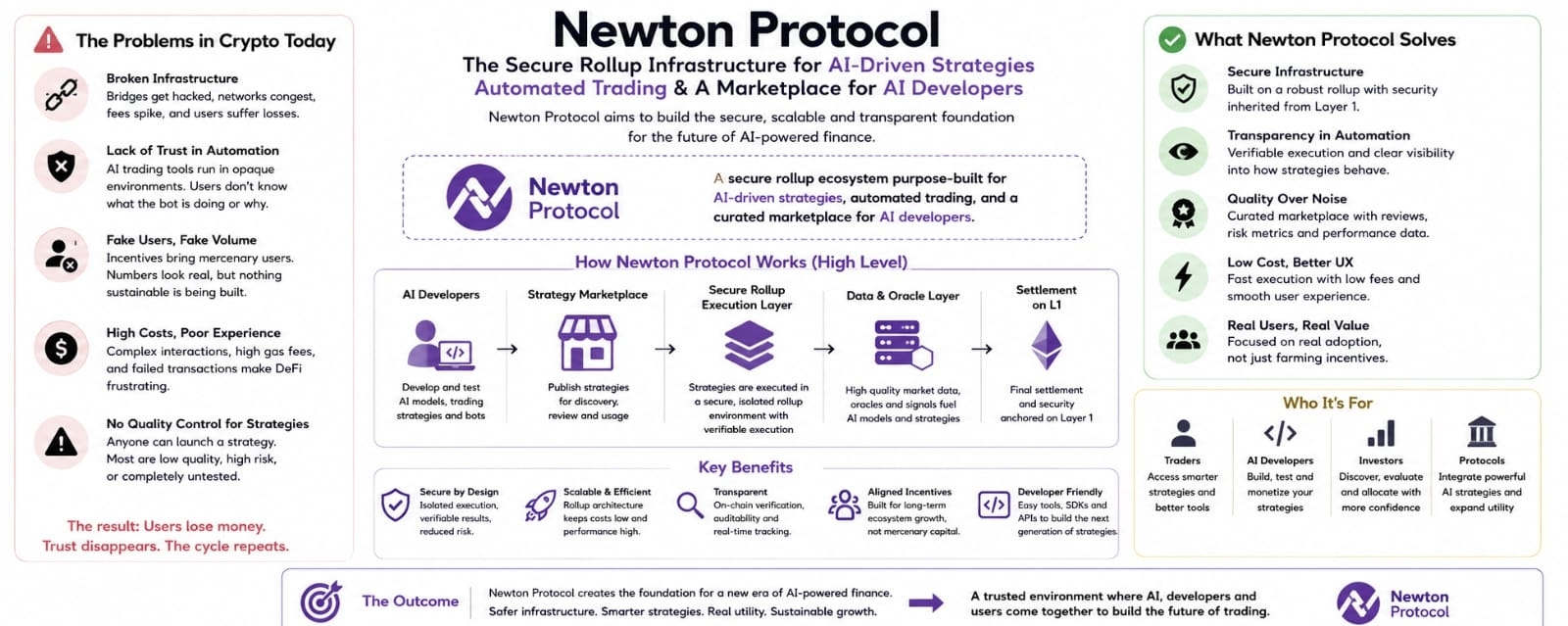
Newton Protocol feels like one of those projects I had to sit with for a while before saying anything, because the first reaction is too easy.
AI trading. Rollup. Marketplace. Token.
In this market, those words can make you tired before you even understand the thing.
Look, I have been around long enough to know how crypto works when a new narrative becomes hot. Suddenly every project starts sounding the same. Everyone is building infrastructure. Everyone is solving trust. Everyone is bringing AI on-chain. Everyone has a marketplace. Everyone has some big reason why their token needs to exist.
And after a while, you stop clapping.
You just stare at it.
You ask what actually breaks if this thing does not exist.
That is where Newton became a little more interesting to me. Not because it sounds clean. Not because the idea is easy. It is actually messy. AI-driven strategies, automated trading, and developer marketplaces are not simple things to build around. They touch money, risk, trust, and user behavior all at once.
That is a dangerous mix.
Honestly, crypto has already given us enough trauma without adding AI bots into the middle of it. We have dealt with broken bridges. Fake users farming airdrops. Protocols that looked alive only because incentives were paying people to pretend. High gas fees turning simple actions into painful decisions. Interfaces that made risky behavior look normal. Smart contracts that were technically “working” while users got wrecked anyway.
So when I see Newton trying to build secure rollup infrastructure for automated strategies, I do not look at it like some shiny new toy.
I look at it like plumbing.
Boring plumbing.
The kind nobody cares about until the pipe bursts and everyone starts asking why nobody built it properly in the first place.
That is probably the most honest way to think about Newton. Under the hood, it is not really about making AI sound cool. The AI part gets attention, sure. But the harder question is what happens when automated systems start touching real capital. Where do they run? Who checks them? What limits them? What happens when they fail?
Because they will fail sometimes.
Everything fails eventually.
That is the part people do not like saying out loud. AI does not remove risk. It can move faster than humans. It can process more information. It can make decisions without getting tired. But it can also be wrong with confidence. It can follow bad assumptions. It can behave well in one market and terribly in another.
So if Newton is trying to create infrastructure that actually works for that kind of world, then fine, I get the point.
Not the hype.
The point.
The thing is, automated trading in crypto already exists. Bots exist. Strategy tools exist. People already hand over trust to systems they barely understand. Sometimes they do it because they are lazy. Sometimes because they are desperate. Sometimes because everyone else seems to be doing it and nobody wants to feel left behind.
That is the mess.
Newton seems to be stepping into that mess and saying, maybe this needs a safer environment. Maybe AI-driven strategies should not just be floating around loosely. Maybe developers need a place to build and distribute tools. Maybe users need better rails before automation becomes even more common.
Maybe.
I do not hate that idea.
But I also do not want to pretend it is easy.
This is hard to build. Very hard. It is one thing to say there will be a marketplace for AI developers. It is another thing to make that marketplace useful. Crypto has a graveyard full of marketplaces that had nice designs and no real life inside them. Developers showed up when grants were available. Users showed up when rewards were available. Then the incentives slowed down and the place became quiet.
That can happen here too.
A marketplace needs trust. It needs quality. It needs real users. It needs developers who are not just chasing whatever chain is paying this month. It needs people to believe the tools are worth using when nobody is bribing them to use them.
That is not flashy.
It is just necessary.
And that is why I keep coming back to the infrastructure side. The rollup part is probably less exciting for most people, but it might be the part that matters most. Crypto users usually do not care about the engine. They care when the car stops moving. They care when gas is too high. They care when a bridge breaks. They care when a transaction fails or funds disappear or a system behaves in a way nobody explained clearly.
Infrastructure is invisible until it hurts.
Newton is trying to live in that invisible layer. That makes it harder to sell, but maybe more important if it actually works.
Still, I have questions.
A lot of them.
Do traders really want AI-driven strategies in a structured environment, or do they just want easy profit buttons?
Do developers actually need Newton, or will they build wherever liquidity and attention already exist?
Does the NEWT token have a real job inside the system, or is it just there because crypto expects every project to have a token?
That last question matters.
It always matters.
I have seen too many projects where the token became louder than the product. The chart became the community. The community became the product. The actual infrastructure sat in the background while everyone argued about listings, unlocks, and price action.
That is not a Newton-specific problem.
That is crypto.
But Newton still has to survive inside that behavior.
Honestly, the token side is where I stay careful. A token can help coordinate a network. It can support usage. It can give participants a reason to contribute. But it can also turn a serious infrastructure idea into another speculative object people trade without caring what is being built.
Both things can be true.
That is what makes this space exhausting.
I can see why Newton might matter. I can also see how the market could ignore the real work and only care about the narrative. AI plus trading plus token is an easy story for people to repeat. But easy stories are not always durable. Sometimes they burn hot and disappear.
The real test is quieter.
Can Newton make automated strategies safer to run?
Can it give AI developers a reason to build there?
Can it create trust without asking users to blindly believe another black box?
Can it keep the focus on infrastructure that actually works instead of letting the token swallow the whole conversation?
I do not know.
And I do not think anyone should pretend they know.
Look, I am not here to act like Newton has solved everything. It has not. At least not in a way the market can fully judge yet. There is a big difference between pointing at a real problem and becoming the thing people actually use to solve it.
Crypto forgets that all the time.
A good idea is not adoption.
A clean concept is not product-market fit.
A token is not demand.
Maybe Newton takes time. Maybe it has to go through ugly phases. Maybe people only understand the need after more AI trading tools break, or after more users get burned by automation they trusted too easily. That would be very crypto, honestly. We usually learn after the damage.
Pain first.
Infrastructure later.
That is why I am cautious but not dismissive. Newton is at least looking at a real problem under the hood. The crypto market is moving toward more automation whether people admit it or not. AI agents, trading bots, strategy systems, execution layers, all of that is already creeping in. The question is whether we build proper plumbing around it or just let everyone connect random pipes until something floods.
Newton seems to be trying to build the plumbing.
Maybe it works.
Maybe it takes longer than people want.
Maybe the market does not care until something breaks.
That is usually how this industry behaves.
So my feeling on Newton is not hype. It is not blind belief. It is more like tired curiosity. The kind that comes after watching enough projects promise the world and deliver a dashboard. I want to see whether this becomes real infrastructure or just another AI-cycle name people talk about for a few months.
The idea makes sense.
The build is hard.
The trust problem is real.
And for once, that is enough for me to keep watching without pretending I already know the ending.