
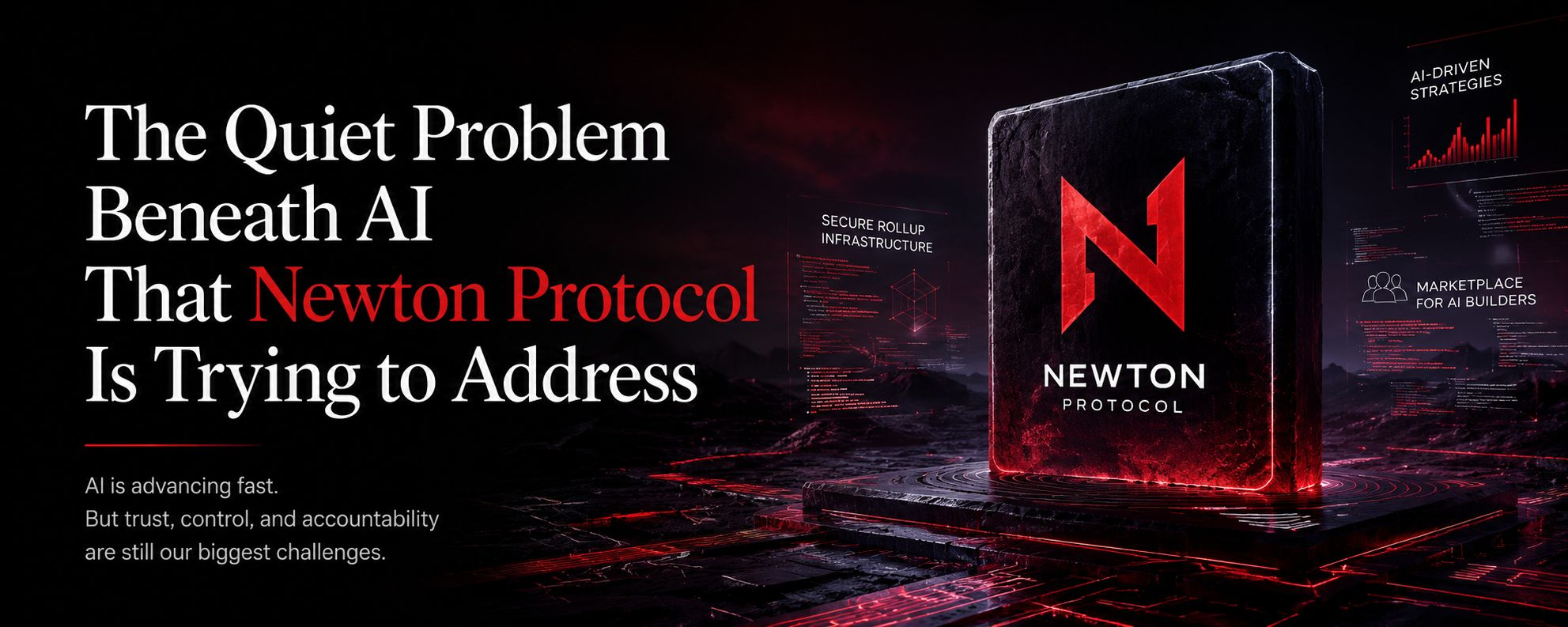
I'll be honest, I didn't expect Newton Protocol to hold my attention for very long. The combination of AI and crypto has become so common that I instinctively approach new projects with a degree of skepticism. Every protocol seems to promise a future where intelligent agents manage portfolios, execute trades, optimize strategies, and remove the inefficiencies of human decision-making. After hearing the same narrative repeated enough times, it becomes difficult to separate genuine architectural ideas from polished storytelling.
What made me stay with Newton wasn't the promise of smarter AI. It was the realization that the project is asking a quieter question, one that feels much more important than building another intelligent model. It asks what happens after AI becomes capable enough to move real money, interact with financial infrastructure, and make thousands of decisions without human intervention. At that point, intelligence is no longer the hardest problem. Trust becomes the harder one.
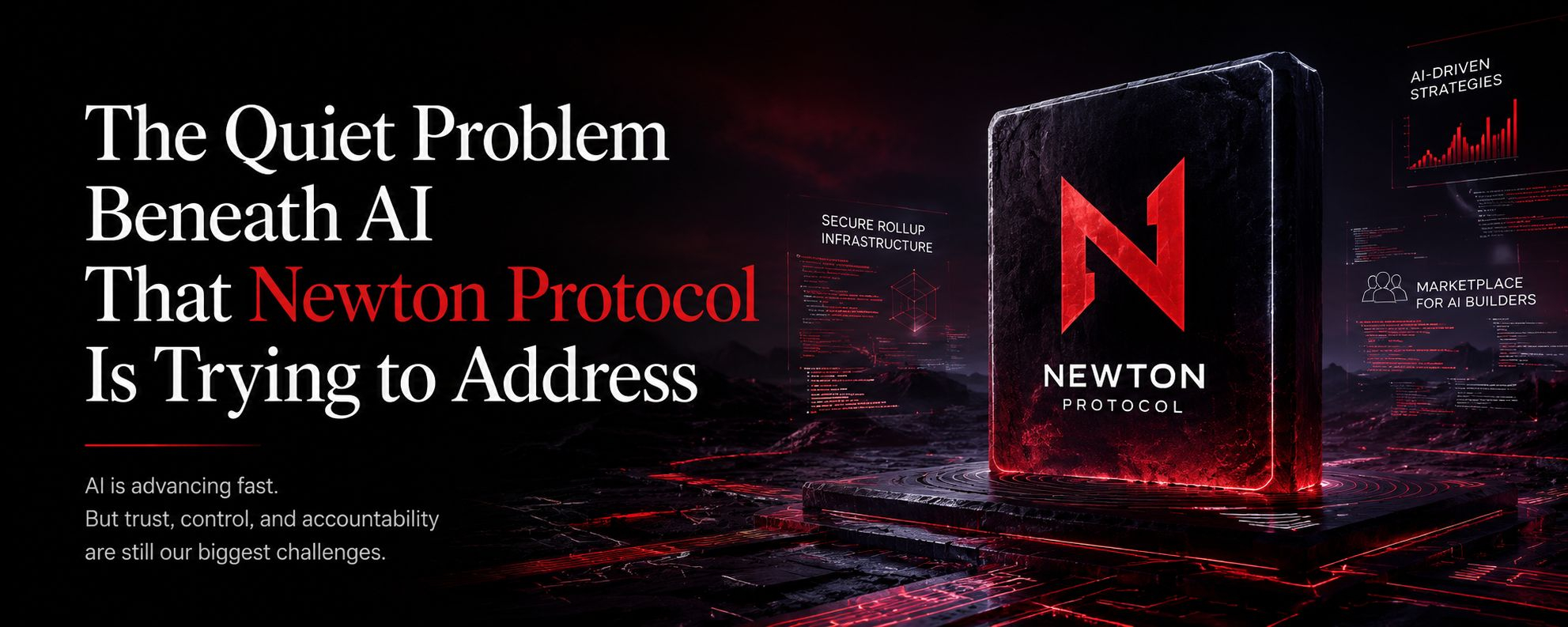 That shift in perspective made me rethink where the real bottleneck might be.
For years, the crypto industry has focused on removing intermediaries. Smart contracts replaced institutions in many situations because code could enforce rules more consistently than people. At the same time, AI has been evolving in almost the opposite direction. Instead of enforcing predetermined rules, modern AI systems interpret information, adapt to changing situations, and make probabilistic decisions. Those qualities are exactly what make AI useful, but they are also what make it difficult to trust with irreversible financial actions.
Most discussions stop at how intelligent an AI model can become. Newton seems more interested in asking how much authority that intelligence should actually receive. That difference sounds small until you think about what autonomous software could eventually control. A trading strategy connected to multiple protocols is no longer just software. It becomes an economic participant capable of creating consequences that cannot simply be undone.
The uncomfortable reality is that intelligence and judgment are not the same thing. An AI model might identify profitable opportunities with remarkable accuracy while still making decisions that ignore context, risk tolerance, or the intentions of the person who deployed it. Giving an algorithm unrestricted access to digital assets because it performs well in testing feels strangely similar to trusting a stranger with the keys to your house because they solved a difficult math problem. Competence alone has never been enough to justify complete authority.
That is where Newton becomes more interesting than I initially expected. Instead of treating AI as something that should eventually replace human oversight, the protocol appears to build around the assumption that oversight should remain part of the system itself. The secure rollup is not simply another technical layer designed to increase efficiency. It functions as a framework where AI operates within predefined boundaries instead of unlimited permissions. In many ways, the architecture reflects an old human lesson. Freedom without responsibility rarely ends well, whether the participant is a person or a machine.
I find that philosophy surprisingly refreshing because it accepts something the technology industry often tries to ignore. Every powerful system eventually becomes a governance problem. The moment software begins making meaningful decisions, someone has to determine what it is allowed to do, who is responsible when it fails, and how those responsibilities are distributed across a network of participants. These questions cannot be answered by larger language models or faster blockchains. They belong to the architecture surrounding the intelligence rather than the intelligence itself.
The marketplace for AI developers also becomes more interesting when viewed through that lens. At first glance, it resembles another place where builders can publish strategies and tools. But underneath that is a broader attempt to coordinate value in a world where contribution has become increasingly difficult to measure. Modern AI depends on researchers, infrastructure providers, data contributors, developers, validators, and countless invisible participants whose work often disappears into larger systems. The internet has become remarkably efficient at creating value while remaining surprisingly poor at recognizing where that value originated.
Crypto has long argued that transparent ownership can reshape incentives. Newton seems to extend that conversation beyond digital assets and toward digital intelligence itself. The question is no longer only who owns a token or a wallet. It is who deserves recognition when autonomous systems generate economic outcomes through layers of interconnected contributions. That may sound abstract today, but it feels like a question that will become much harder to ignore as AI becomes woven into financial infrastructure.
Of course, elegant ideas rarely survive contact with reality unchanged. Permission systems introduce friction. Verification consumes resources. Governance attracts disagreement. Economic incentives create behaviors that no whitepaper fully anticipates. A protocol can be technically sound while still struggling because participants respond to incentives in unexpected ways. Decentralized systems do not eliminate politics; they simply make political decisions visible instead of hiding them behind corporate structures.
I think that is one of the reasons Newton feels intellectually honest to me. It does not appear to assume that decentralization magically removes complexity. If anything, it acknowledges that complexity must be designed carefully rather than avoided. Every rule protecting users also limits flexibility. Every safeguard slows something down. Every attempt to distribute authority creates new coordination challenges somewhere else in the network. Those trade-offs are not signs of failure. They are the unavoidable cost of building systems that people are expected to trust.
As I spent more time thinking about the protocol, I realized my interest had very little to do with AI models or blockchain throughput. What stayed with me was a broader philosophical idea. For a long time, technology has been obsessed with making machines more capable. Perhaps the next stage is not about increasing capability but about defining responsibility. Intelligence without boundaries eventually becomes difficult to distinguish from risk. Infrastructure that quietly limits power may prove more valuable than infrastructure that endlessly expands it.
I still have questions about Newton Protocol. I wonder whether developers will accept stricter execution environments if they reduce flexibility. I wonder whether users will tolerate additional layers of security when convenience has become the defining expectation of modern software. I wonder whether governance can remain practical as ecosystems grow larger and incentives become more complicated. Those uncertainties matter because they remind us that thoughtful architecture is never the same thing as guaranteed adoption.
In the end, what I appreciate most about Newton Protocol is not that it claims to solve the future of AI. It is that it shifts attention toward a problem that feels strangely neglected. As autonomous systems become more common, society will probably spend less time asking whether AI can make decisions and far more time asking under what conditions it should be allowed to make them. Ownership, accountability, and coordination may ultimately shape the next generation of digital infrastructure more than raw computational intelligence ever could. Newton is not interesting because it offers certainty. It is interesting because it quietly recognizes that trust is something systems must earn through design, not something they inherit simply because they are intelligent.
