
Look, I've been around long enough to know that crypto falls in love with new narratives faster than it fixes old problems. One month everyone is chasing memecoins, the next month it's AI. Then the timeline fills up with threads explaining why this thing changes everything. A few months later, nobody talks about it anymore. That's why I wasn't in a rush to care about Newton Protocol. AI attached to a token isn't exactly a rare sight these days.
The thing is, after looking past the headlines, I realized Newton isn't really trying to sell another AI trader. That's the boring part people miss. It's trying to deal with something every active on-chain user has complained about for years.
Doing the same things. Again and again.
Claim rewards. Move funds. Rebalance positions. Check liquidation prices. Sign another transaction. Bridge assets. Wait. Sign another transaction.
It's exhausting.
Anyone who has spent enough time in DeFi knows that feeling. You don't even lose money because your strategy was bad. Sometimes you lose because you were asleep. Or gas fees were insane. Or the bridge got congested. Or you forgot to move collateral before the market dumped. Crypto doesn't always punish bad decisions. Sometimes it just punishes being human.
Honestly, that's the part Newton caught my attention with.
Instead of asking people to hand over their wallet to some mysterious bot, it tries to build rules around automation. That's a very different idea. Let software do the boring work, but don't let it do whatever it wants. Sounds obvious. Somehow it hasn't been.
Crypto has a terrible habit of making users choose between convenience and security. You either click through every transaction yourself until you're sick of it, or you approve some smart contract with permissions you'll probably forget about six months later. We've all done it. Most of us probably still have approvals sitting out there that should've been revoked a long time ago.
Newton is basically trying to clean up that mess.
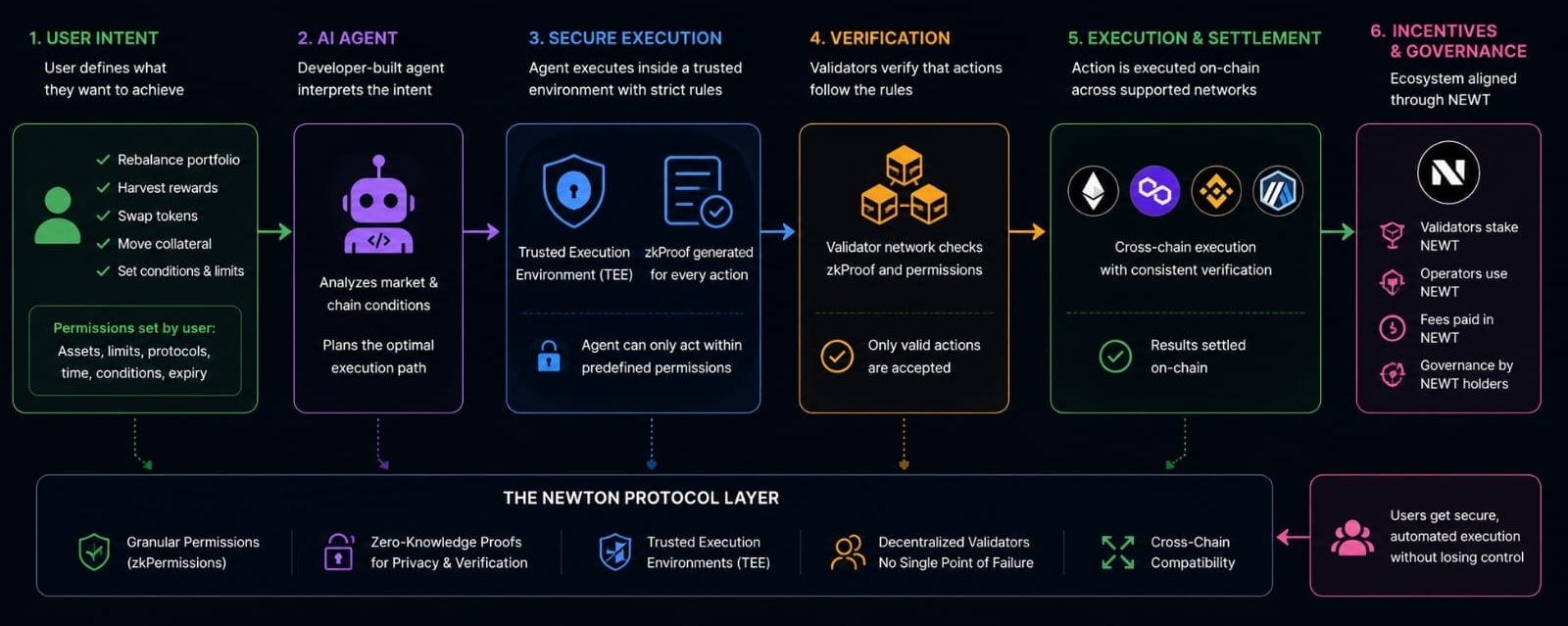
Under the hood it's using things like zero-knowledge proofs, trusted execution environments and a validator network to make sure automated actions stay inside limits set by the user. That sounds technical because it is. But the point isn't the cryptography. The point is simple. If an AI agent is supposed to swap tokens, then it shouldn't suddenly be able to empty your wallet because something went wrong.
That kind of plumbing isn't exciting.
It's just necessary.
I also like that the protocol isn't pretending AI magically solves trading. Markets are still markets. No protocol fixes fear, greed or bad timing. People still make terrible decisions. AI doesn't erase volatility. It just takes repetitive work off your plate so you don't have to babysit your wallet every hour.
The marketplace they're building is probably the part I'm most curious about. Developers create agents. Users choose which ones they trust. Validators check whether those agents actually followed the rules. At least that's the idea. It makes more sense than relying on one company running everyone's automation behind closed doors.
Will it work exactly like that?
Maybe.
Maybe not.
That's the hard part.
Infrastructure like this takes time because nobody notices it until it breaks. Bridges looked great until billions disappeared. Cross-chain tools sounded easy until people actually depended on them. Security always looks boring right up until the day you need it.
The token itself, NEWT, also feels tied to the protocol instead of floating around without a purpose. Validators stake it, operators use it, governance depends on it and fees move through it. That's healthier than projects where the token exists simply because every project thinks it needs one. Still, token utility means very little if nobody ends up using the network. Crypto has taught that lesson enough times already.
Look, I'm not saying Newton becomes the standard for AI automation. Nobody knows that. Crypto has a way of humbling everyone, especially the people making confident predictions. Good ideas fail. Average ideas sometimes explode because the timing is right. That's just how this market works.
What I do know is that the problem Newton is trying to solve feels real. The friction is real. The endless transactions are real. The constant wallet management is real. If crypto is serious about bringing more people on-chain, somebody has to deal with that layer of the experience instead of pretending users enjoy spending half their day signing transactions.
Maybe Newton ends up being part of that answer. Maybe someone else builds it better a year from now. I'm still watching. That's usually where the interesting projects live anyway—not in the loudest part of the market, but somewhere underneath it, quietly trying to make the machinery a little less painful to use.