

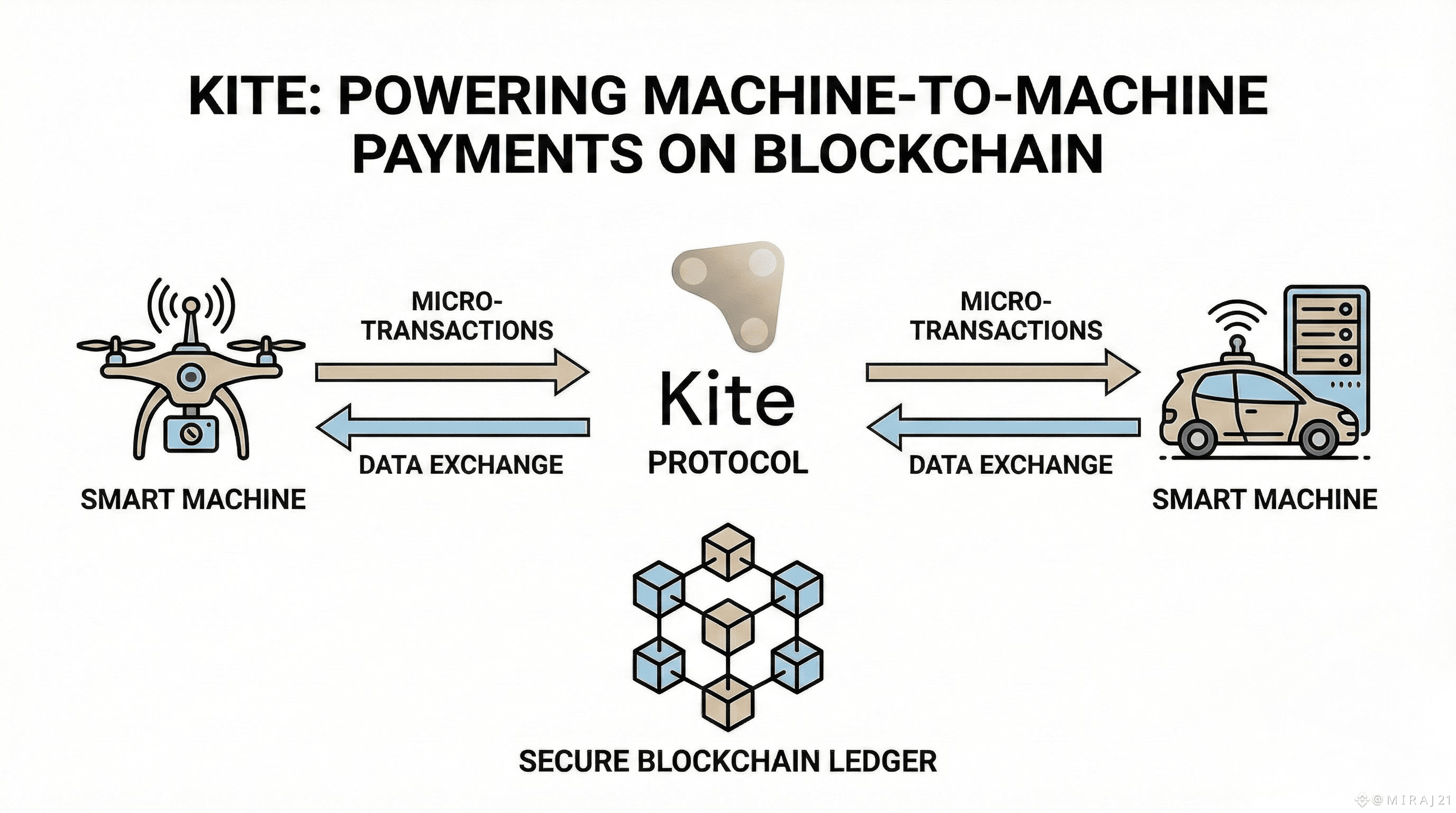
 The next economic leap won't come from people clicking faster. It will come from machines paying each other, Craig Newmark, the founder of Craigslist, said in 2011. Craigslist has
For decades, electronic payments have been designed with a focus on human intent. This includes wallets, confirmations, approvals, and trust assumptions related to manual control. However, since AI agents have become capable of negotiating tasks, buying resources, and managing workflows independently, there is a need for machine-to-machine (M2M) payments now.
KITE is one of the first blockchain architectures to be designed with this purpose in mind that of software agents transacting with other software agents as economic agents.
Traditional blockchains were never meant to support autonomous commerce.
Most chains assume that every transaction originates from a human decision. This assumption breaks down immediately in a machine economy. Autonomous agents need to:
transact continuously, not episodically
operate within strict spending and risk constraints
execute micro-payments at high frequency
settle instantly and predictably
function without manual signature approval
Legacy blockchains introduce friction at every step. KITE removes those frictions by treating machines as first-class economic participants.
Machine-to-machine payments require policy, not permission prompts.
A human wallet asks, “Do you approve this transaction?”
A machine wallet must ask, “Is this transaction allowed under policy?”
KITE’s payment model replaces discretionary approvals with policy-governed wallets, where agents transact only if predefined conditions are met. These conditions include:
task-specific budgets
daily or periodic spend caps
whitelisted counterparties
risk thresholds
emergency stop logic
treasury allocation rules
This allows machines to pay each other safely, repeatedly, and autonomously without compromising control.
Micro-payments become viable only when cost and latency disappear.
Machine economies depend on tiny, frequent payments:
agents paying for inference
agents buying data
agents renting compute
agents compensating sub-agents
agents settling workflow results
On traditional chains, unpredictable fees and slow settlement make this impossible. KITE is engineered for deterministic, low-friction execution, enabling payments that are measured in seconds or fractions of seconds rather than blocks and confirmations.
The Instruction Layer creates demand for M2M payments.
Payments only matter when work is being done.
KITE’s Instruction Layer turns agent capabilities into marketable services, allowing agents to:
advertise skills
accept tasks programmatically
price outputs dynamically
settle compensation automatically
Once instructions are routable and services are discoverable, machine labor markets emerge naturally and payments become the connective tissue that holds them together.
Machine-to-machine payments change how value flows through the economy.
In human economies, value moves in bursts.
In machine economies, value moves continuously.
Agents don’t wait. They don’t speculate. They optimize.
This results in:
smoother capital flows
reduced volatility
fewer speculative distortions
higher capital efficiency
faster economic feedback loops
KITE’s architecture is designed to support this steady, utility-driven flow of value rather than hype-driven transaction spikes.
Security moves from trust assumptions to enforced behavior.
It is clear that letting machines make trades is fraught with danger unless these actions are limited at the protocol level. KITE mitigates this issue by ensuring that:
Agents cannot go beyond their encoded permissions
“The term ‘spending behavior’
execution paths are deterministic
failures degrade gracefully
Anomalies cause automatic stop
This, in turn, creates a payment system where independence can never mean chaos but mean controlled independence.
M2M payments enable novel economic primitives.
Once machines can pay machines, new patterns emerge:
autonomous supply chains
AI agents hiring other AI agents
self-funding software services
recursive service economies
machine-native marketplaces
capital that allocates itself
These systems do not require human intervention once deployed. They scale horizontally, operate continuously, and optimize relentlessly.
KITE is built to host these primitives at the base layer.
Enterprises care about predictability, not novelty and M2M payments deliver it.
For organizations deploying autonomous systems, the priority is not experimentation but reliability. KITE’s approach enables enterprises to:
deploy agent fleets with fixed budgets
monitor spend without approving each transaction
enforce compliance automatically
audit economic behavior in real time
scale operations without scaling oversight
This is the difference between a demo and a production system.
Machine-to-machine payments will feel invisible and that is the point.
Just as APIs quietly reshaped software without users noticing, M2M payments will reshape economic infrastructure without headlines. Value will move constantly in the background, orchestrated by agents responding to demand signals and policy constraints.
The chains that succeed will be the ones users barely notice because machines handle everything.
KITE is not enabling faster payments it is enabling autonomous economies.
This difference is important. Speed by itself does not build a new economy. Autonomy does.
By combining policy-governed wallets, deterministic settlement, instruction routing, and agent-native identities, KITE provides the missing rail for machine commerce.
Human payments moved the digital economy online.
Machine payments will move the digital economy beyond humans.
When machines can pay each other safely, capital stops waiting for permission and economies begin to operate at machine speed.

