

 In every market cycle, the real test of a yield strategy is not how much it earns but how little it loses.
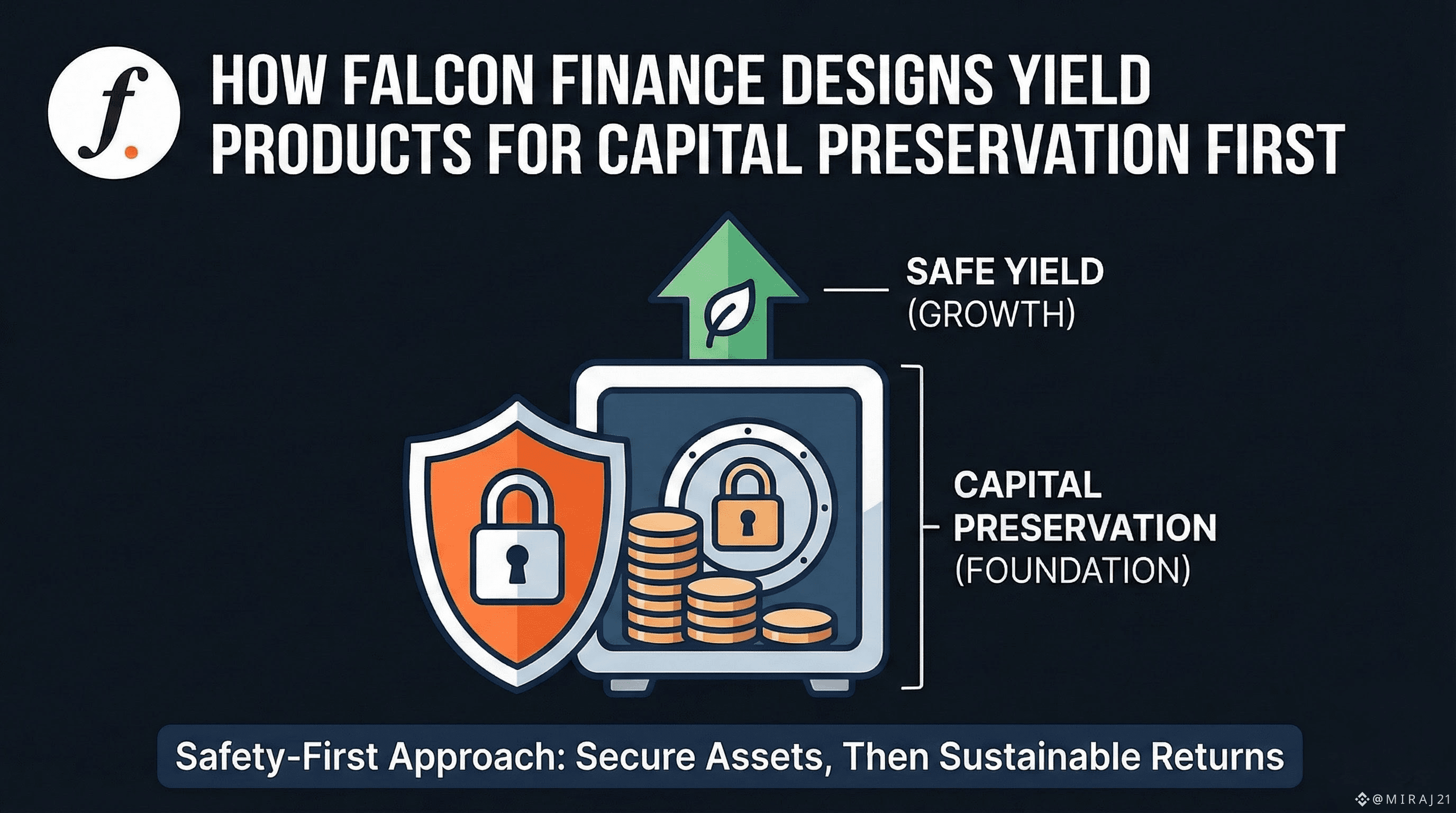
DeFi’s early years trained users to chase APY without questioning its cost. Capital flowed toward the loudest numbers, often ignoring drawdowns, tail risk, and structural fragility. Falcon Finance approaches yield from a different angle. Its product philosophy starts with a constraint, not a promise: capital must survive first. Yield is treated as a secondary outcome, earned only when risk is explicitly bounded.
Capital preservation is a design principle, not a marketing claim.
Many platforms talk about “risk management” after yield is engineered. Falcon inverts the process. Strategy design begins by defining what cannot happen forced liquidations, unbounded downside, dependency on fragile incentives before asking what can be earned within those limits.
This framing immediately narrows the universe of acceptable strategies, but it also produces returns that persist across regimes rather than evaporate during stress.
The first layer of protection is source-of-yield discipline.
Falcon focuses on yield sources that are stable rather than those that provide a short-term boost. It gives preference to:
protocol-native fees generated by real usage
carry and basis derived from market structure
risk-controlled market-making income
collateralized lending spreads
By contrast, strategies that rely heavily on emissions, reflexive leverage, or thin-liquidity arbitrage are treated cautiously or excluded entirely. Preservation begins by refusing fragile income.
Risk is broken down before it is improved.
Falcon does not assess strategies by headline APR. It divides them into exposure vectors:
market risk
liquidity risk
leverage risk
oracle risk
counterparty risk
governance and parameter risk
operational and execution risk
Only after each vector is mapped and then bounded does optimization begin. Such decomposition ensures that no risk silently becomes dominant in the strategy.
It viewed leverage as a controlled tool, not as a growth engine.
Leverage is often the quickest route to return and the quickest route to ruin. Falcon’s design treats leverage as optional, conditional, and reversible. Where leverage is used, it is:
conservatively capped
tied to volatility thresholds
monitored continuously
automatically reduced during the stress.
Justified by structural carry rather than speculation.
It aims not for maximum amplification, but for resilience against adverse price movement.
Liquidity assumptions are stress-tested, not assumed.
Most DeFi strategies fail due to models that always assume exits are available. Falcon makes explicit modeling of liquidity under degraded conditions:
Widened spreads
partial pool withdrawal
correlated liquidity flight
The delayed settlement
Slippage under forced unwind
Strategies unable to implement graceful exit in periods of stress are either re-designed or discarded. Capital preservation involves planning for the worst rather than the best trade.
Oracle and pricing integrity are first-order risks.
Incorrect prices incur greater losses than slow execution. Falcon emphasizes oracle robustness by:
avoiding single point of failure dependencies
Preferring deep, high-integrity markets
Buffer liquidation thresholds in design
reducing the sensitivity to transient price spikes
That also ensures that capital is not sacrificed to data noise or short-lived dislocations.
Duration and redemption structure guard against reflexive runs.
Instant liquidity is dangerous in stressed markets. Falcon brings in duration logic and a well-designed withdrawal mechanism that provides an efficient balance between flexibility for the user and stability for the system. In this case, it cuts down:
For example, forced selling cascades
liquidity mismatches
first-mover advantage dynamics
destabilizing bank-run behaviour
Preservation is not about individual job protection alone; it's about systemic stability preservation.
Strategy is not a static entity but an ongoing process of evolution.
Market conditions change faster than code. Falcon’s approach assumes that no strategy remains optimal forever. Capital preservation depends on:
ongoing parameter review
Governance-Aware Adjustments
monitoring of the incentive decay
Regime Detection
De-risking ahead of volatility spikes
Static strategies break; adaptive strategies endure.
Transparency is a preservation mechanism, not a courtesy.
When people understand risk, they better protect their capital. Falcon's design philosophy emphasizes:
clarity regarding the sources of yield
visibility into risk tradeoffs
Realistic expectations in drawdowns
performing smoothing illusion avoidance
When expectations are anchored, panic behaviour clears off and capital lasts longer.
The institutional lens: Why Preservation attracts durable capital.
The professionals do not look for maximum upside but seek controlled exposure with known failure modes. Falcon naturally aligns with this mindset through its preservation-first design by:
bounding worst-case outcomes
minimizing the risk of dependency
prioritizing survivability over optics
Designing for multiple market cycles
This is how protocols make long-term trust, rather than short-term
inflows. Yield has significance only after survival has been ensured.
Falcon Finance demonstrates a quiet but critical evolution in DeFi thinking. Yield is no longer the objective; it is the reward for disciplined risk design.
In a market defined by volatility and reflexivity, the ability to stay in the game is the highest return of all.
In finance, compounding only works if capital remains intact. The most sophisticated yield strategies are not those that earn the most but those that endure the longest.

