
Was resetting my Ledger this afternoon after a firmware update — tedious, re-entering approvals for stuff I forgot I even had permissions on. Somewhere in the middle of clicking "confirm" for the fifth time, I ended up on Newton's docs tab I'd opened earlier and never closed.
Not really planning to read anything technical at that point, just needed something to look at while the device synced. But I landed on the section walking through how an agent executes a task inside Newton's environment, and I actually stopped resetting my wallet to read it properly.
The whole "AI agents redefine dApps" pitch around @NewtonProtocol is built on this idea that agents replace the UI — instead of you clicking through a dApp's interface, an agent just goes and does the thing. Swap, stake, whatever. That's the redefinition everyone's excited about. So I went looking for the part where the agent actually signs and sends the transaction on its own.
I couldn't find it. Or — I found something, but not that.
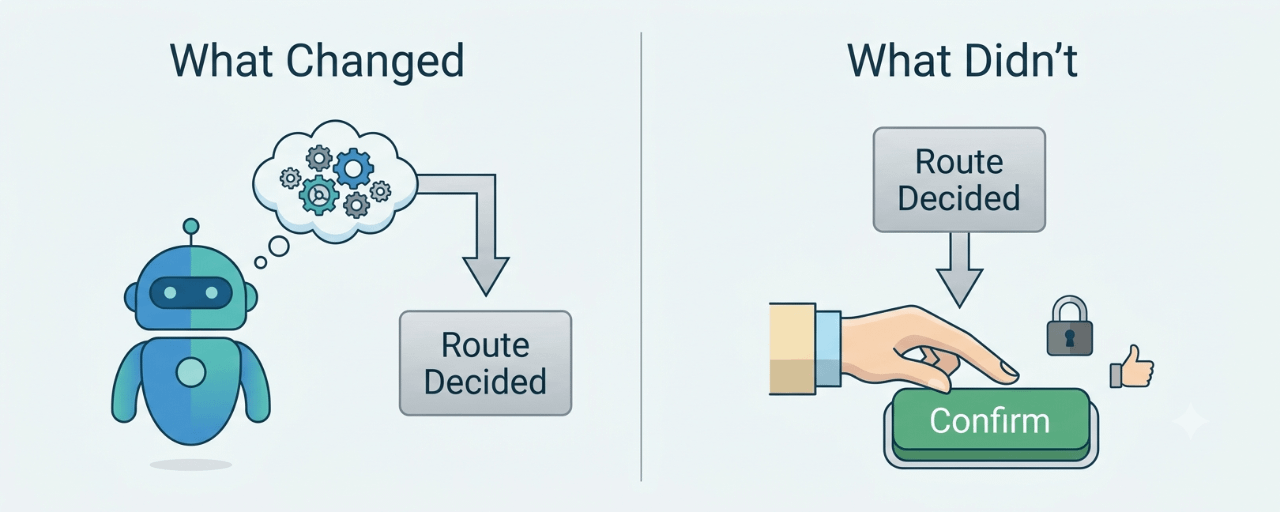
What's actually happening is the agent does the reasoning and the routing, decides what should happen and in what order, and then it hands the actual transaction back to a human wallet for signature. Every single time. The "agent" is doing the thinking part of the dApp experience, but the doing part — the part that actually touches funds — still routes through the same confirm-in-your-wallet step dApps have used since 2018.
I thought that was maybe just a safety rail for now, something they'd loosen later. But actually, sitting with it longer, I'm not sure that's a rail they can loosen without changing what the product fundamentally is. The second an agent gets standing permission to sign and send without a human in the loop, you're not talking about a smarter dApp anymore, you're talking about giving a piece of software custody. That's a completely different risk category, and completely different regulatory territory too.
Here's the part that bothers me. The "redefine dApps" narrative implies the human clicking through menus is the bottleneck being removed. But from what I'm looking at, the human wasn't the bottleneck — the human is the permission layer, and permission is the actual hard problem here, not interface design. Newton's replaced the thinking step. It hasn't replaced the trust step. And the trust step was always the harder one to automate.
I keep going back and forth on whether that's even solvable in a way people would accept. Full autonomous signing sounds great until an agent misreads a market condition and executes something you didn't want, and now there's no human step to catch it. Maybe that friction stays forever, on purpose, and "agent redefines dApps" quietly becomes "agent recommends, human confirms" — which is a real product, just a much smaller redefinition than the one being sold.
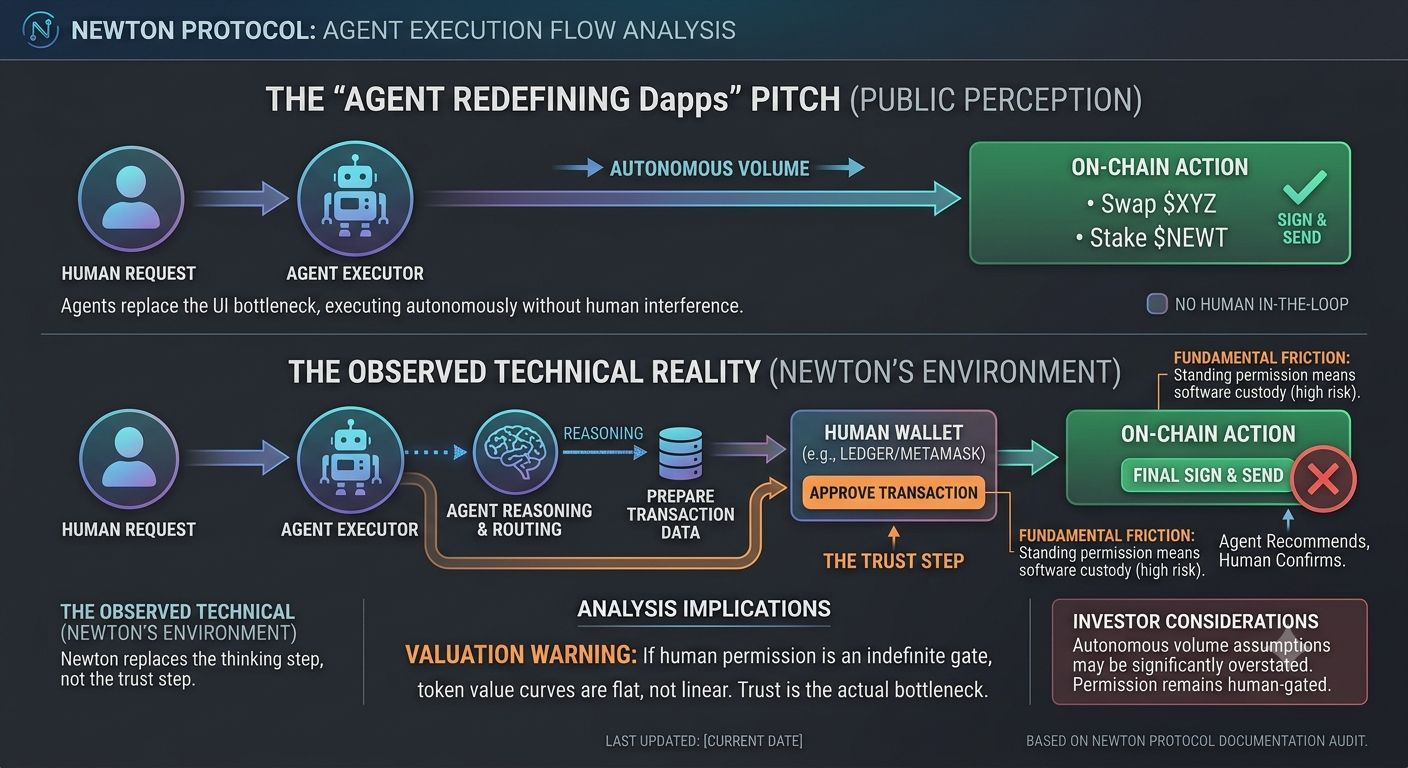
This probably matters most to anyone valuing $NEWT off the assumption that agent autonomy scales linearly with adoption — more agents, more autonomous volume, more fees. If the permission layer stays human-gated indefinitely, that curve looks a lot flatter than the roadmap slides suggest. Doesn't kill the thesis, just changes the shape of it.
Ledger finished syncing about ten minutes ago and I still haven't moved past this tab. Might dig into whether any live agent on Newton actually has standing transaction permission anywhere, even in a limited testnet sense, before I decide how much this actually matters. For now the wallet's just sitting there, fully reset, waiting for me to approve something else.
$NEWT #Newt