
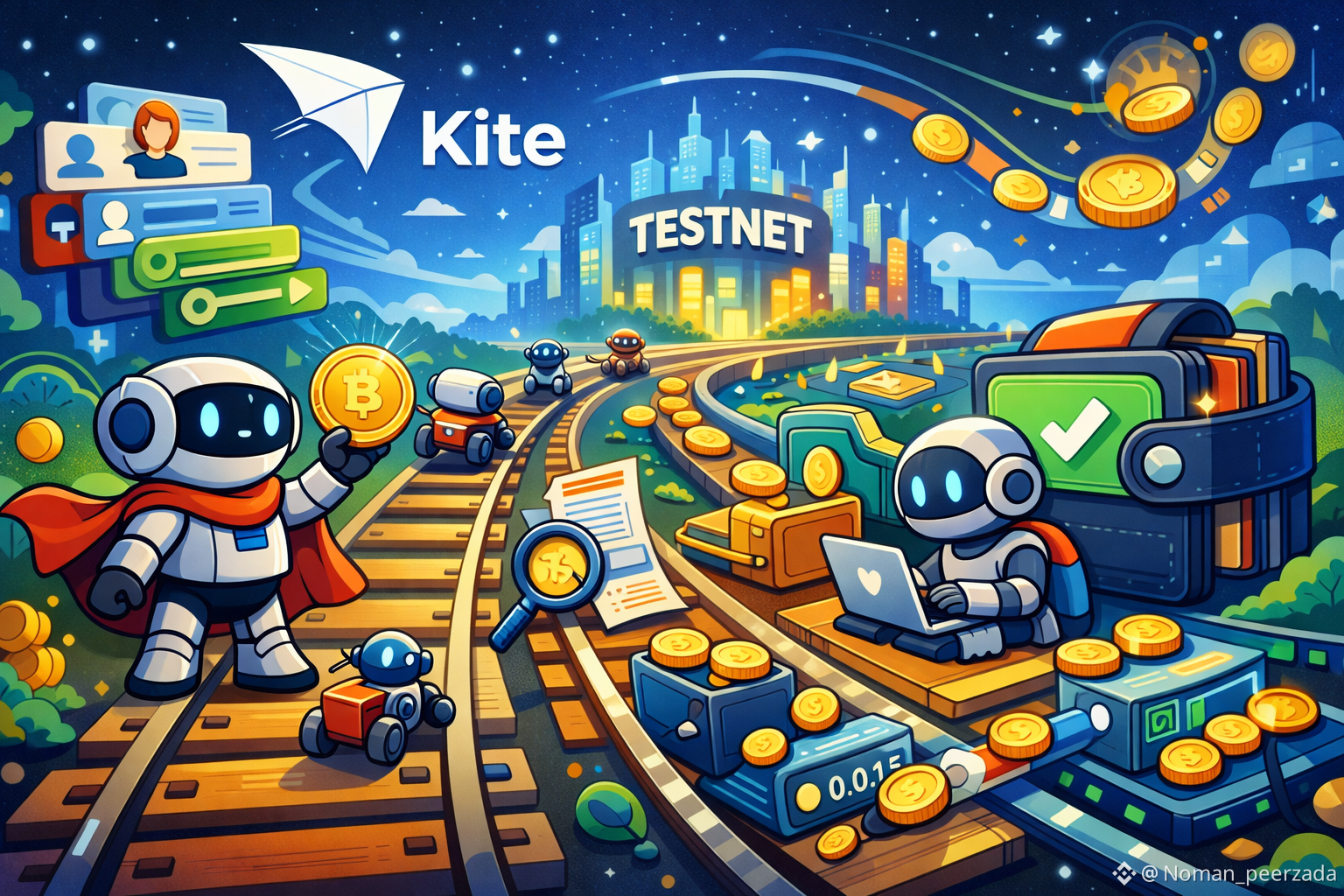
@KITE AI Financial independence for an autonomous agent sounds like a futuristic phrase until you reduce it to something embarrassingly simple. Can it pay. Can it get paid. Can it do both without borrowing a human’s identity every time it needs to move value. Most agent systems today still fail that test. They can plan, summarize, negotiate, even execute workflows, but when money enters the loop, everything quietly snaps back to a human-controlled bottleneck.
That bottleneck is not only technical. It’s structural. Payments are where responsibility, fraud controls, and trust assumptions collide. Web2 systems handle this with accounts, contracts, and centralized enforcement. Web3 systems handle it with keys and settlement finality. Agents sit awkwardly in between. They aren’t humans, but they’re not passive programs either. They need to transact with the world while remaining accountable to whoever delegated authority to them.
Kite’s journey feels like it began by admitting that agents don’t need more clever prompts. They need economic rails designed for machine actors. The leap from theory to testnet is essentially a shift from describing “agent economies” to building the boring parts that make them real. Identity. Delegation. Spend limits. Settlement. Auditability. If those pieces don’t exist, agent autonomy stays theatrical.
The first meaningful move is how Kite treats identity. Instead of pretending an agent is simply a wallet, it models authority in layers. A user creates the root identity. An agent is granted delegated authority. Sessions scope that authority for specific tasks and time windows. This is not a cosmetic structure. It’s the mechanism that lets an agent act while preserving traceable responsibility. The system can answer who authorized what, and under what limits, without collapsing autonomy into full custody of a human key.
Once identity is layered, the next problem is payments. Financial independence isn’t about holding a balance. It’s about being able to transact at the granularity agents operate at. Agents don’t earn in monthly cycles. They earn per action, per inference, per verified task. That pushes the system toward micropayments, streaming payments, and programmable settlement constraints.
Kite’s testnet direction leans into that reality. Rather than forcing agents into the same payment patterns humans use, it designs around machine-scale frequency. The best agent economy is not the one with the biggest transactions. It’s the one with the most attributable transactions that remain economically rational even when each action is small.
This is where the concept of attributed intelligence starts to matter. If an agent gets paid, the system must prove it did something that earned the payment. If an agent spends, the system must prove it was authorized to do so under defined constraints. Attribution becomes the bridge between autonomy and trust. Without it, financial independence turns into financial risk.
What changes at the testnet stage is that these ideas stop being ideals and start being surfaces developers can build on. A testnet isn’t impressive because it exists. It’s impressive when it forces every design to confront adversarial conditions. Can a session key be abused. Can an agent exceed its budget through edge cases. Can payments be routed without leaking authority. Does auditability remain intact when transactions scale.
There’s also a quiet product truth in Kite’s approach. The first generation of Web3 payments tools were designed for humans using wallets. The next generation has to support non-human actors that still require accountability. That means the system needs programmable constraints, not just programmable money. A dollar that can be sent is useful. A dollar that can only be sent under certain conditions becomes infrastructure.
A practical example makes the shift clearer. Imagine an agent hired to monitor on-chain positions and rebalance exposure when risk thresholds are hit. Without financial independence, it can alert a human. With financial independence, it can act. It can pay for data feeds, execute the rebalance, and report the action, all within a predefined mandate. The human remains responsible, but not operationally required for every step. That is the difference between automation and autonomy.
The counterargument is that giving agents money is dangerous. And it is, if authority is broad and persistent. The safer model is narrow and temporary. That’s why sessions matter. An agent should not hold unlimited permission indefinitely. It should operate under scoped authority that expires, renews, and logs everything. Financial independence is not granting freedom. It’s granting bounded capability.
Another risk sits underneath adoption. Enterprises care less about whether agents can transact and more about whether they can explain transactions later. Accounting, compliance, and governance require clear trails. Kite’s layered identity and attribution framework is designed to produce those trails by default. If it succeeds, it reduces the cost of letting agents operate inside real businesses.
Zooming out, Kite’s path from theory to testnet reflects a broader shift happening in the AI world. As agents become more capable, the limiting factor becomes integration with economic systems. The future isn’t only agents that can think. It’s agents that can settle value responsibly. That requires infrastructure that treats machine actors as first-class participants without allowing them to become unbounded risks.
The sharp observation is this. Autonomy doesn’t become real when an agent can do more tasks. It becomes real when an agent can hold a budget, earn revenue, and follow constraints so reliably that humans stop hovering over every transaction.


