
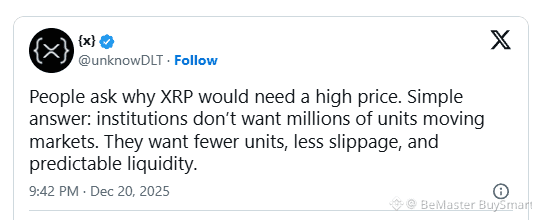
$XRP Crypto pundit UnknowDLT recently addressed a question that often appears in XRP discussions. Why would the asset need a high price at all? His answer focused on institutional behavior.
He wrote, “Institutions don’t want millions of units moving markets,” adding, “They want fewer units, less slippage, and predictable liquidity.”
That statement cuts directly to how large financial players think. Institutions operate at scale, adhering to strict risk controls. They prioritize execution certainty over short-term price swings. When viewed through that lens, the idea of a permanently cheap settlement asset makes little sense.
✨Unit Volume Matters at Scale
UnknowDLT’s point centers on mechanics. Low-priced assets require more units to move the same value. More units increase market footprint. That footprint can shift the price during execution. In this case, costs become harder to forecast.
Institutions prefer to avoid those conditions. They work with assets that allow them to move large sums with minimal disruption. Fewer units reduce market impact, and predictable liquidity reduces risk. A higher unit price directly supports both goals. This logic applies across financial markets. It becomes even more relevant for a digital asset designed for global payments.
✨XRP’s Design Aligns With This View
XRP was built for cross-border settlement. The target users are institutions like banks, payment providers, and liquidity managers. These entities do not operate like traders. They require reliability and efficiency at scale.
Ripple CTO David Schwartz has previously made a similar argument about XRP’s long-term role. He has suggested that XRP cannot remain cheap if it is to function efficiently on a global scale. The reasoning follows basic arithmetic. Moving large values with a low-priced token requires excessive volume, and that outcome undermines efficiency.
XRP will work better at higher prices because it allows the same value to move with fewer tokens. It simplifies liquidity management across corridors and supports consistent execution.
✨Institutional Adoption Changes Price Dynamics
When institutions adopt an asset, demand becomes structural. Payment flows do not pause, and liquidity must remain available regardless of the market situation. That reality forces markets to adapt.
As usage grows, the price often adjusts upward to support smoother settlement. This move is driven by operational necessity, and assets that fail to meet these requirements lose relevance.
As more institutions rely on XRP for settlement, liquidity expectations rise. Execution standards tighten, and under those conditions, a higher valuation becomes functional, not speculative.
🚀🚀🚀 FOLLOW BE_MASTER BUY_SMART 💰💰💰
Appreciate the work. 😍 Thank You. 👍 FOLLOW BeMaster BuySmart 🚀 TO FIND OUT MORE $$$$$ 🤩 BE MASTER BUY SMART 💰🤩
🚀🚀🚀 PLEASE CLICK FOLLOW BE MASTER BUY SMART - Thank You.
